
May 31, 2026
Understanding Purchase Orders
A purchase order is a formal commercial document issued by a buyer to a supplier that specifies the products, quantities, agreed prices and delivery terms for a specific transaction. It becomes a legally binding contract once the supplier accepts it, creating a clear record of what was ordered, at what price and on what terms.
Drishti, Manager - Digital Marketing

Table of Contents
- What Is a Purchase Order?
- What Are the Key Components of a Purchase Order?
- What Are the Main Types of Purchase Orders?
- How Does the Purchase Order Process Work?
- What Is the Difference Between a Purchase Order and an Invoice?
- What Are the Advantages and Disadvantages of Purchase Orders?
- Manage Purchase Orders with Flipkart Commerce Cloud
Understanding Purchase Orders
Purchase orders are foundational documents in retail and B2B procurement, providing businesses with a structured, auditable way to manage the purchase of specific goods from suppliers. They create accountability at every stage of the buying process, from internal approval through to supplier fulfillment and payment.
For retailers managing large supplier networks, the purchase order process is a critical control mechanism. It links procurement decisions to inventory management, cash flow planning and supply chain operations in a single traceable document.
- Purchase orders give procurement teams a formal approval structure before any commitment to a supplier is made.
- A unique PO number allows both buyers and suppliers to track transactions accurately across fulfillment and invoicing.
- Digital systems have made electronic purchase orders faster to create, send and match against supplier invoices.
- Retailers who use purchase orders consistently build a clear record of every procurement decision and supplier obligation.
What Is a Purchase Order?
A Purchase Order is a formal commercial document issued by a buyer to a supplier for specific goods. It records quantities and agreed prices, along with delivery details, so both sides understand the transaction before fulfillment begins.
Once accepted by the supplier, the purchase order becomes a legally binding agreement. It gives legal protection when disputes arise over products supplied, payment terms, delivery dates or specifications listed in the accepted document.
Retailers use purchase orders across physical stores and B2B ecommerce channels. The purpose of purchase orders is to control procurement spending, improve supply chain visibility and keep supplier commitments aligned with agreed terms.
What Are the Key Components of a Purchase Order?
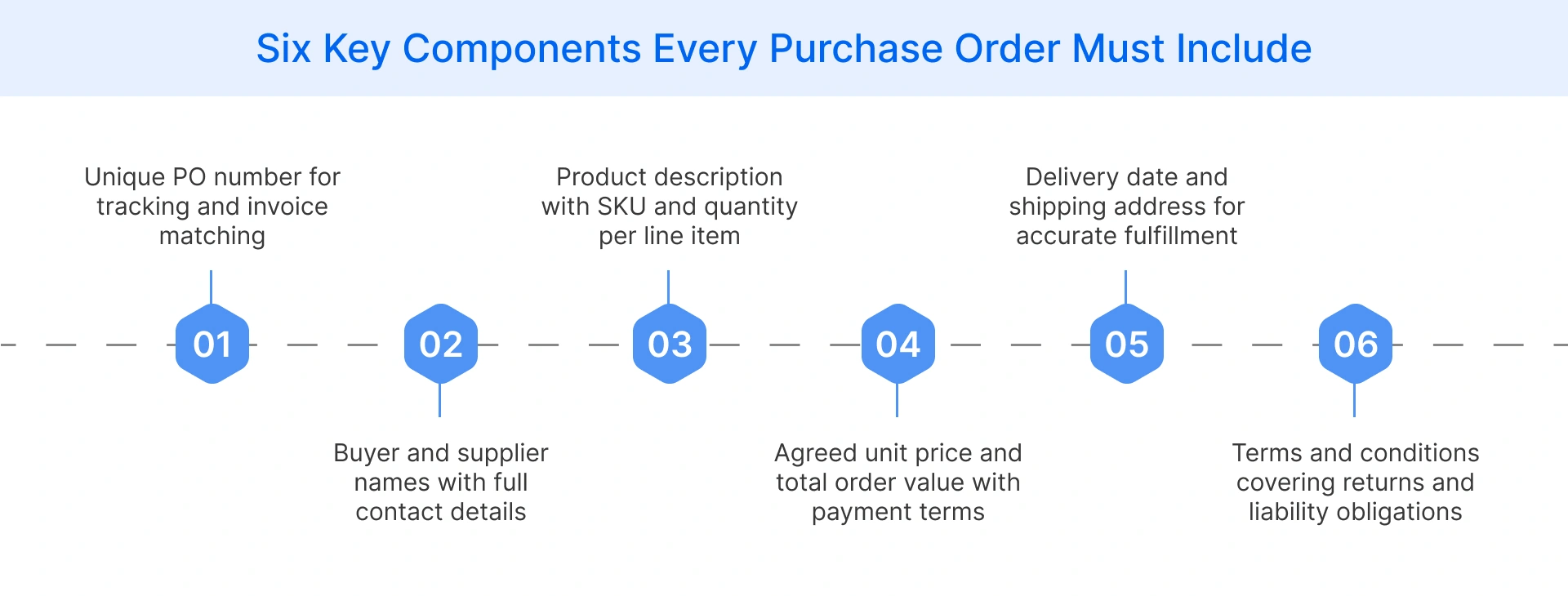
The following key components are standard across most purchase order formats:
PO Number: A unique number that both buyer and supplier use to track the order through fulfillment, invoicing and payment reconciliation. This purchase order number serves as the primary reference for invoice matching and audit trail purposes throughout the PO process.
- Buyer and Supplier Details: Full business names, addresses and contact information for both parties involved in the transaction. This includes the company name, billing address, shipping address, and the relevant team member responsible for the order on each side.
- Product or Service Description: Clear specifications of each item ordered, including product name, SKU, quantity and unit of measurement. Line items in the purchase order should leave no room for misinterpretation about what specific goods are being procured.
- Agreed Price and Payment Terms: The price per unit, total order value, applicable taxes, and the agreed payment timeline, such as net 30 or net 60 days. Defined payment terms protect cash flow for both the buyer and the supplier across the purchasing process.
- Delivery Details: Expected delivery dates, shipping address, carrier preferences, and any special handling instructions relevant to the order. Accurate delivery details reduce the risk of shipments being sent to the wrong location or arriving outside the agreed fulfillment window.
- Terms and Conditions: The contractual terms covering returns, liability, quality standards, and what happens if either party fails to meet their obligations. These purchase order terms transform the document from an informal request into a legally binding document with defined consequences for non-compliance.
What Are the Main Types of Purchase Orders?
To better understand what is a purchase order, it is vital to understand its different types:
- Standard Purchase Order: A one-time order for a specific quantity of goods at a fixed price, used when the buyer knows exactly what they need and when they need it. Standard POs are the most common type in retail procurement and represent the clearest form of a legally binding contract between buyer and supplier.
- Blanket Purchase Order: An agreement to purchase a set quantity of goods over a defined period, allowing buyers to call off individual deliveries as needed without issuing a new PO each time. This type reduces administrative overhead for recurring purchases and supports more predictable cash flow across a set period.
- Contract Purchase Order: A long-term agreement that defines the terms and conditions of supply without specifying quantities or delivery dates upfront, which are confirmed in subsequent orders. Contract POs establish the legal framework for ongoing supplier relationships and are common in enterprise resource planning environments, where procurement teams manage multiple vendors simultaneously.
- Planned Purchase Order: A forward-looking order that specifies items and quantities based on forecasted demand, with tentative delivery dates confirmed closer to the fulfillment window. Planned POs support better inventory management by aligning procurement decisions with anticipated sales data and seasonality patterns.
How Does the Purchase Order Process Work?
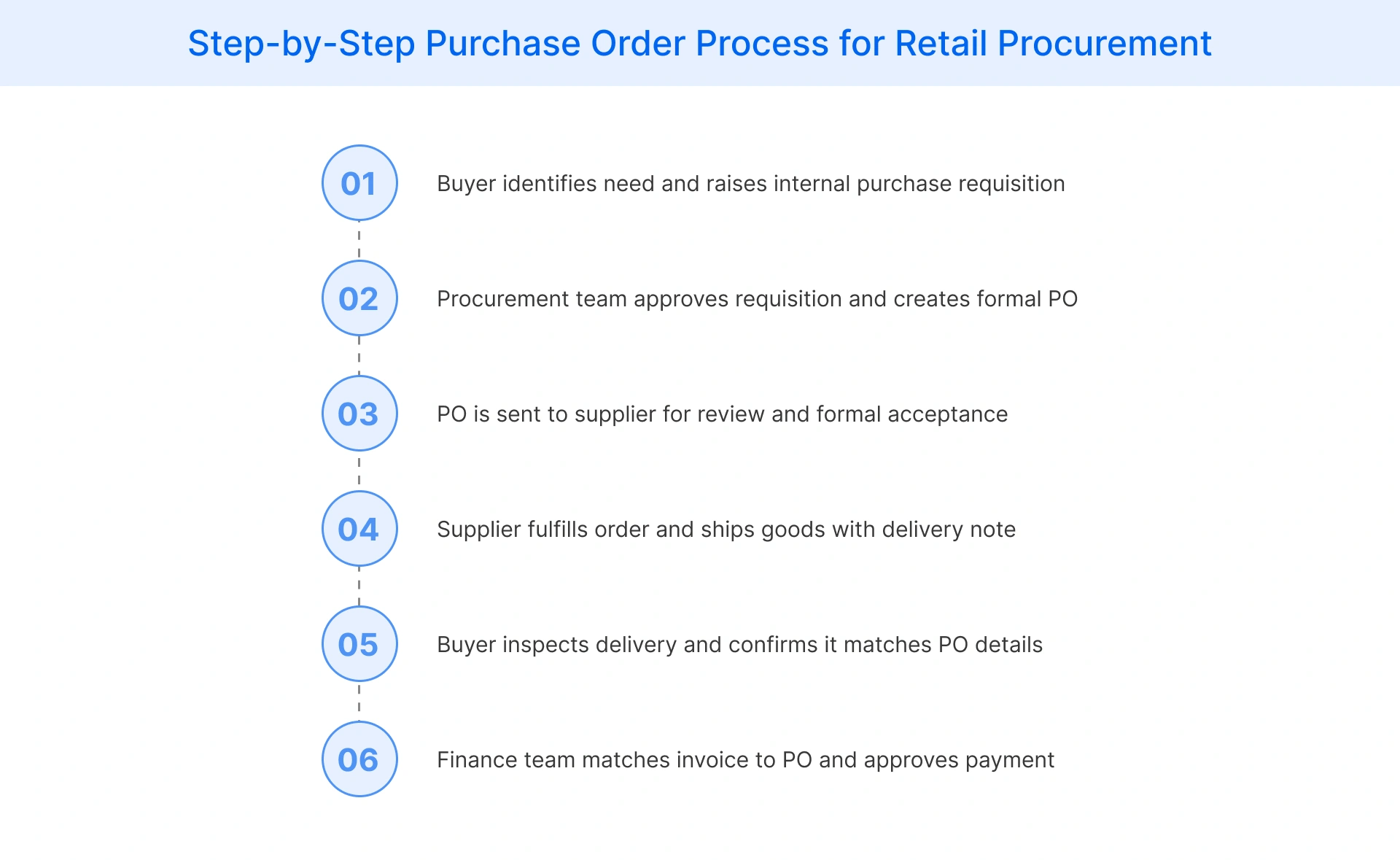
The purchase order process follows a defined sequence of steps that moves from internal business need to supplier fulfillment and final payment:
- The first step begins when the buyer identifies a procurement need and raises a purchase requisition internally for approval before any external order is placed.
- Once approved, the buyer creates a purchase order with all relevant order details and sends it to the chosen supplier for review and acceptance.
- The supplier reviews the PO, confirms they can fulfill the order on the stated terms and sends an acknowledgment back to the buyer.
- The supplier fulfills the order and ships the goods alongside a delivery note that references the original PO number for matching.
- The buyer receives the goods, inspects them against the PO specifications, and approves the delivery before the supplier submits a vendor invoice for payment.
- The finance team matches the invoice to the original PO and delivery receipt in a three-way match process before releasing payment to the supplier.
What Is the Difference Between a Purchase Order and an Invoice?
A purchase order and an invoice are both commercial documents used in the buying process, but they serve opposite purposes and flow in opposite directions between buyer and supplier.
A purchase order is issued by the buyer before delivery to confirm what is being ordered and the agreed terms. An invoice is issued by the supplier after delivery to request payment for goods already received.
Understanding this distinction is essential for accurate PO matching and financial control, as the table below illustrates:
|
Basis of Difference |
Purchase Order |
Invoice |
|
Issued By |
Buyer, sent to the supplier |
Supplier, sent to the buyer |
|
Purpose |
Requests goods or services at agreed terms |
Requests payment for goods already delivered |
|
Timing |
Issued before delivery takes place |
Issued after delivery is completed |
|
Legal Status |
Binding once supplier accepts it |
Binding payment obligation for the buyer |
|
Document Direction |
Buyer to supplier |
Supplier to buyer |
What Are the Advantages and Disadvantages of Purchase Orders?
Purchase orders offer retailers clear operational and financial benefits, but they also introduce process complexity that requires careful management.
Advantages
- Spending Control: Purchase orders create an approval path that ensures each purchase of goods follows budget authority. This financial control helps the procurement department manage high volumes of suppliers without allowing unauthorized spending.
- Dispute Resolution: A signed PO gives both parties a clear reference when quantities or agreed delivery dates create disputes. It provides legal protection because both sides accepted the same order details.
- Inventory Planning: POs give teams advance visibility into incoming stock before goods arrive. When purchase order creation connects with inventory management software, teams update stock forecasts in real time as POs are confirmed.
- Audit Trail: Every purchase order creates a clear record for auditing and supplier review. Finance teams use this record to reconcile vendor invoices with accuracy and prevent errors from affecting cash flow.
Disadvantages
- Administrative Overhead: Raising and approving purchase orders can slow procurement cycles for frequent low-value purchases. Manual work in PO creation increases when procurement teams manage more suppliers and line items.
- Rigidity: An accepted purchase order often needs a formal change process before updates. This rigidity can delay fast-moving retail decisions when supplier lead times or product needs change.
- System Dependency: Effective purchase order management needs digital systems that track incoming orders across suppliers. Without connected tools, procurement teams struggle to maintain accuracy and visibility across routine transaction volumes.

Manage Purchase Orders with Flipkart Commerce Cloud
Retailers managing large supplier networks need connected purchase order management across fulfillment and inventory workflows. At Flipkart Commerce Cloud, we provide an integrated supply chain management suite that gives procurement and operations teams a unified view of every transaction across the entire order lifecycle.
Our Order Management System gives retailers central visibility across suppliers and fulfillment locations. It automates order routing, tracks status in real time and flags discrepancies before they affect delivery commitments.
This visibility connects with our Inventory Management System as purchase orders move through fulfillment. Stock data updates across locations when orders are received, helping teams prevent overselling and maintain accurate records.
Our Seller Portal helps suppliers manage incoming purchase orders and update fulfillment status without manual follow-ups. The FCC Warehouse Management System connects receiving workflows directly to purchase order data. This enables teams to verify incoming goods against the original PO specifications and update inventory in real time upon delivery confirmation.
Book a demo to explore how Flipkart Commerce Cloud transforms purchase order management into a scalable operational advantage.
FAQ
Purchase orders give retailers legal protection, spending control and an audit trail for every procurement transaction. They ensure suppliers deliver the correct goods at the agreed price and on the stated delivery dates. Retailers who use POs consistently also improve their inventory management and cash flow forecasting across supplier relationships.
The PO process begins with a purchase requisition, moves through internal approval and PO creation, and is sent to the supplier for acceptance. The supplier fulfills the order and issues a vendor invoice after delivery. The finance team completes a three-way match between the PO, delivery receipt and invoice before releasing payment.
Canceling a PO after supplier acceptance is complex because the document becomes a legally binding agreement at that point. Both parties must agree to the cancellation, and any costs already incurred by the supplier may still be payable. Retailers should review their purchase order terms carefully before attempting to cancel an accepted PO.
A purchase order becomes a legally binding document once the supplier formally accepts it, thereby creating a legal contract between the buyer and the supplier. The document defines the agreed-upon terms, including price, quantity, and delivery dates, for both parties are obligated to honor. Disputes are resolved by reference to the original PO as the official document of record.
A purchase requisition is an internal request submitted by a team member to procure specific goods or services. A purchase order is the external commercial document sent to a supplier after approval of the requisition. The purchase requisition is the first step in the PO process, while the PO is the formal commitment issued to the supplier.