
May 23, 2026
What Is a Content Delivery Network (CDN)?
Content delivery networks (CDNs) improve website speed by caching content across distributed servers closer to users.
Drishti, Manager - Digital Marketing

Table of Contents
- What Is a Content Delivery Network (CDN)?
- How Does a CDN Work?
- Types of Content Delivery Networks
- Static vs Dynamic Content in CDNs
- Benefits of Using a CDN
- CDN vs Traditional Web Hosting
- Common Use Cases for CDNs
- Conclusion
What Is a Content Delivery Network (CDN)?
A Content Delivery Network (CDN) is a network of geographically distributed servers designed to deliver web content more efficiently based on the user's location. Instead of relying on a single origin server, a CDN stores cached versions of content across multiple servers worldwide.
When a user accesses a website, the CDN routes the request to the nearest available server. This reduces the distance data has to travel, resulting in faster loading times, improved performance, and reduced latency.
In simple terms, a CDN is technology that helps websites and applications deliver content faster and more reliably to users across different geographic locations.
How Does a CDN Work?
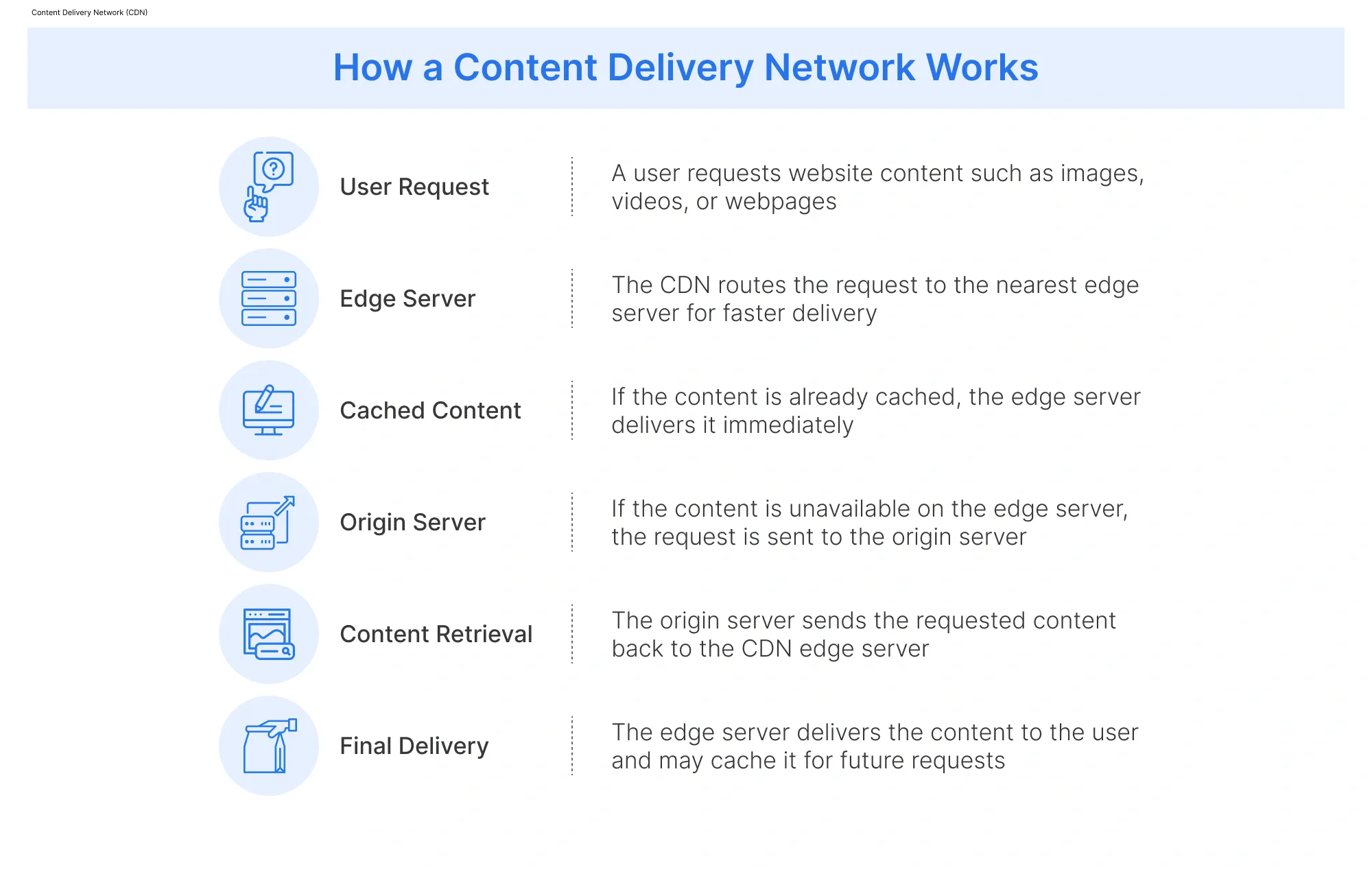
A CDN works by distributing content across a network of servers and intelligently delivering it from the closest location to the user.
It involves several key components:
- Origin server: The main server where the original website content is stored.
- Edge servers: Distributed servers that store cached copies of content closer to users.
- PoPs (Points of Presence): Physical locations where edge servers are hosted globally.
- Caching: Storing copies of content to reduce repeated requests to the origin server.
- Request routing: Automatically directing user requests to the nearest or best-performing server.
When a user visits a website, the CDN identifies their location and delivers content from the closest edge server. This reduces load time, improves and personalizes the overall browsing experience.
Types of Content Delivery Networks
There are different types of CDNs based on how content is delivered and managed:
- Push CDN: Content is manually uploaded to edge servers and regularly updated. Common in media-heavy platforms where content changes are controlled.
- Pull CDN: Content is fetched from the origin server only when requested and then cached for future use. Commonly used for websites with frequently updated content.
- Peer-to-Peer CDN: Uses end-user devices to distribute content alongside servers, reducing load on origin infrastructure. Often used for large file sharing or video distribution.
- Private CDN: Dedicated CDN infrastructure used by enterprises for greater control, security, and performance optimization.
These CDN models are widely used across industries such as streaming platforms, e-commerce websites, software distribution, and digital media companies.
Static vs Dynamic Content in CDNs
|
STATIC CONTENT |
DYNAMIC CONTENT |
|
|
Definition |
Pre-built content that stays the same for all users |
Content generated in real time based on user requests |
|
Examples |
Images, CSS files, videos, PDFs |
Shopping carts, live dashboards, personalized feeds |
|
Delivery Speed |
Faster because content is cached |
Slower without optimization because content changes frequently |
|
CDN Caching |
Easily cached on edge servers |
Requires dynamic acceleration or smart routing |
|
Server Load |
Reduces origin server requests significantly |
May still rely heavily on the origin server |
|
User Experience |
Improves page load speed and stability |
Supports personalized and interactive experiences |
Benefits of Using a CDN
Using a CDN provides multiple performance, security, and scalability advantages:
- Faster load times: CDNs reduce the physical distance between users and website content by delivering files from nearby edge servers. This helps websites load more quickly.
- Reduced latency: Edge server delivery minimizes delays in transferring data between servers and users, creating smoother browsing experiences.
- Better scalability: CDNs distribute traffic across multiple servers, helping websites handle sudden traffic spikes without performance issues.
- Lower bandwidth costs: Cached content reduces repeated requests to the origin server, lowering bandwidth consumption and infrastructure costs.
- Improved SEO performance: Faster website speeds can improve search engine rankings and enhance overall user experience.
- Enhanced security: Many CDNs include DDoS protection, traffic filtering, and secure content delivery features to improve website security.
Better uptime and reliability: Distributed server networks help maintain website availability even if one server experiences downtime or heavy traffic.
These benefits make CDNs essential for modern websites and digital platforms.
CDN vs Traditional Web Hosting
Traditional web hosting stores and manages website files on a central origin server, while a CDN improves content delivery by distributing cached content across multiple edge servers in different locations. Hosting provides the core website infrastructure, whereas a CDN reduces latency, improves loading speed, handles traffic spikes more efficiently, and enhances website performance for users across different regions.
Common Use Cases for CDNs
CDNs are widely used across industries that require fast and reliable content delivery:
- E-commerce: Online stores use CDNs to deliver product images, pages, and checkout content more quickly to shoppers in different locations. This helps improve customer shopping experience during high-traffic periods.
- Streaming platforms: Video and audio streaming services use CDNs to distribute media files across edge servers, reducing buffering and improving playback quality for users worldwide.
- Gaming: Gaming companies use CDNs to deliver game updates, downloadable content, and real-time data with lower latency to support smoother gameplay experiences.
- SaaS platforms: Software-as-a-service providers use CDNs to improve application speed and ensure users can access cloud-based tools efficiently from different geographic regions.
- CMS platforms: Content management systems such as WordPress use CDNs to cache website assets like images, scripts, and stylesheets to improve page loading performance.
- Mobile apps: Mobile applications use CDNs to accelerate API responses, media delivery, and app updates for users across different network conditions and locations.
Conclusion
A Content Delivery Network (CDN) plays a critical role in modern internet infrastructure by improving speed, performance, and reliability of digital content delivery. By using geographically distributed servers, CDNs ensure users receive content from the closest possible location, reducing delays and improving overall user experience.
Businesses often use scalable infrastructure and CDN solutions provided by Flipkart Commerce Cloud, to improve e-commerce performance, website reliability, and customer experience across different regions.
Book a demo with FCC to create smoother e-commerce experiences for your customers across different regions.

FAQ
The primary purpose of a Content Delivery Network (CDN) is to provide high-speed, reliable content delivery by reducing the physical distance between a user and a website's server. By utilizing a globally distributed network of edge servers, a CDN ensures that static and dynamic assets are served from the closest geographical location, significantly minimizing latency.
A CDN improves website load times by caching content on multiple servers located around the world. When a user visits your site, the network routes their request to the nearest geographical "Point of Presence" (PoP). This drastically reduces the distance data must travel, delivering images and scripts much faster than a single, distant origin server could.
A CDN improves website security by acting as a protective buffer between your origin server and potential threats. Modern solutions include built-in features like DDoS mitigation, Web Application Firewalls (WAF), and automated SSL/TLS encryption. This helps block malicious traffic and protects your site from volumetric attacks before they reach your core infrastructure.
The difference between a VPN and a CDN lies in their primary function: a VPN is a tool for individual users to secure their personal connection and hide their IP address, whereas a CDN is a tool for website owners to accelerate content delivery to their global audience. VPNs prioritize privacy, while CDNs focus on performance and speed.
A CDN can significantly improve SEO and user experience by directly boosting your site's Core Web Vitals, such as Largest Contentful Paint (LCP). Search engines in 2026 prioritize fast-loading, secure websites. By using a CDN, you lower bounce rates and ensure that both human visitors and AI search crawlers can access your content instantly.