
December 19, 2024
Cost-based Pricing
Cost-based pricing is a strategy where retailers arrive at a selling price by adding a certain percentage of the total production cost to the product's cost.
Drishti, Manager - Digital Marketing

Table of Contents
- What is cost-based pricing?
- Cost plus pricing formula and calculation
- Benefits of cost based pricing?
- Drawbacks of cost based pricing?
- Conclusion
What is cost-based pricing?
Cost-based pricing is a popular pricing strategy that involves adding a specific markup amount to the total cost of goods and services to determine an ideal selling price.
This strategy is dependent on several critical factors, including the cost of labor, direct material or manufacturing expenses, and overhead costs for a specific product or service.
Cost-based pricing is one of the most straightforward methods for setting the selling price, representing a fundamental concept of business operations.
Numerous companies employ a markup pricing strategy when launching products. During this process, companies calculate the total production cost or the total costs and forecast the desired profit margin. Then, these two figures are combined to establish their unique pricing method.
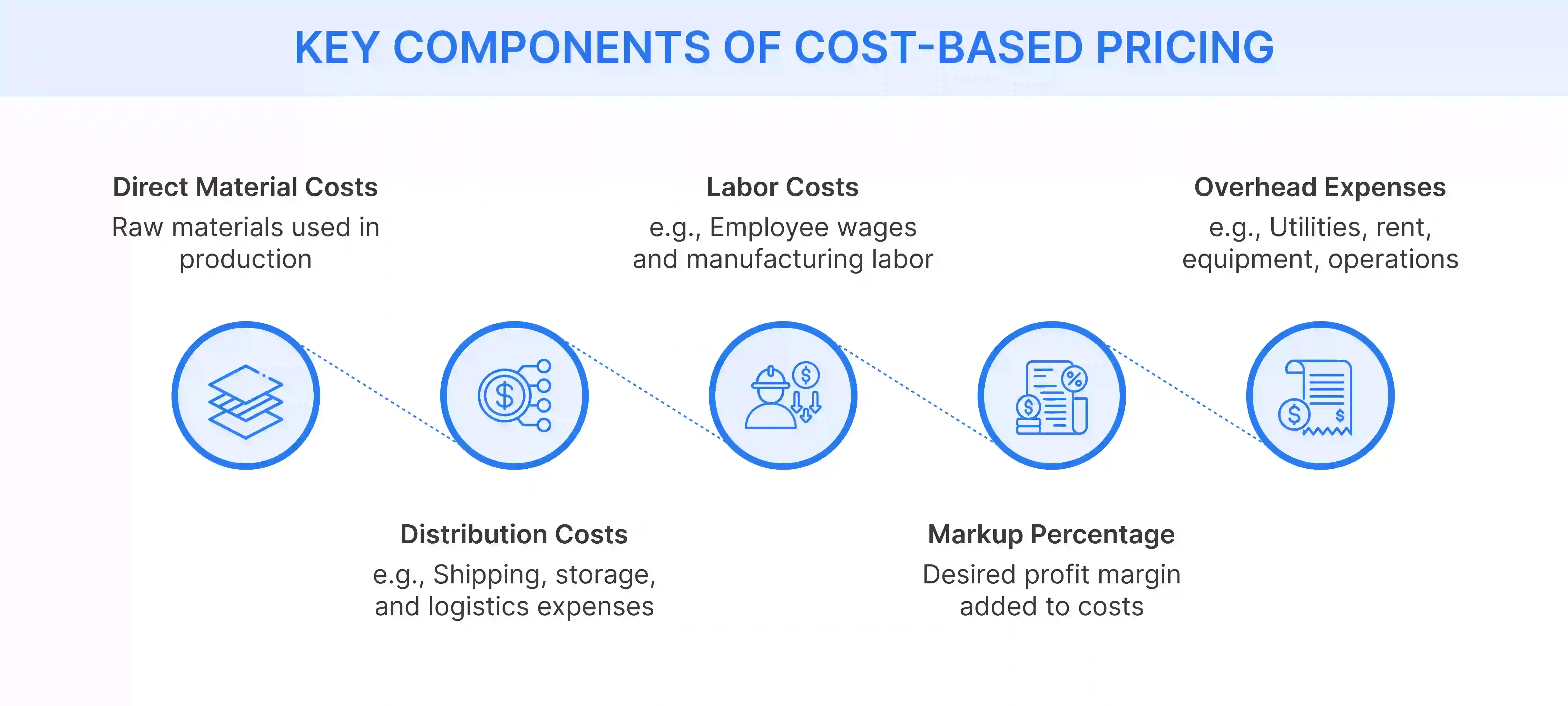
Explain the cost-based pricing formula and calculation
The formula for cost-plus pricing is:
Price = Cost + Expected Profit
Note: While often used interchangeably, cost-based pricing is the general category of pricing strategies, whereas cost-plus pricing is a specific method within that category that adds a fixed percentage markup to the unit cost.
The cost-plus calculation involves the following steps to determine the optimal selling price:
- The first stage involves calculating the total cost of a specific product or service. This is achieved by adding both fixed and variable costs, which include labor costs, overhead expenses, and the markup percentage.
- Next, divide the total cost by the number of units of a product to determine the unit of product cost. This calculation allows businesses to determine a key aspect of the pricing strategy and the selling price.
- The final stage of the cost-plus calculation involves multiplying the unit of product cost by the markup percentage to derive the selling price.
To demonstrate how the cost-plus calculation operates, let's consider an example.
Suppose a company is developing a product with a direct material cost of $15, labor costs of $25, and overhead costs of $10. The company applies a markup percentage of 15% to its products.
Using the cost-plus pricing approach, the company calculates the total cost of $50 and multiplies it by a markup percentage of 15% to arrive at a final price of $57.5.
Benefits of cost-based pricing?
- Ease of Calculation: Cost-based pricing, with its simple pricing model, is beneficial for companies with scarce resources or those in the early stages of business development.
- Simplified Product Launches: This strategy is a boon for new product launches. It provides a baseline price that can be adjusted as extensive market research is gathered, reducing the risk of over or under-pricing.
- Guaranteed Profit Margin: Cost-based pricing safeguards businesses from potential losses that could arise from external factors like market conditions or competitor pricing.
- Protection Against Volatility: In industries prone to volatility, such as commodity products or technology, cost-based pricing acts as a buffer. It helps businesses maintain profitability despite sudden market changes.
- Baseline for Testing: Cost-based pricing serves as a valuable testing ground to determine market demand for businesses of all sizes. The market's reaction to cost-based prices can generate insightful data, clearing the way for the development of data-driven pricing strategies.
Also Read: How Retailers Use Price Optimization Models To Grow Revenue
Drawbacks of cost-based pricing?
Now, let's understand some of the disadvantages of using cost-based pricing:
- Ignoring Competition: Cost-plus pricing focuses on internal factors when setting prices, often overlooking competitor pricing strategies. This could potentially lead to pricing that is out of sync with the market.
- Overlooking Product Cost Overruns: Another drawback of this method is its potential to overlook overruns in the cost of your products. This means the product design process may not adequately adapt to the target audience's needs and preferences, affecting its market share.
- Neglecting Replacement Costs: This simple pricing method often fails to account for constant cost changes, particularly replacement costs. This oversight could impact the accuracy and effectiveness of the pricing strategy in the long run.
Conclusion
Cost-plus pricing is a practical and simple method to implement. However, it is essential to weigh both its pros and cons.
While companies can reap benefits from this strategy, they must also be mindful of the risks posed by competitive prices, potential fluctuations in replacement costs, and the necessity to tailor the product design to ensure customer satisfaction.
This is precisely where Flipkart Commerce Cloud (FCC) delivers real impact. FCC's AI-powered pricing platform gives retailers the competitive intelligence to know when cost-based prices are holding strong and when market conditions demand a smarter response. By combining its cost-floor certainty with real-time competitor price monitoring, demand signals, and dynamic pricing capabilities, you move beyond a single pricing model and build a strategy that protects margins, stays competitive, and scales with your business.
Book a demo to discover how pairing cost-based pricing discipline with AI-driven market intelligence can unlock the revenue your current pricing strategy may be leaving behind.

FAQ
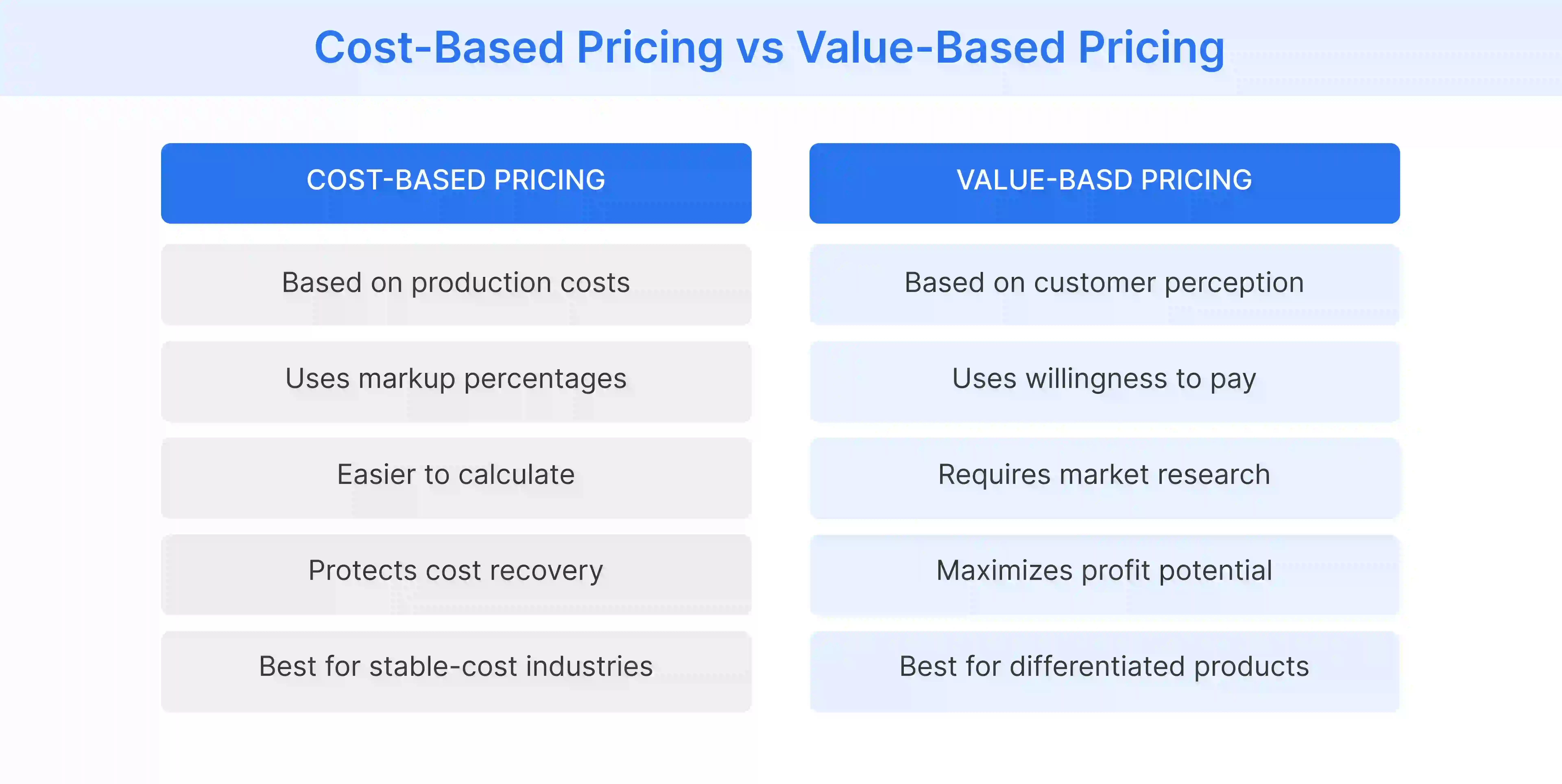
Value-based pricing differs from cost-based pricing in how both set the selling price of a product. Cost-based adds a predetermined markup to production costs. Value-based pricing sets a higher price around your value proposition what buyers believe similar products are worth. Cost-based guarantees coverage; value-based unlocks greater profit.
Decide if cost-based pricing fits your business by assessing your pricing structure and cost stability. If your raw materials and distribution costs are predictable, cost-based pricing delivers reliable margins. Factor in consumer demand and competitive pricing benchmarks, too. Where customer trust and perceived value drive purchases, value-based pricing becomes the stronger, more profitable alternative.
The most common cost-based pricing approach is cost-plus pricing. It adds a predetermined markup on top of the production cost, covering raw materials, labor, and distribution costs to set the selling price of a product. Target profit pricing is another key method, building prices around a defined target profit margin rather than a fixed markup.
The core problem with cost-based pricing is that it ignores consumer demand and competitive pricing. Rivals offering similar products at lower prices give your business a harder time holding market share. Without real market signals, cost-derived prices risk falling out of step with buyer expectations, hurting both customer trust and long-term retail pricing performance.
A cost-based pricing example: a manufacturer calculates raw materials at $15, labor at $25, and overhead at $10 a unit cost of $50. Applying a 15% markup sets the selling price of a product at $57.50. FCC helps retailers validate these figures against historical data to keep cost-derived prices accurate as market conditions shift.
Yes, combining cost-based and value-based pricing creates a stronger pricing structure. Cost-based pricing sets the floor, covering the total cost of production. Value-based pricing sets the ceiling, anchoring a higher price to your product's value proposition. This hybrid approach ensures you never undersell and captures how much profit the market is genuinely willing to return.
Under a cost-based pricing strategy, the selling price of a product is arrived at by factoring in its production costs, manufacturing expenses, and distribution costs. A specific markup, which ensures a profit margin, is added to these costs.
This method starts with determining the total costs incurred during production. Once the break-even point is established, the selling price is set by adding a predetermined markup to reach the target profit margin.
This method is useful for companies with stable production costs and those aiming to maintain consistent profit margins. It is simple, predictable, and guarantees a profit on every sale.
There are four primary types of cost-based pricing strategies:
-
Cost-Plus Pricing: This competitive pricing structure involves adding a specific markup to the total cost of goods and services to arrive at the selling price. It is a simple method often used in manufacturing industries where production costs are the primary driver of pricing decisions.
-
Markup Pricing: At its core, markup pricing refers to the difference between the cost of producing a good or service and its selling price. It is a specific amount or percentage added to the production costs to determine the final selling price. This methodology ensures that all business costs, both direct and indirect, are accounted for.
-
Target Profit Pricing: The target profit price strategy determines the price of a product by considering the cost of manufacturing, production, and delivery without a markup.
-
Break-Even Pricing: Also known as target-return pricing, this strategy determines the price of a product by considering the cost of manufacturing, production, and delivery without a markup. The goal is to determine how many units a company needs to sell to cover the costs of production.