
August 22, 2026
Market Demand and How It Shapes Retail Decisions
Market demand is the total quantity of a product or service that consumers are willing and able to purchase at a given price within a specific market. It reflects the combined demand of individual consumers and considers both their willingness to buy and their ability to pay.
Drishti, Manager - Digital Marketing

Table of Contents
- What Is Market Demand?
- Why Is Market Demand Important for Businesses?
- What Factors Influence Market Demand?
- What Is the Difference Between Individual Demand and Market Demand?
- What Are Some Examples of Market Demand?
- How Can Businesses Assess Market Demand?
- How Can Businesses Use Market Demand Insights?
- Turn Market Demand Insights into Better Retail Decisions
Market Demand and How It Shapes Retail Decisions
Understanding market demand helps businesses make better decisions before investing in a product, changing prices, expanding an offering, or increasing production. A product may have strong potential, but without enough customers willing and able to buy it, businesses can struggle to generate sales.
For retailers and other businesses, demand analysis provides insight into customer needs, preferences, purchasing behaviour, and the size of a potential market. These insights can inform decisions around product development, pricing strategy, inventory, marketing efforts, and production levels.
This guide explains what market demand means, why it matters to businesses, the factors that influence it, how it differs from individual demand, and how businesses can assess and use demand insights to make better decisions.
What Is Market Demand?
Market demand is the total quantity of a product or service that consumers are willing and able to purchase at a given price within a specific market. It reflects the combined demand of individual consumers and considers both their desire to buy and their ability to pay.
Unlike simply wanting a product, consumer demand requires both the willingness and purchasing power to make a purchase. For example, many people may want a specific product, but its overall demand depends on how many consumers can and will actually purchase it at its price point.
Demand can change as factors such as price, consumer preferences, income levels, broader trends, and the number of potential buyers change. Understanding these shifts helps businesses identify opportunities and make informed decisions about products, pricing, marketing, and inventory. Research similarly describes demand as the quantity consumers want and can afford to purchase at a given price.
Why Is Market Demand Important for Businesses?
Market demand gives businesses a clearer picture of how much interest exists for a product or service within a particular market. Knowing this can help businesses make decisions based on actual customer needs and purchasing potential rather than assumptions.
Its importance extends across several areas of business decision-making:
- Product development: Understanding demand can help businesses determine whether there is sufficient interest in a product before committing resources to developing or expanding it.
- Identifying market opportunities: Demand analysis can reveal customer groups or markets with enough potential to justify further investment.
- Pricing decisions: Demand provides insight into how changes in price may affect the quantity customers are willing and able to purchase.
- Production and inventory planning: Estimating demand helps businesses determine how much product to make or stock, reducing the risk of overproduction, excess inventory, or stockouts.
- Marketing efforts: Understanding where demand exists and what customers value can help businesses focus their marketing strategies on the right audience.
- Revenue and profitability: A clearer understanding of potential demand can help businesses estimate sales, align supply with customer needs, and make more informed commercial decisions.
What Factors Influence Market Demand?
Market demand changes as consumers’ circumstances, preferences, and wider market conditions change. Several factors can influence the quantity consumers are willing and able to purchase.
Price
Price is one of the most direct factors influencing market demand. When the price of a product changes, the quantity consumers are willing and able to purchase can also change. This reflects the basic law of demand: quantity demanded generally decreases as prices increase and rises as prices fall, assuming other factors remain constant.
Consumer Income and Purchasing Power
Changes in consumer preferences, lifestyles, consumer needs, and purchasing behavior can influence consumer demand. When consumers have more disposable income, they may be able to purchase more goods and services. When purchasing power falls, demand for some products may decline as consumers become more selective about their spending.
Consumer Preferences and Behavior
Changes in consumer preferences, lifestyles, needs, and purchasing behavior can influence demand. A product may experience increased demand when it aligns with changing preferences or addresses a need that has become more important to consumers.
Market Size
The number of potential buyers in a market affects the overall level of market demand. A larger potential customer base can create greater demand for a product or service.
Price of Related Products
Demand can also change based on the prices of related products, including substitutes and complementary products. These include substitutes, which consumers can use in place of another product, and complementary products, which are typically used together.
Economic and Market Conditions
Broader economic and market conditions can influence consumers’ willingness and ability to spend. Factors such as economic growth, inflation, employment levels, market trends, and consumer confidence can affect demand.
These factors can also interact. A change in consumer income, for example, may alter purchasing behaviour at the same time that changing preferences or economic conditions affect what consumers choose to buy. As a result, businesses need to consider the wider market rather than attributing a change in demand to a single factor.
What Is the Difference Between Individual Demand and Market Demand?
Individual demand refers to the quantity of a product or service that a single consumer is willing and able to purchase at different prices, while market demand represents the total quantity demanded by all consumers in a particular market at those prices.
Individual Demand vs. Market Demand |
||
|---|---|---|
|
Individual Demand |
Market Demand |
|
|
Definition |
The quantity of a product or service a single consumer is willing and able to purchase at a given price. |
The total quantity of a product or service that all consumers in a market are willing and able to purchase at a given price. |
|
Scope |
Focuses on one consumer’s purchasing behaviour. |
Covers the purchasing behaviour of all consumers in a specific market. |
|
Number of consumers |
One consumer. |
Multiple consumers in the market. |
|
Main use |
Helps businesses understand an individual consumer’s willingness to buy at different prices. |
Helps businesses estimate overall demand and make decisions about pricing, production, and market opportunities. |
|
Example |
A customer is willing to buy two pairs of shoes at $50 per pair. |
If 1,000 customers each have different quantities they are willing to purchase at $50, the combined quantities represent market demand at that price. |
How Individual Demand Contributes to Market Demand
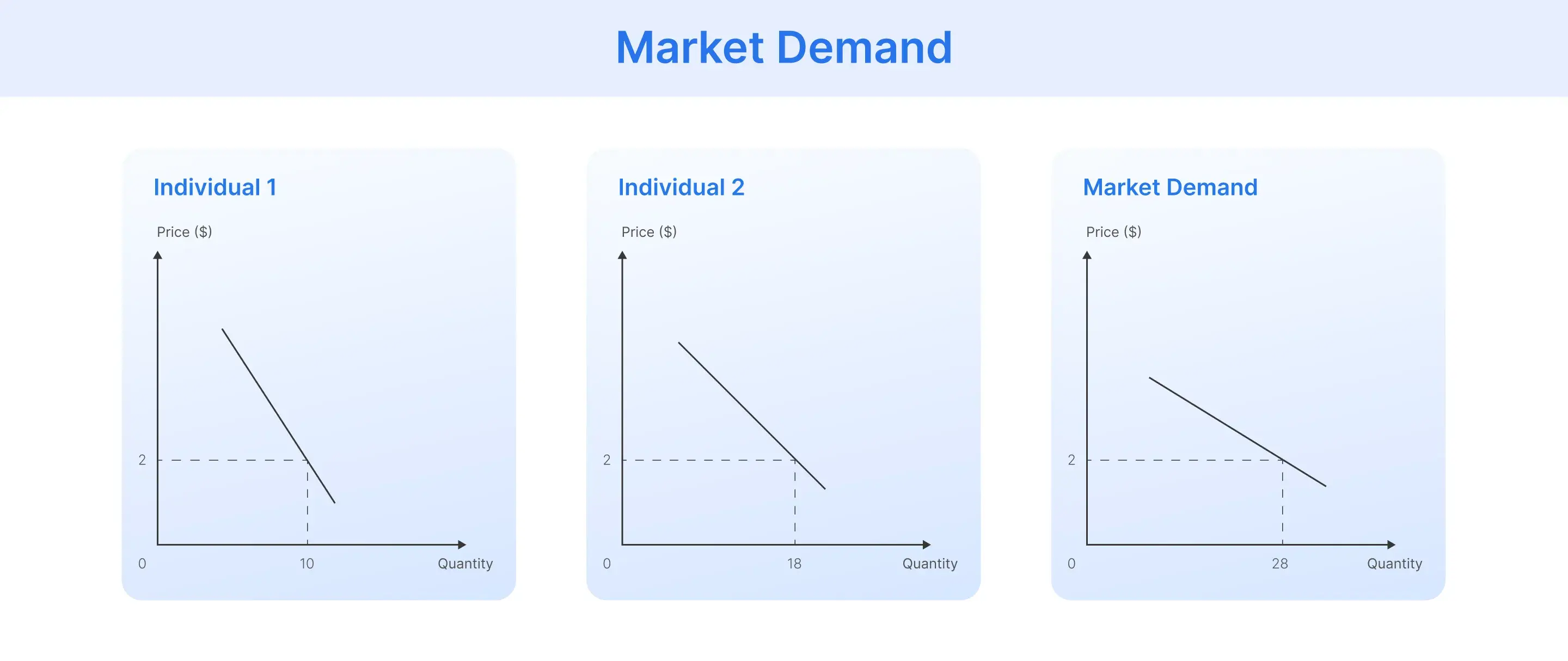
Market demand is derived by aggregating the quantities that individual consumers demand at each price. For example, if one consumer is willing to buy two units of a product at $10 and another is willing to buy three units at the same price, the market demand at $10 is five units. Combining the quantities demanded by all consumers at different prices provides a broader picture of demand across the market.
What Are Some Examples of Market Demand?
Real-world examples make market demand easier to understand because they show how businesses can use customer interest and purchasing signals to make decisions about products and opportunities.
LEGO: Using Customer Interest to Validate Product Ideas

LEGO Ideas is one example of how customer interest can help validate a product idea. Through LEGO Ideas, fans submit product concepts and other users can support them. When a submission reaches 10,000 supporters, it moves into LEGO’s review stage. At that point, LEGO evaluates factors including expected demand, brand fit, production capacity, feasibility, and other considerations before deciding whether to develop the idea into an official set.
This does not mean that 10,000 supporters automatically translate into a product launch. Rather, the process gives LEGO a measurable signal of customer interest that can form part of a broader product decision.
McDonald’s: Responding to Changing Customer Demand

McDonald’s Snack Wrap provides an example of responding to changing demand. The return of the Snack Wrap followed sustained interest from customers who continued to ask for the discontinued product. Its return demonstrates how businesses can pay attention to customer preferences and changing demand when deciding whether to bring an existing product back to the market.
Together, these examples show that market demand can inform different types of business decisions: validating interest in a potential product, identifying opportunities, and responding when customer preferences change.
How Can Businesses Assess Market Demand?
Define the Target Market
Businesses can begin by identifying the target audience most likely to need and afford the product. This involves looking at factors such as demographics, customer needs, purchasing behaviour, and ability to pay. A clearly defined target market makes it easier to estimate how much demand a product may have.
Analyse Existing Market and Customer Data
Existing market demand research can provide useful evidence for market analysis and demand assessment. Businesses can examine sales data, search behaviour, customer feedback, historical demand, market reports, and relevant secondary research to identify patterns and changes in customer interest.
For example, rising search activity for a particular product alongside increasing sales may indicate growing demand. Reviewing these signals together can support more informed strategic decisions about pricing, inventory, and product development.This can also reveal periods of high demand for a specific product.
Conduct Primary Research
Primary research allows businesses to gather information directly from potential or existing customers. Surveys, interviews, questionnaires, and direct customer feedback can reveal what customers want, what problems they are trying to solve, and how likely they are to purchase a product.
This information can complement existing market data and provide a clearer picture of consumer preferences and purchasing behaviour.
Test Demand Before Scaling
Businesses can test demand on a smaller scale before committing significant resources. Small-scale product launches, pre-orders, interest-based tests, and controlled experiments can provide evidence of whether customers are willing to buy.
The results can then help determine whether demand is high enough to justify expanding production, distribution, or marketing efforts.
Monitor Demand Over Time
Consumer demand can change as behaviour, market conditions, and broader trends change. Businesses should therefore monitor market trends, seasonality, changes in consumer behaviour, and changes in market conditions rather than relying on a single demand estimate.
Ongoing monitoring can help businesses adjust their products, pricing, inventory, and marketing strategies as demand changes.This helps businesses respond when demand decreases or increases.
How Is Market Demand Calculated?
Market demand is calculated by combining the quantities that individual consumers are willing and able to buy at a given price. In other words, market demand is the sum of individual quantities demanded at each price.
For example, suppose three consumers would buy the following quantities of a product at a price of $20:
Consumer Quantity Demanded at a $20 Price |
|
|---|---|
|
Consumer |
Quantity Demanded |
|
A |
2 units |
|
B |
3 units |
|
C |
5 units |
|
Market demand |
10 units |
At $20, the market demand is therefore 10 units.
Individual demand can also be represented using a demand function such as:
Qd = a − bP
Where:
- Qd = quantity demanded
- a = quantity demanded when price is zero
- b = how strongly quantity demanded changes as price changes
- P = price
When individual demand functions are combined at each price, they produce the market demand curve, helping businesses understand market equilibrium. This relationship can be illustrated alongside the supply curve.
The curve generally slopes downward because, all else being equal, consumers tend to demand fewer units as the price increases and more units as prices fall.
How Can Businesses Use Market Demand Insights?
Market demand insights become useful when businesses apply them to everyday decisions. Rather than treating demand data as a theoretical measure, businesses can use it to decide what to sell, how much to stock, how to price products, and where to focus their market efforts.Using these insights effectively can also help businesses maintain a competitive edge.
Businesses can use market demand insights to:
- Adjust product assortment based on what customers are looking for and buying.
- Plan inventory by anticipating changes in demand and reducing the risk of excess or insufficient stock.
- Inform pricing decisions by considering how changes in price may affect the quantity customers demand and how demand may respond to a future price change
- Prioritise promising markets and customer segments where demand is strong or growing, particularly where there is potential to increase market share.
- Refine marketing strategy by aligning campaigns with customer interests and demand patterns.
- Identify gaps or unmet needs where existing products may not fully satisfy customer demand.
- Forecast potential demand and plan resources such as inventory, production capacity, and marketing spend.
Turn Market Demand Insights into Better Retail Decisions
Understanding market demand gives retailers a clearer basis for deciding what to sell, how much to stock, which prices to set, and where to focus growth efforts. The value comes from turning those insights into decisions that respond to actual customer and market conditions.
Flipkart Commerce Cloud (FCC) helps retailers turn data and market insights into practical decisions across pricing, product discovery, customer engagement, and other areas of digital commerce. Its retail solutions are designed to support different retail environments while helping businesses respond more effectively to changing market conditions.

FAQ
In economics, market demand represents the total quantity of a product or service that all consumers in a given market are willing and able to purchase at various price points over a specific period. It reflects the combined purchasing power and overall consumer behavior of the entire customer base.
To calculate market demand from individual demand, you sum up the specific quantity of the product demanded by every single buyer at each price point. This process combines individual purchasing decisions to help businesses perform an accurate market demand analysis for their entire target market.
A market demand curve is a graph that illustrates how the total quantity demanded changes alongside the price of a product. Typically sloping downward, it visually demonstrates how demand increases as prices fall, giving companies clear insights into consumer sensitivity across a competitive market.
The factors that influence market demand and cause shifts include changes in income levels, shifting customer preferences, and general economic conditions. When these external factors alter buyer habits, the entire demand curve moves, affecting expected production levels and sales projections for businesses.
To forecast market demand for a new offering, the marketing department analyzes early consumer feedback, historical trends, and data analysis. Enterprise solutions like Flipkart Commerce Cloud enable brands to evaluate these behavioral signals accurately, helping guide critical product development decisions and inventory planning.
To measure market demand size, you multiply the total number of potential customers in a specific market by the average quantity consumed per person. Conducting thorough market research allows businesses to estimate their potential sales volume and evaluate new growth opportunities effectively.