
December 19, 2024
Predatory Pricing
Predatory pricing is an anti-competitive business strategy where businesses sets product prices very low, often below cost, to eliminate competition.
Drishti, Manager - Digital Marketing

Table of Contents
- What is predatory pricing?
- How does the predatory pricing strategy work?
- Example of predatory pricing
- What is the effect of predatory pricing on the market?
- What are the advantages and disadvantages of predatory pricing?
- How to counter a predatory pricing strategy?
- Conclusion
What is predatory pricing?
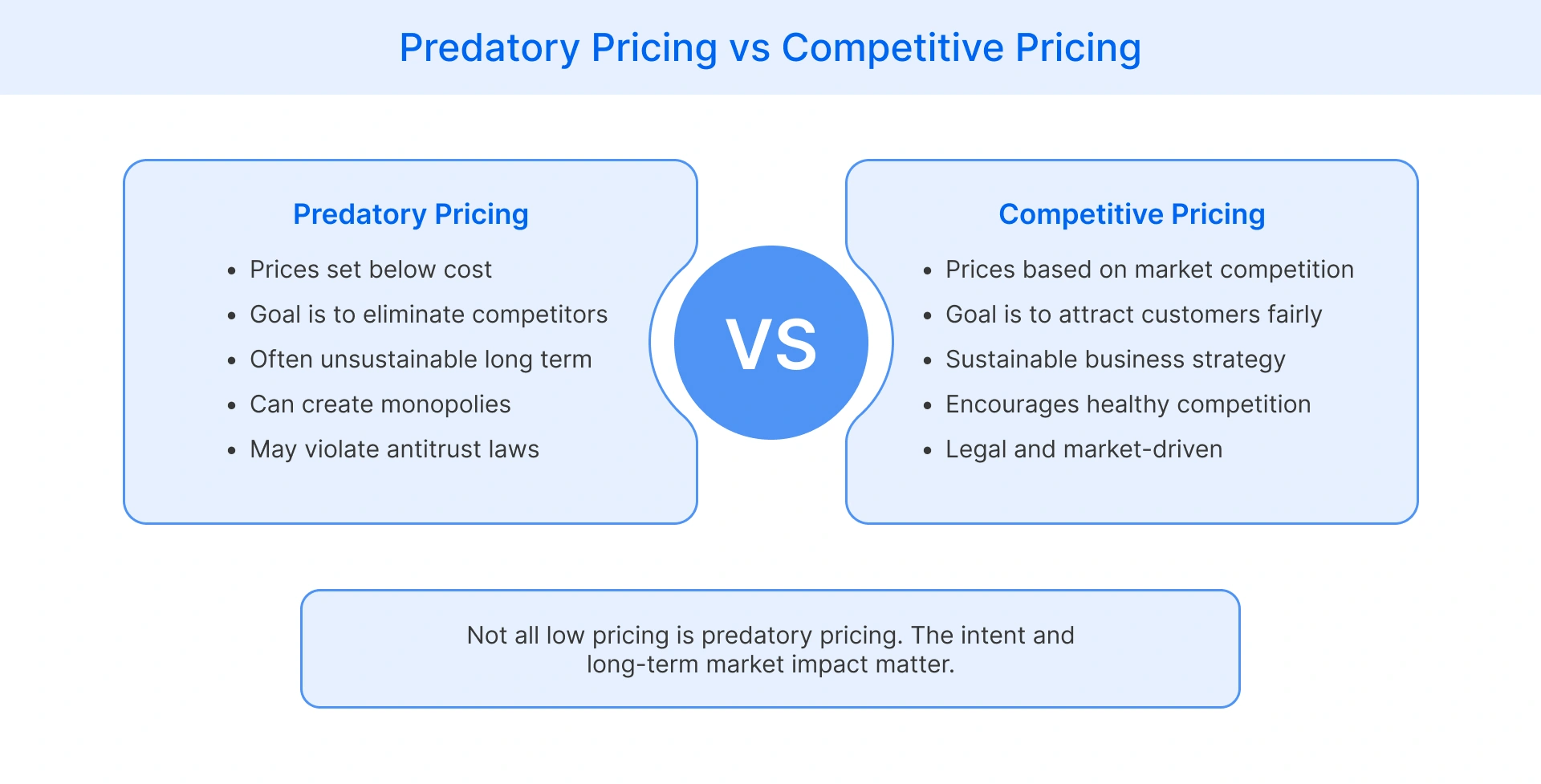
Predatory pricing is a strategy where prices are set exceptionally low, often below production costs, to eliminate competition. This pricing strategy is designed to drive out competitors by creating market conditions where they cannot compete, effectively allowing the dominant firm to increase its market power.
While competitive pricing may seem beneficial to consumers, predatory pricing practices are considered illegal in most countries because they violate competition law and the Sherman Act.
The ultimate goal of predatory pricing is to create a monopolistic market where the dominant company can increase prices without facing competitive pressure. This predatory pricing policy contradicts the principles of a free market and undermines healthy competition.
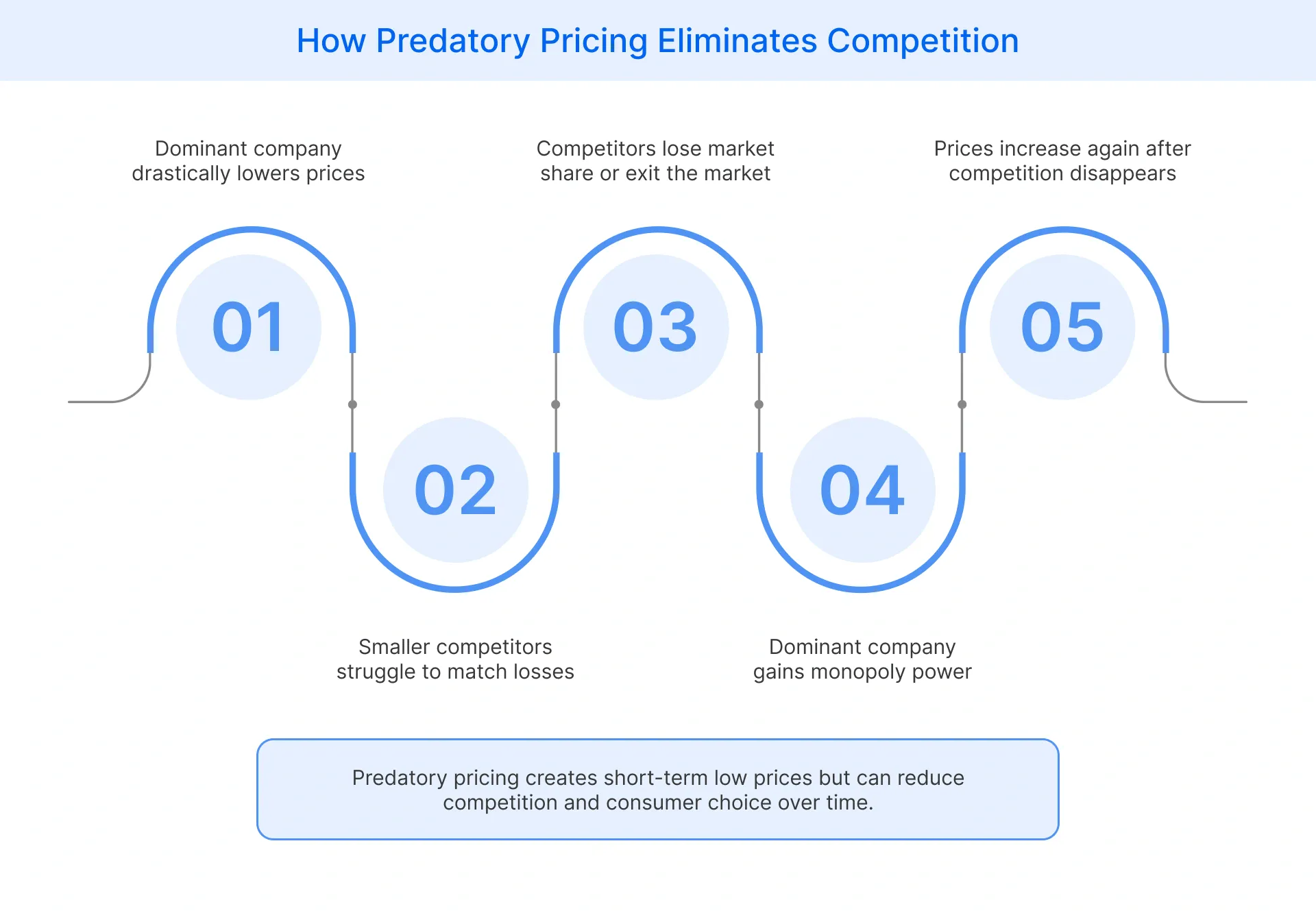
Businesses that employ predatory pricing aim to eliminate competition, allowing them to increase prices later significantly. They often set prices so low that they incur losses for a certain period. This strategy makes it unfeasible for smaller competitors, such as small businesses, to match these prices.
Large firms also use predatory pricing practices to prevent new entrants from gaining a foothold. For instance, a well-established company with significant market power may reduce prices to prevent competitors from launching new products. While this results in lower prices for consumers in the short term, it can lead to a lack of market diversity and innovation in the long run.
How does the predatory pricing strategy work?
Under predatory pricing, companies reduce their prices drastically, not to offer value to customers but to undercut competitors who are smaller or new to the market. This predatory pricing strategy is unsustainable over an extended period and is often employed by companies with substantial financial backing that can withstand short-term losses.
The objective is to drive competitors out of the market, allowing the company to hike prices in the absence of competitive pressure. Therefore, predatory pricing is viewed critically in many jurisdictions and could be subject to legal penalties, including summary judgment in lower courts or action by the Federal Trade Commission (FTC).
Example of predatory pricing
The Standard Oil Company, under the leadership of John D. Rockefeller, is a classic example of predatory pricing. In the early 20th century, Standard Oil was accused of drastically reducing its prices, often below average variable cost, to drive smaller competitors out of the market.
Once the competition was eradicated, the company could then increase prices without the pressure of competition. This case, which dates back to 1911, is frequently cited as a standard example of predatory pricing. The company was eventually prosecuted under the Sherman Act, and its aggressive tactics, including price manipulation (price cutting) to drive out competitors, led to its eventual breakup by the US Supreme Court in 1911.
Another notable case involved American Airlines, which faced allegations of predatory pricing for lowering fares on certain routes to eliminate competition. The Justice Department investigated the airline's pricing practices, but proving predatory intent and recoupment requirements in lower courts posed challenges.
What is the effect of predatory pricing on the market?
Predatory pricing significantly impacts the market in both the short term and the long term. In the short term, this strategy can create a consumer-friendly environment with low pricing. However, this immediate impact can lead to financial strain for these companies, and in some cases, they may not be able to sustain the losses and could exit the market.
In the long term, the effects of predatory pricing can be detrimental to the market. If the predatory firm succeeds in driving out competitors, it can establish monopoly power. With no competition to keep them in check, the firm can exploit consumers by setting high prices. The lack of competition stifles innovation, and the market becomes stagnant as the monopolistic firm has little reason to improve their products or services.
John McGee argued in his economic theory discussion paper that predatory pricing is often irrational due to the high costs and low likelihood of successful recoupment. However, Paul Milgrom and other scholars have shown through game theory that predatory pricing can be a profitable long-term strategy in certain market conditions.
What are the advantages and disadvantages of predatory pricing?
Predatory pricing has both advantages and disadvantages, impacting various market participants differently. Let's understand how:
Advantages
- Market Dominance: Predatory pricing can help a company quickly achieve a dominant position in the market. The company can attract a large customer base by setting prices low, driving its growth ambitions.
- Customer Benefit: Initially, customers can benefit from the significantly low pricing. This can lead to increased purchasing power and choice for potential buyers.
Disadvantages
- Barrier to Entry: Predatory pricing creates a high barrier to entry for new market players. Future entrants may find it difficult to compete at such low price points.
- Long-Term Consumer Impact: Although consumers may benefit from lower prices initially, the long-term effects could be detrimental. Once a company establishes monopoly power, it can raise prices, exploiting consumers.
- Harm to Innovation: A monopolistic market indirectly stops innovation as the dominant firm has no good reason to improve products or services.
How to counter a predatory pricing strategy?
Countering predatory pricing involves a combination of strategic business practices and legal policy. Let's analyze the available options further.
Strategic Business Practices
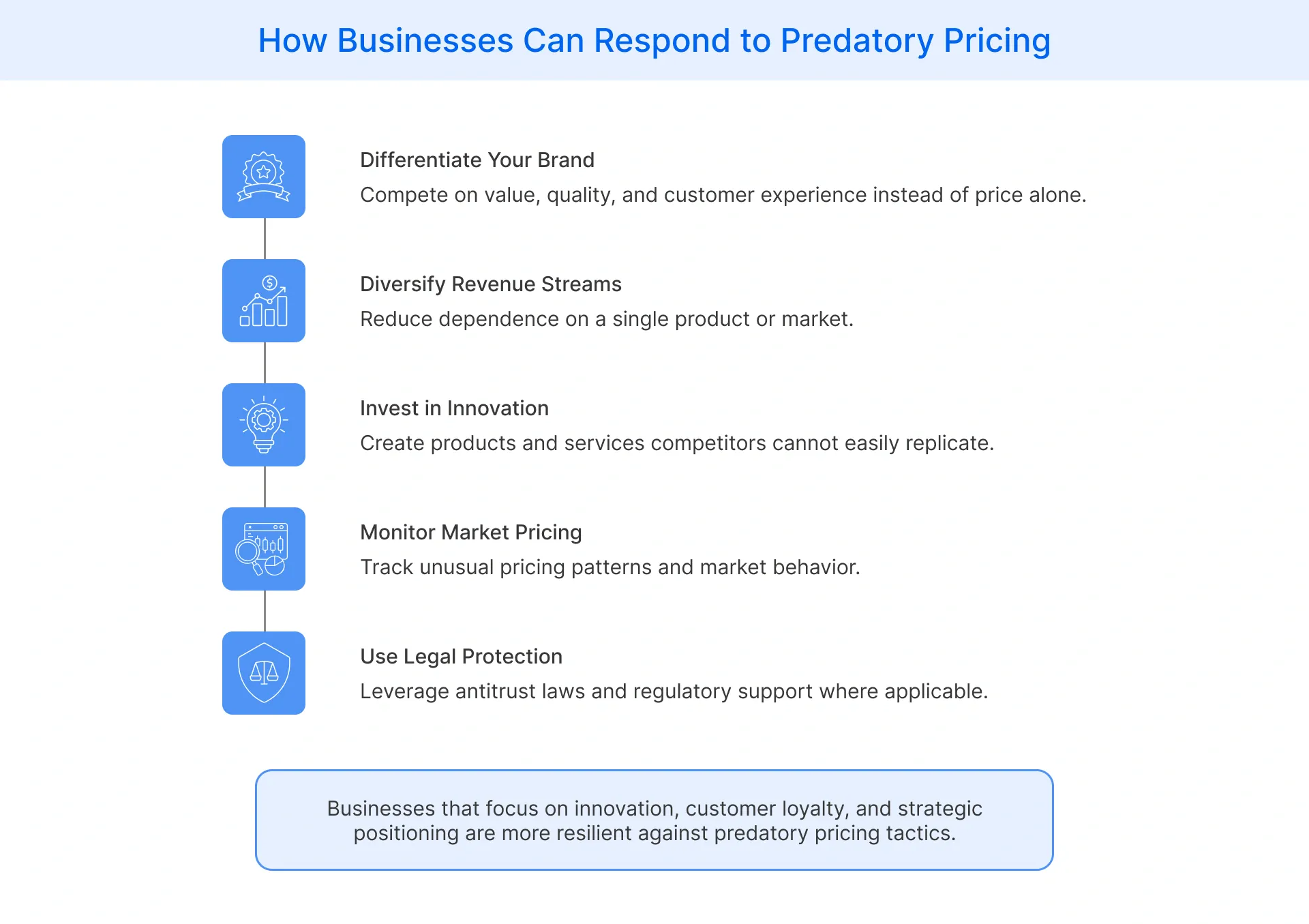
- Diversify Revenue Streams: You can explore other sources of revenue beyond your core product or service, reducing dependence on a single market.
- Monitor Competitors: Keeping a close eye on competitors' pricing strategies can help you identify potential predatory pricing.
- Value Proposition: Creating a compelling value proposition can help differentiate your business from its competitors.
- Innovation: Being innovative can provide a competitive edge, making your business less vulnerable to predatory pricing.
- Customer Experience: When customers have a great experience, they are less likely to focus solely on price. Instead, they will consider factors such as quality, service, and overall value.
Legal Recourse
- Antitrust Laws: Most countries have laws against predatory pricing. These laws aim to protect competition and prevent monopolies.
- Legal Action: If predatory pricing is suspected, gathering evidence and seeking legal recourse can be an effective countermeasure.
Brooke Group is a landmark case where the Supreme Court set standards for proving predatory pricing under US competition law. The court emphasized the need for evidence of pricing below average variable cost and a likelihood of recouping losses after driving competitors out of the market.
Your company can also leverage software tools like Flipkart Commerce Cloud, which is designed to monitor competitors' and partners' prices. This can help identify patterns or anomalies that may indicate predatory pricing tactics. It's important for you to stay vigilant and proactive in maintaining fair competition in the marketplace.
Conclusion
Predatory pricing is illegal and harmful to consumers, as it reduces choice and can lead to higher prices and lower quality products.
The challenge for most businesses is that predatory pricing is difficult to detect until significant damage has already occurred. By the time pricing anomalies become obvious, the competitive window to respond has often narrowed.
Flipkart Commerce Cloud (FCC) equips retailers and brands with the competitive intelligence to stay ahead of exactly this. FCC's real-time competitor price monitoring tracks pricing movements across markets and surfaces unusual patterns, giving your team the visibility to identify potential predatory behaviour early and the data to respond strategically. Paired with FCC's AI-powered retail pricing tools, you can protect your margins, hold your competitive position, and make pricing decisions grounded in market intelligence rather than guesswork.
Book a demo with FCC and see how smarter pricing intelligence can protect your business from competitive threats and safeguard your margins.

FAQ
Signs of predatory pricing include sudden, unexplained price drops by a dominant player, sustained below-cost pricing with no clear efficiency justification, and price cuts concentrated in markets where rivals are strongest. Tools like FCC help businesses detect unusual competitor pricing patterns early, enabling a strategic response before competitive damage escalates.
In the US, predatory pricing is an antitrust violation governed by the Sherman Act and enforced by the Federal Trade Commission (FTC). Courts apply the Brooke Group standard to prove it, requiring evidence that prices fell below average variable cost and that the company could realistically recoup those losses after eliminating competition.
Predatory pricing is also called "below-cost pricing" or "destroyer pricing" terms that reflect its core intent of eliminating competition through unsustainably low prices. In international trade, the equivalent practice is called "dumping," where companies export goods and sell them below domestic production cost to undercut and weaken foreign market competitors.
Predatory pricing and competitive pricing both involve low prices, but their intent is entirely different. Competitive pricing sets prices low to win customers while remaining profitable and sustainable. Predatory pricing sets prices deliberately below cost to eliminate rivals and raise prices later, making it illegal, anti-competitive, and harmful to long-term market health.
Predatory pricing hurts competition by forcing smaller rivals to match unsustainably low prices or exit the market entirely. This erodes market diversity, discourages new entrants, and reduces consumer choice. Once the dominant firm achieves monopoly power, it raises prices freely removing the competitive pressure that drives fair pricing, product improvement, and market innovation.
Yes, dumping is widely considered a form of predatory pricing in international trade. It occurs when a company sells exported goods in a foreign market below their domestic production cost, undercutting local competitors. The World Trade Organization (WTO) classifies dumping as an unfair trade practice, and affected member countries can impose anti-dumping duties in response.
Predatory pricing can significantly limit consumer choice in the long run. By driving competitors out of the market, predatory companies can create a monopoly or near-monopoly.
This reduces the number of options available to consumers, forcing them to purchase from the dominant company, even if the price is high or the quality is poor. Additionally, without competition, there is less incentive for innovation and improved products, further limiting consumer choice.
Predatory pricing is illegal because it harms competition and reduces consumer choice. By driving competitors out of the market, predatory companies can create monopolies or near-monopolies, allowing them to charge higher prices and reduce the quality of goods and services.
Imagine a large grocery store chain that suddenly starts selling milk at a price significantly below the average cost of production. This drastic price cut could force smaller, independent grocery stores, which may not have the same buying power or financial resources, to sell milk at a loss or even close their doors. Once the competition is eliminated, the large grocery store chain can raise the price of milk to a profitable level, gaining a dominant market share and potentially reducing consumer choice.