
September 1, 2026
Predictive Pricing
Predictive pricing uses historical and real-time data to forecast demand, anticipate market changes, and determine optimal prices for products and services.
Drishti, Manager - Digital Marketing

Table of Contents
- What Is Predictive Pricing?
- How Does Predictive Pricing Work?
- What Data Is Used in Predictive Pricing?
- What Are the Benefits of Predictive Pricing for Retailers?
- Predictive Pricing vs. Dynamic Pricing
- How Can Retailers Use Predictive Pricing?
- What Are the Challenges of Predictive Pricing?
- Conclusion
Predictive Pricing
Setting the right price is a constant challenge for retailers. Customer demand, competitor pricing, market conditions, and changes in the supply chain can all influence how much shoppers are willing to pay. Relying only on past sales or basic pricing tools can make it difficult to respond quickly to these changes.
Predictive pricing uses historical data, customer behavior, market trends, and other relevant signals to help retailers anticipate future demand and make more informed pricing decisions. By combining predictive analytics, machine learning, and price elasticity insights, retailers can identify opportunities for price optimization while adapting to changing market conditions.
For retailers managing large product catalogs, predictive pricing can support more consistent pricing strategies, improve decision-making, and help teams determine optimal prices as demand and market dynamics change. The approach can also work alongside dynamic pricing to help retailers make timely price adjustments based on new data.
In this guide, we explore how predictive pricing works, the data and models behind it, its benefits and limitations, and how retailers can use it as part of a broader pricing strategy.
What Is Predictive Pricing?
Predictive pricing is a data-driven approach that uses historical sales data, customer demand, market conditions, and other relevant signals to estimate how prices may perform in the future. Retailers can use these insights to make better pricing decisions instead of relying only on past performance or intuition.
By combining predictive analytics with tools such as machine learning and artificial intelligence, retailers can identify patterns, anticipate market changes, and determine optimal prices for different products and customer segments. This can help retailers respond to changing demand while protecting profit margins and supporting their broader business goals.
How Does Predictive Pricing Work?
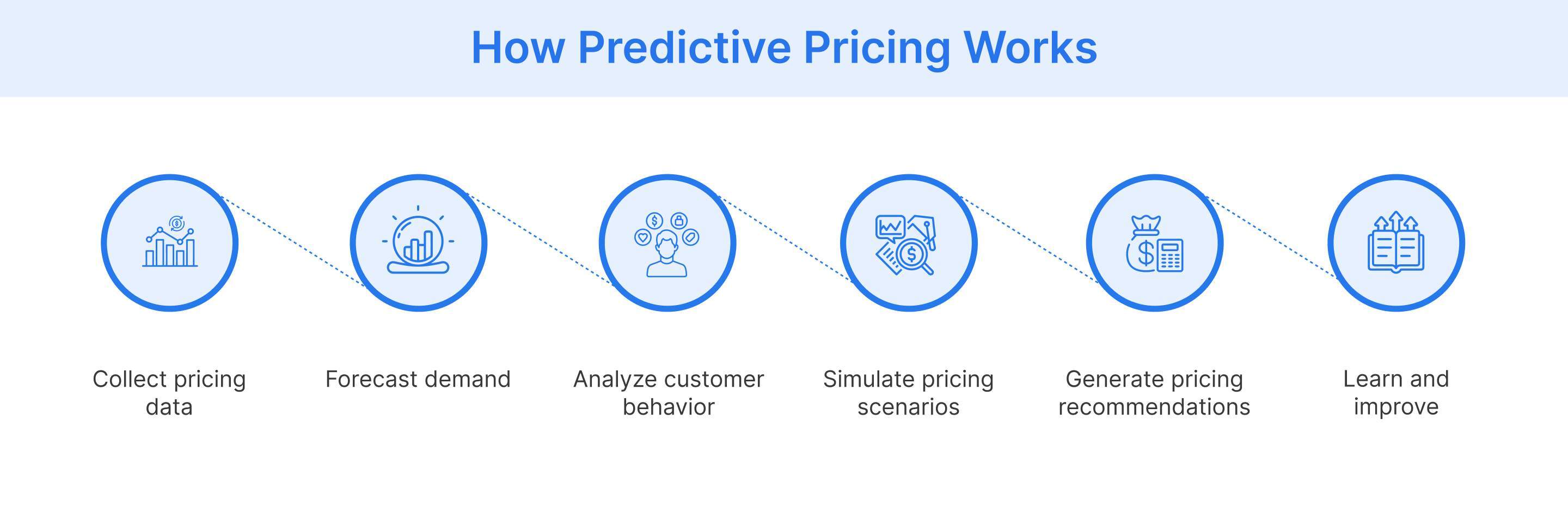
Predictive pricing uses data and predictive models to estimate how different pricing decisions may affect future demand and sales. Retailers can analyse historical data, customer behaviour, market trends, competitor pricing, and other relevant factors to identify patterns that can inform future prices.
The process typically involves collecting and analysing relevant data, identifying the factors that influence pricing, and using predictive models to estimate likely outcomes. Retailers can then use these insights to make price adjustments based on current market conditions and expected customer demand.
What Data Does Predictive Pricing Use?
Predictive pricing depends on multiple data sources to build a more complete view of the factors that influence price and demand. The data used may include:
- Historical sales data: Past sales can reveal patterns in demand, product performance, and seasonal changes.
- Customer data: Information about purchasing patterns and customer behaviour can help retailers understand how shoppers respond to different prices.
- Market data: Broader market trends can provide insight into changes that may influence demand and pricing decisions.
- Competitor pricing data: Monitoring competitors can help retailers understand how their prices compare within the market.
- Inventory data: Stock levels and product availability can provide additional context when determining pricing decisions.
By bringing these data points together, retailers can use predictive models to identify patterns and generate pricing insights based on expected market and customer behaviour.
What Are the Benefits of Predictive Pricing for Retailers?
Predictive pricing can help retailers make more informed pricing decisions by using data to anticipate changes in demand and market conditions. Some of the key benefits include:
- Better pricing decisions: Retailers can use data-driven insights to set prices based on expected customer demand and market conditions.
- Improved profit margins: Identifying suitable price points can help retailers balance demand with profitability.
- More accurate demand forecasting: Predictive models can help retailers anticipate changes in demand and plan their pricing accordingly.
- Greater responsiveness to market changes: Retailers can adapt their pricing strategies as customer demand, competitor prices, and other market factors change.
- Reduced reliance on guesswork: Using historical and current data gives retailers a stronger basis for making pricing decisions.
What Is the Difference Between Predictive Pricing and Dynamic Pricing?
Predictive pricing uses historical and current data to forecast demand and estimate how pricing decisions may perform in the future. Dynamic pricing, on the other hand, adjusts prices in response to changing factors such as demand, inventory levels, competitor prices, or market conditions.
The two approaches can work together. Predictive pricing can help retailers anticipate changes in demand and determine suitable price points, while dynamic pricing can use those insights to make timely price adjustments as conditions change.
Difference Between Predictive and Dynamic Pricing |
||
|---|---|---|
|
Aspect |
Predictive Pricing |
Dynamic Pricing |
|
Primary purpose |
Forecasts how pricing decisions may perform in the future |
Adjusts prices based on changing conditions |
|
Main focus |
Predicting future demand and pricing outcomes |
Responding to current market conditions |
|
Data used |
Historical data, customer behaviour, market trends, and other relevant signals |
Demand, inventory, competitor prices, and real-time market conditions |
|
Timing |
Helps retailers plan pricing decisions ahead of changes |
Enables retailers to make price adjustments as conditions change |
|
Relationship |
Provides insights that can inform pricing decisions |
Can use predictive insights to determine timely price adjustments |
What Is the Difference Between Predictive Pricing and Prescriptive Analytics?
Predictive pricing focuses on forecasting what is likely to happen based on historical and current data, such as future demand or potential pricing outcomes. Prescriptive analytics goes a step further by using data and predictive insights to recommend actions that can help achieve a desired business outcome.
For retailers, predictive pricing can indicate how demand may change at different price points, while prescriptive analytics can help determine what pricing action to take based on those predictions. Together, they can support more informed and proactive pricing decisions.
How Can Retailers Implement Predictive Pricing?
Retailers can implement predictive pricing by establishing the data, technology, and processes needed to support data-driven pricing decisions. A practical implementation can involve the following steps:
- Collect relevant data: Gather historical sales, customer, inventory, competitor, and market data that can influence pricing decisions.
- Identify pricing factors: Determine which variables have the greatest influence on demand and price sensitivity across products and customer segments.
- Build predictive models: Use statistical models, machine learning, or predictive analytics to identify patterns and forecast demand at different price points.
- Test pricing scenarios: Evaluate how different price points may affect demand, sales, and profitability before applying changes.
- Integrate with pricing systems: Connect predictive models with existing pricing and commerce systems so insights can inform pricing decisions efficiently.
- Monitor and refine: Track outcomes against predictions and update the models as customer behaviour, market conditions, and business priorities change.
What Are the Use Cases of Predictive Pricing in Retail?
Retailers can apply predictive pricing across different areas of their pricing strategy to anticipate demand, respond to market changes, and make more informed decisions. Common use cases include:
- Demand-based pricing: Retailers can use demand forecasts to predict how customers may respond to different price points and adjust prices based on expected demand. During periods of high demand, this can help determine prices that balance sales and profitability.
- Inventory management: Using inventory levels as a pricing signal can help move products before they become slow-selling or overstocked. For seasonal products, predictive pricing can help determine when a price adjustment may encourage sales before demand declines.
- Promotional pricing: Predictive models can help identify which discounts or promotional offers are most likely to drive sales while protecting profit margins. A retailer selling a product for $50 could compare a $45 price reduction with a 10% discount to determine which option is likely to generate better results.
- Competitive pricing: Analysing competitor prices can help identify price points that remain competitive without unnecessarily reducing margins. If competitors lower their prices, predictive models can help assess whether matching the change is likely to benefit the business.
What Are the Challenges of Predictive Pricing?
While predictive pricing can help retailers make more informed decisions, implementing and maintaining it can present several challenges:
- Data quality and availability: Incomplete, inaccurate, or inconsistent data can affect the reliability of predictive models and the pricing decisions based on them.
- Model accuracy: Predictive models depend on historical patterns and assumptions that may not always reflect unexpected changes in customer demand or market conditions.
- Integration complexity: Connecting predictive pricing models with existing pricing, inventory, and commerce systems can require significant technical resources.
- Changing market conditions: Competitor actions, economic shifts, and changes in customer behaviour can reduce the accuracy of predictions over time.
- Ongoing monitoring: Retailers need to regularly evaluate model performance and update their models as new data becomes available.
Conclusion
Predictive pricing gives retailers a more forward-looking way to make pricing decisions by combining business data with predictive analytics. It can help retailers anticipate changes in demand, evaluate pricing opportunities, and respond more effectively to changing market conditions.
For retailers looking to make pricing decisions more responsive and data-driven, the right commerce and technology infrastructure is essential. Flipkart Commerce Cloud helps retailers build the capabilities needed to manage modern digital commerce at scale.
Book a demo to learn how FCC can support your retail pricing and commerce operations.

FAQ
Predictive pricing is an advanced data strategy that uses historical sales data, market trends, and machine learning to forecast optimal product price points. Analyzing consumer behavior and competitor actions allows merchants to implement effective predictive pricing, adjusting every retail price dynamically to maximize margins while driving sustainable growth.
A predictive price model is a powerful tool built around predictive modeling algorithms that evaluate historical demand, competitor rates, and purchasing power. By performing deep data analysis, the model predicts how price changes impact overall sales, helping merchants make better decisions that protect profit margins.
The difference between predictive and prescriptive analytics lies in forecasting trends versus recommending operational actions. While predictive pricing analytics forecast future market shifts and demand fluctuations, prescriptive systems go further by recommending exact predictive pricing strategies, advising retail teams on precise adjustments to achieve specific strategic goals.
Predictive pricing is used in retail to automate dynamic adjustments based on real-time competitive intelligence and sales trends. Enterprise solutions like Flipkart Commerce Cloud leverage an automated pricing engine as a complete price optimization solution, empowering brands to optimize promotional discounts and respond to market shifts seamlessly.