
June 19, 2026
What Is Supply Chain Management?
Supply chain management is the end-to-end coordination of sourcing, production, and delivery that moves goods from raw materials to customers. It helps businesses reduce costs, improve efficiency, and stay competitive in a fast-moving global market.
Drishti, Manager - Digital Marketing

Table of Contents
- What Is Supply Chain Management?
- What Are the 5 Key Processes of Supply Chain Management?
- What Are the Key Components of a Supply Chain?
- What Are the Types of Supply Chain Management?
- What Are the Benefits of Supply Chain Management?
- Technologies Driving Modern Supply Chain Management
- Challenges in Supply Chain Management
- Conclusion
What Is Supply Chain Management?
Every product on a retail shelf moves through a network of suppliers, manufacturers, warehouses, and logistics providers before reaching the customer. Managing that journey efficiently is what separates profitable retail operations from costly, reactive ones.
Supply chain management (SCM) is the coordination of activities involved in sourcing raw materials, producing finished goods, and delivering them to customers. It covers the entire production flow, from the first supplier to the final point of sale, helping businesses align procurement, manufacturing, logistics, and customer service into one connected operation.
SCM also manages the flow of information, finances, and decisions across suppliers, manufacturers, distributors, and retailers. The goal is to ensure the right product reaches the right place at the right time and at the right cost.
For retailers, supply chain management is important because it improves inventory availability, reduces operational costs, supports faster fulfillment, and helps businesses respond more effectively to disruptions and changing customer demand.
What Are the 5 Key Processes of Supply Chain Management?
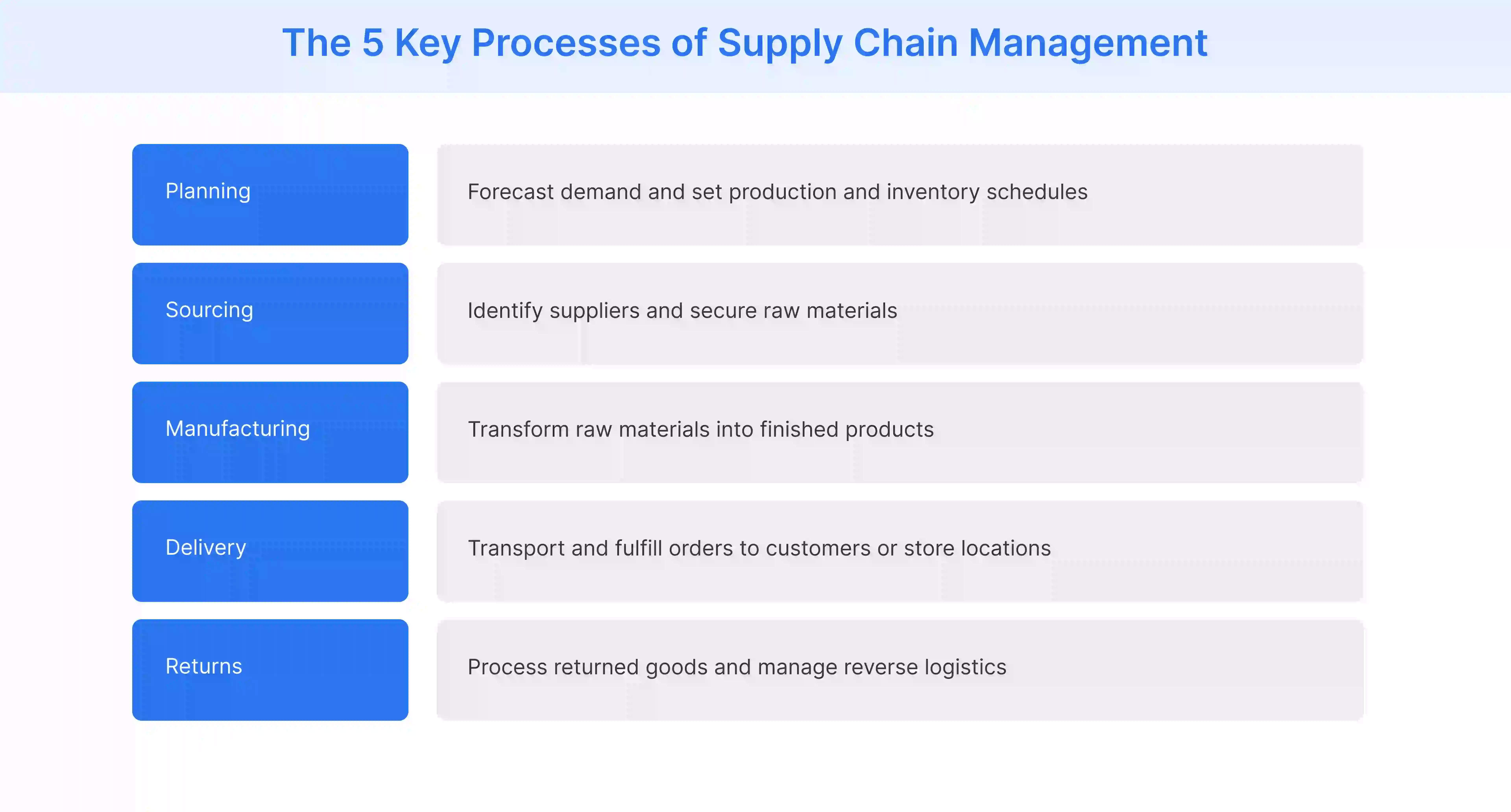
Planning
Planning is the foundation of the supply chain. It involves forecasting demand, setting production schedules, and managing inventory to ensure products are available when needed. Accurate planning helps retailers reduce stockouts and excess inventory.
Supply chain managers use demand planning and forecasting to reduce inventory risks and improve operational efficiency.
Sourcing
Sourcing involves selecting suppliers, negotiating contracts, and securing raw materials or products. Strong sourcing practices help businesses maintain quality standards, control costs, and improve supply reliability.
Manufacturing
Manufacturing is the process of turning raw materials into finished goods. This stage includes production, quality control, testing, and packaging to ensure products meet customer expectations.
Delivery
Delivery covers transportation, warehousing, and order fulfillment processes that move finished products to customers or store locations. Effective delivery depends on strong logistics coordination and inventory visibility.
Warehouse management and logistics coordination play an important role in maintaining delivery speed and inventory visibility.
Returns
Returns, also called reverse logistics, manage products moving back through the supply chain. This includes customer returns, defective items, repairs, recycling, and inventory recovery.
What Are the Key Components of a Supply Chain?
A supply chain consists of several connected participants that help move products from origin to customer.
- Suppliers: Provide raw materials and components needed for production. Supplier quality and reliability affect every stage of the chain.
- Manufacturers: Transform raw materials into finished products through production, testing, and quality control.
- Distributors: Store final products in distribution centers and move them from manufacturers to retailers or end customers.
- Retailers: Sell products to customers through physical stores or ecommerce channels while managing pricing, promotions, and availability.
- Customers: The final stage of the supply chain. Customer demand, returns, and feedback influence planning and inventory decisions.
Supply chain managers oversee these interconnected components to ensure products move efficiently from suppliers to customers while balancing inventory, costs, and delivery performance.
What Are the Types of Supply Chain Management?
Different businesses use different supply chain management (SCM) approaches depending on demand patterns, operational priorities, and market conditions.
Lean Supply Chain Management
Lean SCM focuses on reducing waste across the supply chain by minimizing excess inventory, unnecessary movement, and inefficient processes. It works best for businesses with stable and predictable demand.
Agile Supply Chain Management
Agile SCM prioritizes flexibility and fast response to changing customer demand. It is commonly used by retailers managing seasonal products or unpredictable buying patterns.
Resilient Supply Chain Management
Resilient SCM focuses on minimizing disruptions and recovering quickly when supply chain issues occur. This approach often includes supplier diversification and contingency planning.
Green Supply Chain Management
Green SCM reduces the environmental impact of supply chain activities through sustainable sourcing, optimized logistics, and waste reduction practices.
Digital Supply Chain Management
Digital SCM uses technologies such as artificial intelligence (AI), IoT, and analytics to improve forecasting, inventory visibility, and decision-making across the supply chain.
What Are the Benefits of Supply Chain Management?
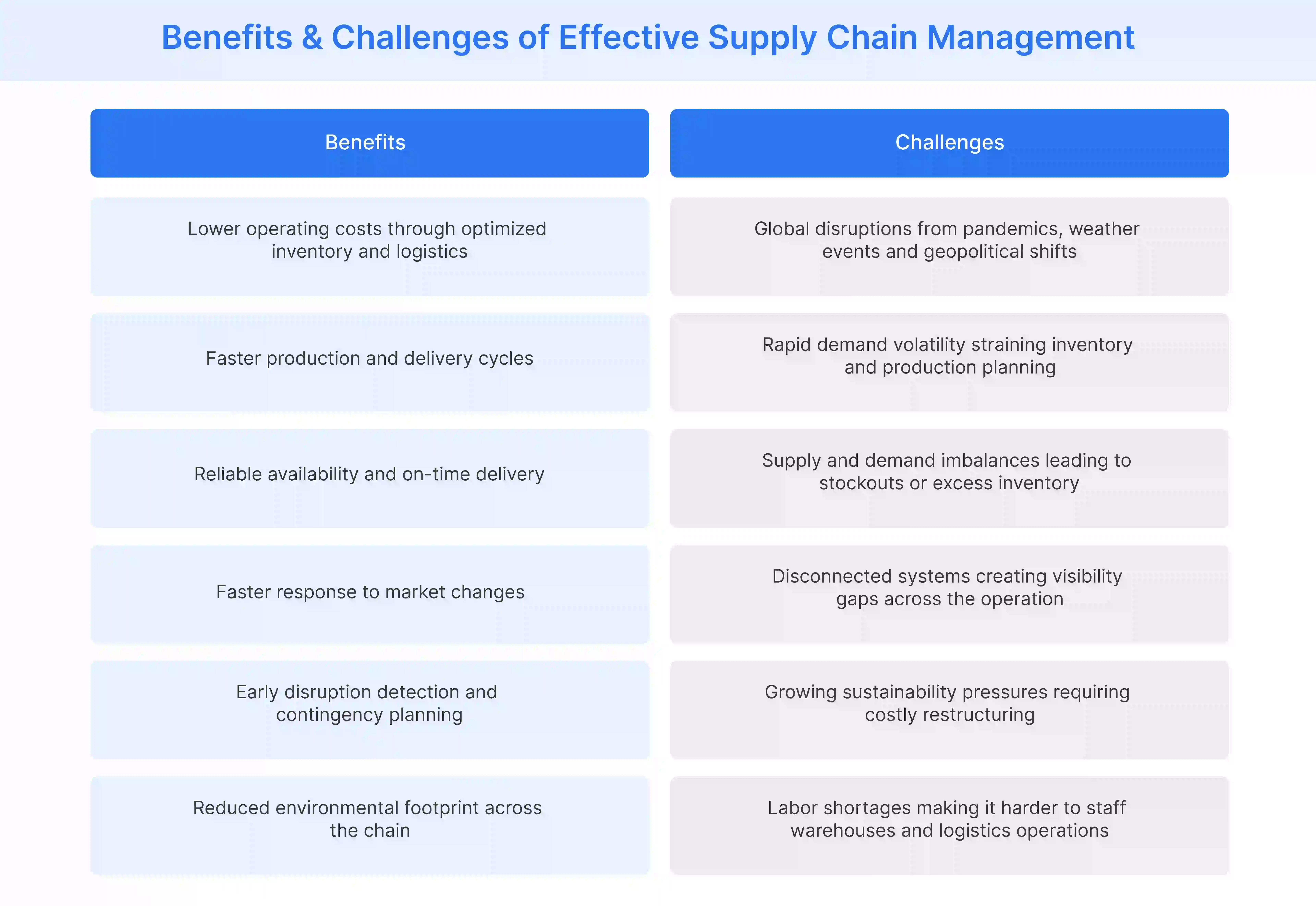
Effective supply chain management helps businesses improve efficiency, reduce operational costs, and respond faster to changing customer demand. For retailers, strong supply chain practices support inventory accuracy, faster fulfillment, and better customer experiences.
Technologies Driving Modern Supply Chain Management
Technology has transformed supply chains by improving visibility, forecasting, and operational efficiency across sourcing, inventory, and logistics.
Artificial Intelligence and Machine Learning
AI and ML improve demand forecasting by analyzing historical and real-time data to predict customer demand more accurately. These technologies also help optimize inventory, delivery routes, and supply chain visibility.
Internet of Things (IoT)
IoT devices such as sensors and RFID tags provide real-time visibility into inventory, shipments, and warehouse operations. This helps retailers improve stock accuracy and monitor goods across the supply chain.
Blockchain
Blockchain improves transparency by creating secure records of transactions across suppliers, manufacturers, and distributors. It helps businesses improve traceability, compliance, and product authentication.
Enterprise Resource Planning Systems
ERP systems connect procurement, inventory, logistics, and finance data into one platform. This gives supply chain teams better visibility and supports faster decision-making.
Cloud Supply Chain Management
Cloud-based SCM platforms support real-time collaboration, improve scalability, and make supply chain data accessible across teams and locations.
Challenges in Supply Chain Management
Even well-managed supply chains face operational challenges that retailers must plan for and manage proactively.
Strong risk management practices help businesses prepare for disruptions and maintain supply chain continuity.
- Global Disruptions: Pandemics, geopolitical events, extreme weather, and port congestion can interrupt supply chains.
- Demand Volatility: Rapid shifts in customer demand make inventory planning and production more difficult.
- Supply and Demand Imbalances: Poor forecasting can lead to stockouts or excess inventory that ties up working capital.
- Limited Visibility: Disconnected systems create gaps across procurement, inventory, logistics, and sales operations.
- Sustainability Pressures: Businesses face growing pressure to adopt more sustainable sourcing, packaging, and logistics practices.
- Labor Shortages: Staffing shortages can disrupt warehouse operations, fulfillment, and transportation.
Conclusion
Supply chain management helps businesses coordinate sourcing, production, inventory, and delivery more efficiently while improving visibility across operations. As supply chains become more complex, retailers need connected systems that support faster decisions, better inventory control, and operational resilience. FCC helps retailers unify inventory, fulfillment, customer data, and analytics to improve supply chain visibility and performance at scale.

FAQ
The primary difference between logistics and supply chain management lies in their overall scope. Logistics focuses specifically on the internal movement, storage, and flow of goods within a company. Conversely, supply chain management encompasses the entire broader network, handling everything from raw material sourcing and manufacturing to ultimate product delivery.
The main challenges in supply chain management today include volatile consumer demand, rising transportation costs, and fragmented data visibility across vendors. Managing these complex global networks requires real-time coordination. If companies fail to address these disruptions quickly, they face costly inventory stockouts, shipping delays, and damaged customer trust.
Artificial intelligence has fundamentally transformed supply chain management by replacing manual forecasting with predictive analytics. AI algorithms rapidly analyze massive datasets to anticipate market shifts, optimize warehouse storage, and streamline delivery routes. This technological evolution allows modern businesses to shift from reactive problem-solving to highly proactive, efficient operations.
AI is becoming essential to the supply chain through five key applications: automated demand forecasting, predictive maintenance for machinery, dynamic route optimization, automated inventory replenishment, and warehouse robotics. Implementing these intelligent tools allows retail operations powered by Flipkart Commerce Cloud to minimize waste, maximize fulfillment speed, and slash overhead costs.
The main difference between supply chain management and operations management is their core focus. Supply chain practices oversee the external flow of goods, data, and finances across various distinct organizations. In contrast, operations management focuses internally on supervising the daily manufacturing and service delivery processes within a single company's walls.
Retailers measure supply chain performance by tracking critical key performance indicators like order accuracy, perfect order rate, and inventory turnover. Analyzing these metrics ensures the entire distribution network functions optimally. Advanced enterprise systems like FCC aggregate this operational data seamlessly, giving merchants a clear view of their overall logistics health.
A supply chain manager oversees day-to-day supply chain operations, including inventory planning, supplier coordination, logistics tracking, and order fulfillment. They monitor inventory levels, manage disruptions, improve customer satisfaction, and ensure products move efficiently from the point of origin to the point of consumption.