
March 24, 2026
Warehouse KPIs
Warehouse KPIs are quantifiable performance indicators that retailers use to measure how efficiently a warehouse handles inventory and order processing. These metrics cover critical functions from the receiving process to order dispatch, giving warehouse managers visibility into operational strengths and weaknesses.
Drishti, Manager - Digital Marketing

Table of Contents
- What are Warehouse KPIs?
- Why are Warehouse KPIs Important for Retailers?
- What are the Main Categories of Warehouse KPIs?
- Which Warehouse KPIs Measure Inventory Performance?
- Which Warehouse KPIs Track Order Fulfillment Accuracy?
- Which Warehouse KPIs Measure Operational Speed?
- Which Warehouse KPIs Monitor Labor Productivity?
- What are the Risks of Not Tracking Warehouse KPIs?
- Optimize Your Warehouse Performance with Flipkart Commerce Cloud
Warehouse KPIs
Retailers across ecommerce and physical retail depend on warehouse operations to process customer orders accurately and on schedule. Warehouse KPIs provide the measurable performance data that managers need to maintain operational efficiency.
Without concrete indicators, identifying inefficiencies across the receiving and shipping functions becomes very difficult for managers. These metrics provide warehouse staff with a factual basis for improvements that directly affect profitability and customer satisfaction.
- Warehouse KPIs convert raw operational activity into data that supports evidence-based decisions across retail operations.
- Retailers use these indicators to benchmark warehouse performance and identify processes that need immediate attention.
- Tracking the right metrics helps retailers cut labor costs and minimize costly order fulfillment errors.
- Consistent monitoring enables warehouse managers to detect performance gaps well before they escalate into problems.
What are Warehouse KPIs?
Warehouse KPIs are measurable metrics that track warehouse operations' performance and efficiency. These indicators span inventory handling to order dispatch, giving retailers a quantifiable view of how well each operation performs.
They measure how well a warehouse handles incoming inventory and outgoing customer orders. Key data points, such as stock accuracy and order processing speed, reveal where the warehouse gains or loses efficiency across the entire operation.
Each KPI represents a specific, measurable aspect of warehouse management that can be tracked over time. When reviewed together along with an inventory management software, these metrics provide warehouse managers with actionable insights into warehouse performance and areas that require corrective action.
Why are Warehouse KPIs Important for Retailers?
Warehouse KPIs transform operational data into insights that support smarter decisions and improve overall retail efficiency.
- Cost Visibility: KPIs reveal where time and money are being lost during the receiving and order picking processes. Identifying these inefficiencies early allows warehouse managers to act before they drain profits further.
- Expense Control: Tracking metrics like inventory carrying costs and labor productivity helps managers cut unnecessary expenses. Data-driven cost management enables retailers to improve margins without reducing service quality or order accuracy.
- Customer Satisfaction: Monitoring order accuracy and fulfillment speed ensures customers receive correct products on time. Meeting customer expectations for speed and accuracy is directly linked to repeat purchases and brand loyalty.
- Data-Driven Decisions: KPIs replace guesswork with concrete numbers that guide warehouse improvements and resource allocation. Retailers using measurable data rather than intuition make faster improvements and reduce the risk of costly operational mistakes.
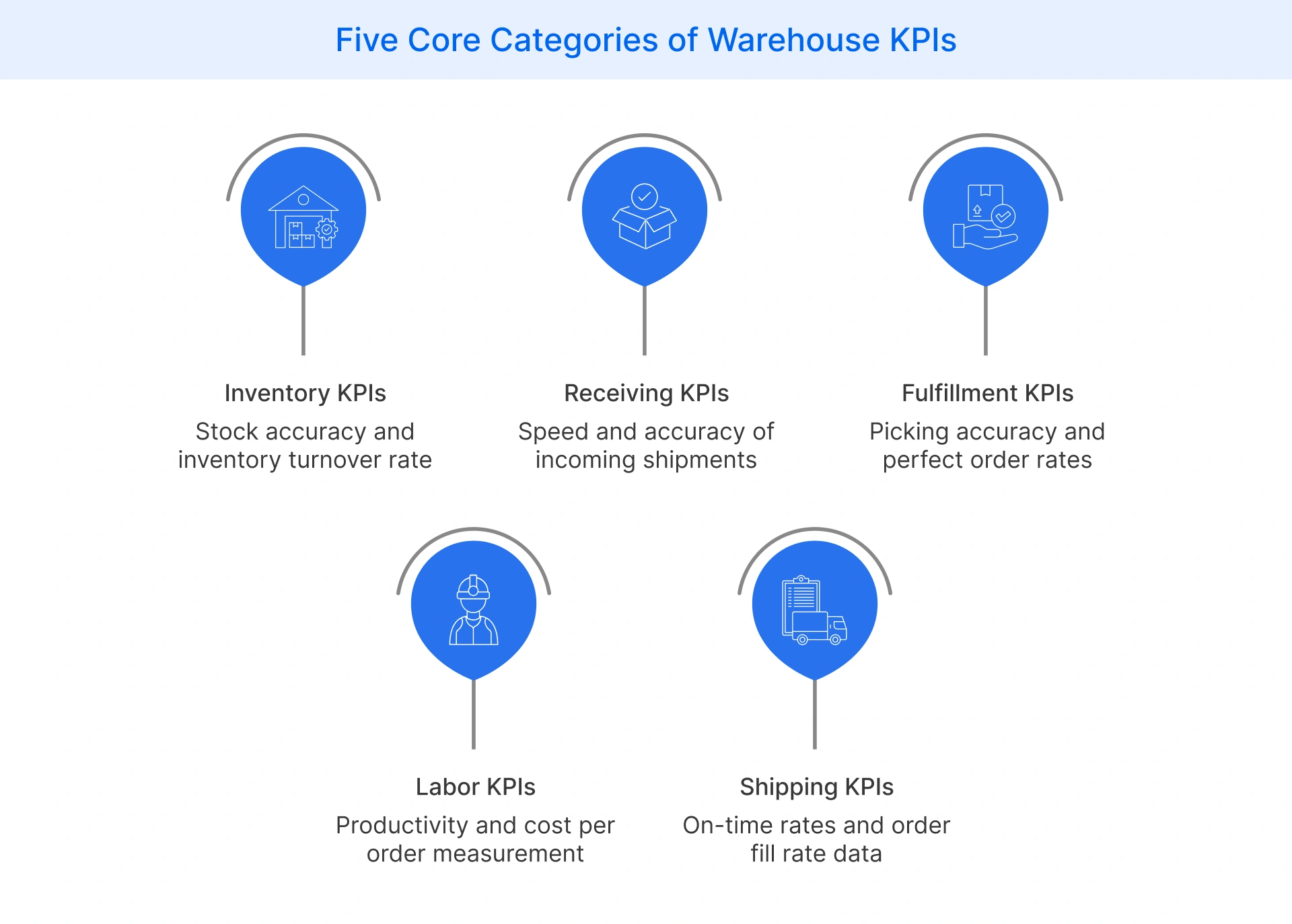
What are the Main Categories of Warehouse KPIs?
Warehouse KPIs fall into distinct functional categories, with each one addressing a specific stage of the complete warehouse operation cycle.
- Inventory KPIs: These track stock accuracy and inventory turnover rate to keep inventory levels properly balanced. They indicate whether a retailer holds the right quantity of stock for any given period, preventing both excess and shortages.
- Receiving KPIs: Receiving KPIs track the speed and accuracy of processing incoming shipments at the receiving area. These metrics measure receiving cycle time and the rate at which inventory enters the storage system correctly.
- Order Fulfillment KPIs: These monitor picking accuracy and perfect-order rates throughout the order fulfillment process. They provide visibility into how efficiently the warehouse converts received orders into successful deliveries that meet customer expectations.
- Labor KPIs: They measure worker productivity and labor costs across all warehouse functions. They help warehouse managers assess whether workforce deployment is aligned with actual order volumes and warehouse capacity.
- Shipping KPIs: These track on-time shipments and order fill rate as key delivery performance indicators from the distribution center to the customer. Shipping KPIs directly reveal whether the warehouse meets committed delivery timelines.
Which Warehouse KPIs Measure Inventory Performance?
When used along with an inventory management system, these performance metrics help retailers maintain appropriate stock levels and control inventory costs.
- Inventory Turnover Rate: It measures how many times inventory is sold and replaced during a specific period. Higher turnover signals efficient stock management and a healthier cash flow for the retail business overall.
- Inventory Accuracy: It is the percentage match between inventory records and actual physical inventory counts. An accuracy rate above 95 percent prevents stockouts and overstocking, thereby protecting the retailer's average inventory value.
- Carrying Cost of Inventory: This measures the total cost of holding stock, including storage space, insurance, and capital tied up in unsold goods. Reducing the carrying cost of inventory directly improves retailer profitability and releases cash for other operations.
- Inventory-to-Sales Ratio: This compares the average inventory value on hand to revenue generated over a defined period. A high sales ratio signals excess stock that ties up capital and unnecessarily increases the cost of goods held.
Which Warehouse KPIs Track Order Fulfillment Accuracy?
Order fulfillment accuracy metrics determine whether the warehouse consistently delivers the right products to the right customers on time.
- Order Picking Accuracy: This is the percentage of orders where items are picked correctly on the first attempt. High picking accuracy reduces the return rate and prevents customer complaints, which can damage long-term customer service performance.
- Perfect Order Rate: The perfect order rate measures the total number of orders delivered with correct items and in good condition without any incidents that impact customer satisfaction. It is one of the strongest indicators of the quality of the order fulfillment process.
- Return Rate: The return rate tracks the percentage of total orders that customers return due to incorrect items or product quality issues. A rising return rate signals failures in picking accuracy and directly impacts customer satisfaction across order processing.
- Backorder Rate: This measures how often orders placed cannot be fulfilled due to out-of-stock items, expressed as a percentage of total orders. A high backorder rate indicates poor inventory planning and weak demand forecasting within the supply chain.
Retailers managing complex order workflows must use an order management system reduces fulfillment errors at scale that may arise due to automated processes.
Which Warehouse KPIs Measure Operational Speed?
Operational speed metrics reveal how quickly the warehouse moves inventory and fulfills customer orders from order placement through to dispatch.
- Order Cycle Time: Order cycle time is the total time from order placement to shipment leaving the warehouse. Shorter cycle times directly improve customer satisfaction and strengthen the retailer's reputation for on-time delivery.
- Receiving Efficiency: This measures how quickly incoming inventory is unloaded and made ready for storage in the receiving area. Slow receiving cycle time creates bottlenecks that delay restocking high-demand products and reduce warehouse efficiency.
- Putaway Time: Putaway time tracks the total time required to move received items from the dock to designated storage space. Reducing this metric improves warehouse space utilization and keeps stock levels accurate and up to date in real time.
- Pick and Pack Cycle Time: This measures the total time from the start of picking an order until it is packed and ready for shipment. Optimizing this cycle time reduces order lead time and the total time needed to process each order.
Which Warehouse KPIs Monitor Labor Productivity?
Labor productivity metrics measure how effectively the warehouse workforce contributes to order fulfillment and overall operational efficiency.
- Units Picked Per Hour: This measures how many items warehouse staff pick within one hour of active work. Higher rates indicate strong labor productivity and reflect the benefits of effective safety training and an optimized warehouse layout.
- Labor Cost Per Order: This calculates total labor costs divided by the total number of orders fulfilled over a given period. Tracking this metric helps warehouse managers determine whether current staffing levels are sustainable relative to actual order volumes.
- Overtime Costs: Overtime costs track expenses from overtime hours used to meet order volumes beyond standard scheduling. Rising overtime figures signal the need for better workforce planning and may indicate that training programs for staff need to be reviewed.
- Revenue Per Employee: This measures the revenue each warehouse worker generates over a specific period. Aligning this figure with labor cost per order helps managers assess whether warehouse staff levels deliver adequate operational returns.
What are the Risks of Not Tracking Warehouse KPIs?
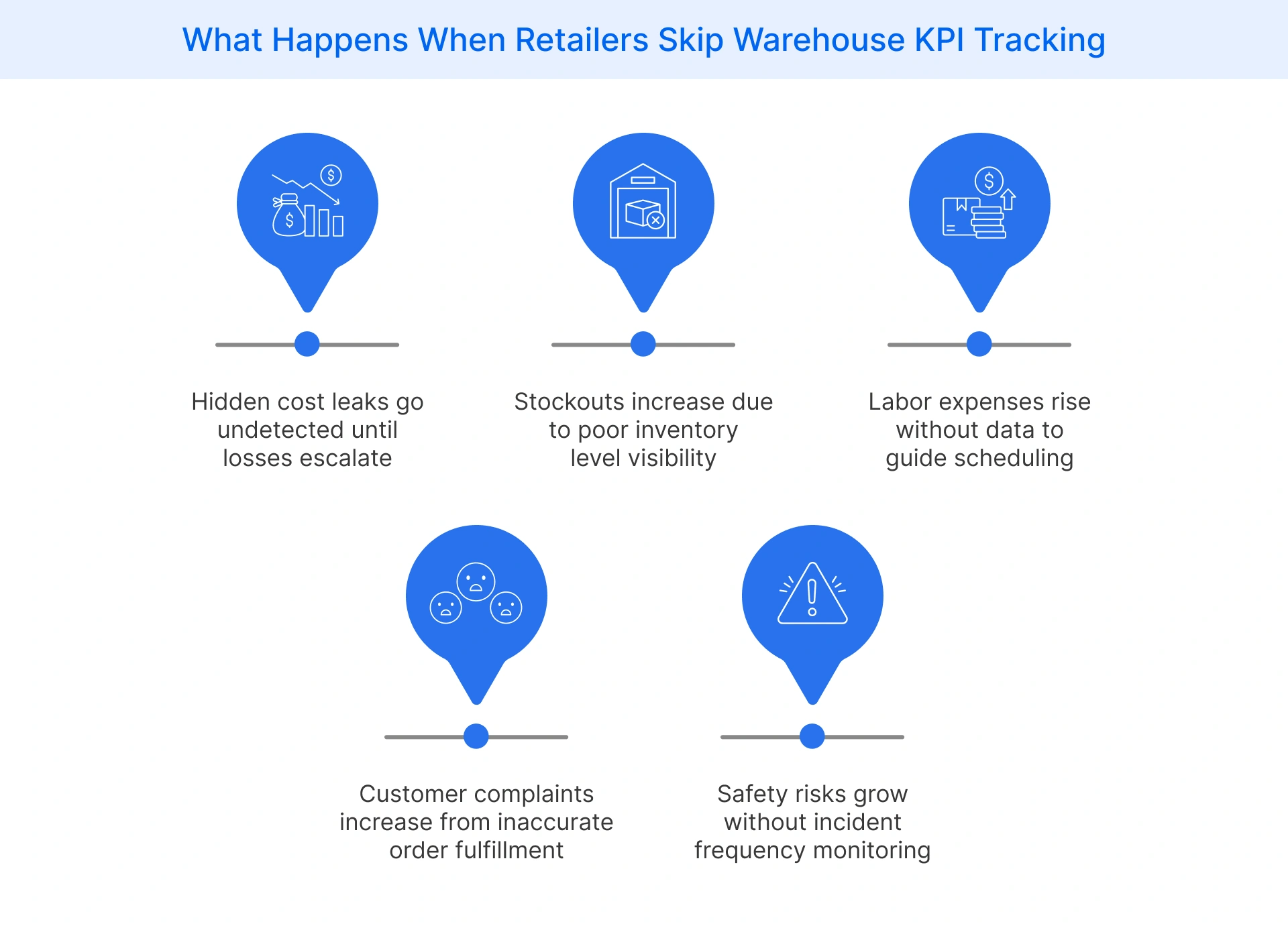
Retailers that operate without warehouse KPIs lose visibility into where operations are failing and make decisions based on guesswork rather than data.
- Hidden inefficiencies drain profits without visible warning signs until losses become severe enough to affect overall cash flow.
- Stockouts and overstocking occur repeatedly because stock levels lack the consistent data-driven management needed to prevent both scenarios.
- Labor costs spiral upward as managers cannot identify which processes are consuming excessive time and warehouse space.
- Customer satisfaction drops sharply due to delayed shipments and incorrect items being dispatched without any clear process accountability.
- Warehouse safety standards decline when managers lack clear data on incident frequency since the last accident date was recorded.
Optimize Your Warehouse Performance with Flipkart Commerce Cloud
Tracking warehouse metrics is critical for profitability in physical and online retail. Retailers must identify inefficiencies and act on them before warehouse performance problems affect their bottom line and customer satisfaction, with valuable insights as the foundation for every improvement.
Flipkart Commerce Cloud empowers retailers to achieve operational excellence with its warehouse management system, delivering real-time KPI tracking and intelligent analytics across the entire operation. The WMS provides the technology needed to monitor every aspect of warehouse operations and make data-driven decisions rather than relying on guesswork.
FCC's warehouse management system uses automated tracking for precise KPI measurement across inventory receiving and order picking. You can monitor performance trends, identify bottlenecks, and optimize labor allocation to achieve significant cost savings while improving order accuracy throughout the fulfillment process.
With FCC, you gain the tools to move from reactive problem-solving to proactive data-driven warehouse management. Request a demo today to see how our warehouse management system transforms raw operational data into measurable, long-term results.

FAQ
Most retailers benefit from tracking between 8 and 15 warehouse KPIs at one time. Starting with core metrics such as order accuracy and inventory accuracy helps teams focus improvements before expanding the number of indicators being monitored.
Inventory accuracy measures the match between inventory records and actual physical inventory on hand. Order accuracy measures whether the correct item was picked and delivered to the customer. Both metrics address different stages of the fulfillment process.
High-frequency metrics such as order cycle time and labor productivity should be reviewed daily or weekly. Inventory turnover and the inventory-to-sales ratio suit monthly review cycles, while annual assessments work well for evaluating longer-term trends in warehouse performance.
Yes. Small warehouses can begin tracking basic warehouse KPIs using spreadsheet tools and manual counts. Starting with order accuracy and return rate provides immediate useful insights. As volumes grow, a warehouse management system adds automation and reliable data.
Inventory turnover rate has one of the strongest direct impacts on profitability. Low turnover increases inventory carrying costs and ties up capital. Improving it frees cash flow and reduces the total cost of holding unsold stock over time.