
September 26, 2026
What Are Social Signals and Why Do They Matter in Digital Commerce?
Social signals are interactions with a brand or its content across social media platforms, including likes, shares, comments, mentions, views, and other forms of engagement.
Drishti - Digital Marketing, Manager

Table of Contents
- What Are Social Signals?
- What Are the Different Types of Social Signals?
- How Do Social Signals Work?
- How Do Social Signals Affect SEO?
- Why Are Social Signals Important for Retailers?
- How Can Retailers Measure Social Signals?
- How Can Retailers Improve Social Signals?
- What Are the Challenges of Relying on Social Signals?
- Conclusion
What Are Social Signals and Why Do They Matter in Digital Commerce?
Social media has become an important part of how consumers discover brands, interact with their content, and respond to products and marketing campaigns. Every interaction across social media platforms can give retailers a clearer view of how their content is reaching and resonating with their target audience.
These interactions can reveal useful patterns around audience engagement, brand visibility, content performance, and customer response. For retailers, paying attention to social signals can provide deeper insights into their online presence and help them understand which types of social media content generate meaningful engagement.
In this article, we discuss social signals, the different types retailers can monitor, how they work, their relationship with search engine optimization, and how retailers can measure and improve them.
What Are Social Signals?
Social signals are interactions and engagement generated around a brand or its content on social media platforms. They include actions such as likes, shares, comments, brand mentions, views, follows, and other ways users engage with social media content.
For retailers, these signals can provide useful insights into how audiences respond to their brand and content. For example, a high level of user engagement can indicate that a piece of content is attracting attention or resonating with its target audience, while brand mentions can show how frequently a retailer is being discussed across social platforms.
Taken together, social signals can serve as useful indicators of online visibility, content popularity, influence, and audience engagement. They give retailers another way to understand how their social media presence is performing and how customers are responding to the content they share.
What Are the Different Types of Social Signals?
Social signals can take different forms depending on how users interact with a brand and its content across social media platforms. Some of the most common types include:
- Likes and reactions: Show that users have noticed and responded to a piece of content. They can provide a quick indication of audience interest.
- Shares and reposts: Indicate that users consider content relevant or valuable enough to share with a broader audience, which can increase content visibility.
- Comments: Reflect more active user engagement and can give retailers insight into opinions, questions, and conversations around their content.
- Brand mentions and tags: Show when users are discussing or referencing a brand, helping retailers understand brand awareness and conversations happening around their online presence.
- Followers and subscribers: Indicate the size of the audience that has chosen to receive or follow a brand's social media content over time.
- Views: Show how often users have viewed content, particularly videos and other visual content, and can help retailers assess its reach.
- Clicks: Indicate when social media content encourages users to take a further action, such as visiting a website or product page.
- Reviews and ratings: Reflect customer opinions and experiences and can contribute to the social proof surrounding a retailer, product, or brand.
Each social signal provides a different view of how audiences interact with content. Looking at them together can help retailers better understand content reach, audience response, and overall social engagement rather than relying on a single engagement metric.
How Do Social Signals Work?
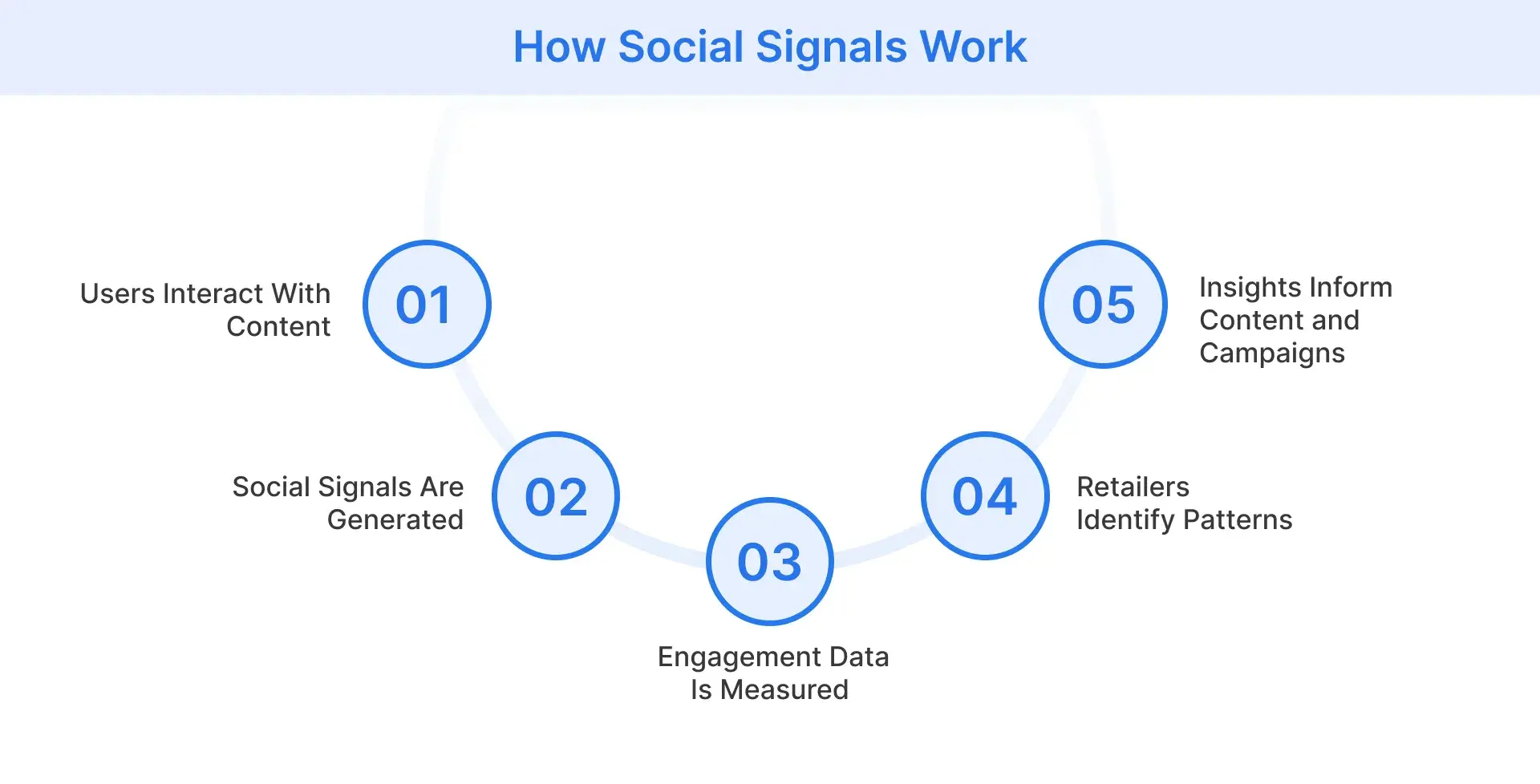
Social signals are generated whenever users interact with a retailer’s social profiles, posts, products, campaigns, or other digital content. These interactions create measurable engagement data that retailers can monitor to understand how audiences are responding to their online activity.
By looking at patterns in this data, retailers can identify which content attracts attention, generates stronger engagement, or reaches a wider audience. They can also see which interactions encourage users to take further action, such as clicking through to a website or engaging with a product or marketing campaign.
Over time, these insights can help retailers understand what resonates with their audience and make more informed decisions about future content and campaigns across digital channels.
How Do Social Signals Affect SEO?
Social signals can support search engine optimization, but their relationship with search rankings is largely indirect. Likes, shares, comments, and other forms of social engagement are not generally considered a confirmed direct Google ranking factor. This means that gaining more social interactions does not automatically improve a page’s organic search ranking.
At the same time, strong social activity can increase the visibility and distribution of relevant content. When content reaches a broader audience, it can generate more website traffic, encourage branded searches, and increase the likelihood of being discovered by people who may link to or share it elsewhere. These effects can extend the reach and lifespan of content and contribute to greater online visibility over time.
For retailers, social signals are therefore more useful as indicators of audience engagement and content performance than as a direct way to improve search rankings. They can complement an SEO strategy by helping retailers understand which content resonates with audiences, but they should not replace established SEO practices.
Why Are Social Signals Important for Retailers?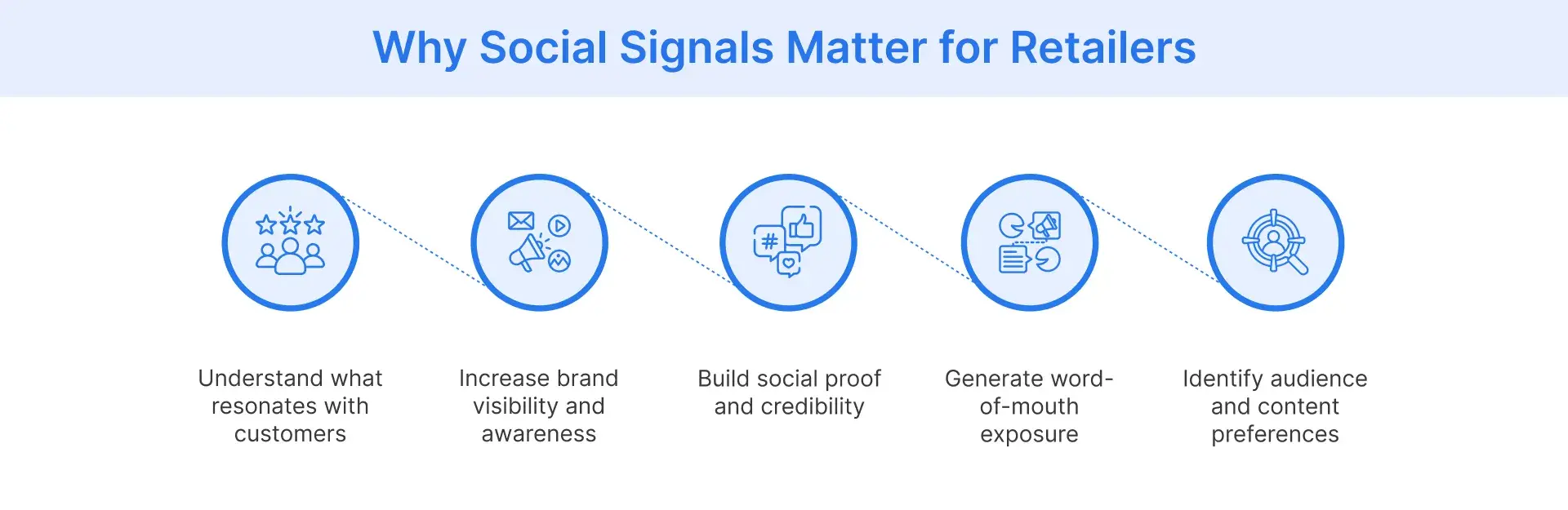
Social signals can help retailers understand how customers respond to their products, campaigns, and other brand content across social media. Patterns in these interactions can reveal customer interest, content preferences, and levels of engagement, giving retailers a clearer picture of what resonates with their audience.
Strong and authentic social engagement can also increase brand visibility and awareness as content is shared and discussed across social platforms. Positive reviews, ratings, mentions, and other customer interactions can contribute to social proof and credibility, while shares and conversations can generate word-of-mouth exposure and introduce a brand to a broader audience.
Social signals can also highlight opportunities for user-generated content and provide insights into audience preferences. By understanding these interactions, retailers can make more informed decisions about the content and campaigns they create and how they engage customers across digital commerce channels.
How Can Retailers Measure Social Signals?
Retailers can measure social signals using social media analytics and other analytics tools that track how audiences interact with their content. The most useful engagement metrics depend on the objective of the content or marketing campaign. Key metrics can include:
- Likes and reactions: Show the volume of immediate responses to social media content.
- Shares and comments: Help retailers assess how actively users are engaging with and distributing content.
- Mentions: Show how frequently a brand is being discussed or referenced across social media platforms.
- Follower growth: Tracks changes in the number of people choosing to follow a brand over time.
- Views and reach: Indicate how many times content is viewed and how widely it reaches an audience.
- Clicks and click-through rate (CTR): Show whether social content encourages users to take further action, such as visiting a website or product page.
- Response rate: Helps retailers understand how consistently interactions or customer enquiries receive a response.
These metrics should be considered in relation to the retailer’s goals rather than treated as equally important key performance indicators. Reach, for example, can provide insight into content visibility, while clicks and conversions can show whether user engagement is leading customers toward a desired action.
How Can Retailers Improve Social Signals?
Improving social signals starts with creating content that gives audiences a reason to interact. Rather than focusing only on increasing engagement numbers, retailers should aim to encourage genuine interactions that reflect real customer interest. Some practical ways to do this include:
- Create relevant, shareable content: Focus on content quality and topics that are useful, interesting, or relevant to the target audience, making users more likely to engage with or share the content.
- Maintain active social profiles: Posting consistently and keeping social profiles active gives audiences more opportunities to discover and interact with a retailer’s content.
- Respond to customers: Replying to comments, questions, and other interactions can encourage conversations and strengthen social engagement.
- Make content easy to share: Clear sharing options can make it easier for users to distribute relevant content to their own networks and extend its reach.
- Use collaborations where appropriate: Working with relevant creators, brands, or partners can introduce content to new audiences and create additional opportunities for genuine engagement.
Retailers should also use performance data to understand which content and interactions resonate most with their audiences. These insights can guide future content and marketing campaigns, helping retailers focus on approaches that generate meaningful engagement rather than simply chasing higher numbers.
What Are the Challenges of Relying on Social Signals?
Social signals can provide useful information about audience engagement, but high engagement numbers do not always reflect genuine customer interest or commercial performance. Metrics can be distorted by fake followers, purchased likes, bots, spam, and other forms of inauthentic engagement, making a brand appear more popular or influential than it actually is.
Relying too heavily on these numbers can therefore give retailers an incomplete picture of how audiences are responding to their content. Inauthentic engagement can also create credibility and reputational risks, particularly when customers question whether the interactions surrounding a brand are genuine.
Retailers should prioritize authentic interactions and evaluate social signals alongside other digital commerce and marketing metrics. Looking at social engagement in a broader context can help distinguish meaningful audience behaviour from numbers that may not translate into genuine customer interest or business results.
Conclusion
Social signals give retailers useful insight into how audiences interact with and respond to their content across social media. When viewed alongside broader digital commerce metrics, authentic engagement can help retailers better understand audience behaviour, content performance, and brand visibility.
The real value comes from turning these insights into action. Understanding what customers respond to can help retailers make more informed decisions about their content, campaigns, and the digital experiences they create for shoppers.
Flipkart Commerce Cloud helps retailers turn customer insights into more relevant digital commerce experiences and respond to changing customer behaviour. Book a demo and discover how FCC can help you create shopping experiences that better reflect what your customers want

FAQ
Social signals refer to the collective engagement metrics, such as likes, shares, comments, retweets, and pins, a brand receives across social media channels. These interactions reflect content popularity and customer trust, helping build broader social media visibility while demonstrating overall brand authority to target audiences and search engines alike.
Social signalling is the ongoing process where consumer interactions across social media sites demonstrate interest in a brand. By producing interactive content that encourages user participation, businesses strengthen their social media strategy, expand organic reach, and effectively drive traffic back to their e-commerce storefronts.
What is true about social signals is that while search engines do not treat them as a direct ranking factor, they significantly improve overall seo performance. Strong online interactions generate qualified referral traffic, extend content lifespan, and naturally create backlink opportunities that enhance long-term visibility within search engine results.
Retailers can measure social signals by tracking essential engagement rates, share volume, brand mentions, and customer referral traffic. Unified enterprise solutions like Flipkart Commerce Cloud help businesses leverage insights across multiple channels, giving merchants clear metrics to evaluate campaign performance and refine their digital growth strategies
Retailers can improve their social signals by publishing high-quality media, maintaining active social media profiles, and maintaining consistent social media engagement. Regularly sharing fresh product updates, responding to comments, and encouraging happy customers to share their purchases online helps build a growing, loyal customer base.
No, social media platforms do not contribute equally to social signals, as their overall impact varies based on user demographics, indexing policies, and content formats. Public networks like Twitter and Pinterest generate more indexable links and immediate visibility, whereas closed or visual platforms like Instagram drive higher engagement rates that indirectly boost brand reach and organic traffic.