
November 21, 2026
Marketing Campaign in Retail: Goals, Channels, and Results
A marketing campaign is a coordinated set of activities designed to achieve a specific business goal. In retail, marketing campaigns help businesses promote products, attract customers, and encourage purchases through channels such as social media, email, paid advertising, and in-store promotions.
Drishti, Manager - Digital Marketing

Table of Contents
- What Is a Marketing Campaign?
- What Are the Key Components of a Marketing Campaign?
- What Are the Different Types of Marketing Campaigns in Retail?
- What Are Some Examples of Marketing Campaigns in Retail?
- What Are the Benefits of Marketing Campaigns for Retailers?
- How Can Retailers Plan a Marketing Campaign?
- How Can Retailers Measure Marketing Campaign Performance?
- What Are the Common Challenges of Retail Marketing Campaigns?
- Conclusion
Marketing Campaign in Retail: Goals, Channels, and Results
A retailer launching a new product might promote it through social media, email marketing, paid advertising, and in-store displays. When these activities aren’t coordinated, customers may encounter inconsistent messages, offers, or product information across different channels.
Marketing campaigns help retailers organize these efforts around specific goals, such as building brand awareness, reaching potential customers, or encouraging purchases. Choosing the right marketing channels is important, but retailers also need to understand whether their campaigns deliver the intended results.
This article explains the key components and types of marketing campaigns, provides practical retail examples, and covers campaign planning, performance measurement, and common challenges.
What Is a Marketing Campaign?
A marketing campaign is a coordinated series of marketing activities designed to achieve a specific objective within a defined period. It targets a particular audience through selected channels and focuses on outcomes such as increasing product awareness, generating leads, or driving sales. Unlike a broader marketing strategy, which guides a business’s long-term marketing direction, a campaign has a specific goal and timeframe.
For example, a retailer could run a two-week back-to-school campaign targeting parents with bundled school supplies, limited-time offers, and in-store promotions. These activities work toward a shared sales objective, allowing the retailer to evaluate whether the campaign achieved its intended results.
What Are the Key Components of a Marketing Campaign?
An effective marketing campaign brings together several components that determine its direction, execution, and measurement. Each serves a specific purpose in keeping campaign activities aligned with business objectives.
The key components include:
- Campaign objectives: Clear, measurable goals that define what the business intends to achieve, such as increasing sales for a product category, attracting new customers, or improving brand awareness.
- Target audience: The customer segment a campaign aims to reach, identified through relevant characteristics such as shopping behavior, interests, needs, or location.
- Core message and offer: The main information communicated to customers, including the product’s value, promotional offer, or intended action. Consistent messaging helps customers understand what the campaign is promoting.
- Marketing channels: The platforms and touchpoints used to reach the target audience. Each channel should have a defined role in communicating the campaign message.
- Budget: The financial resources allocated to campaign activities, including advertising placements, creative assets, and other execution costs.
- Timeline: The campaign’s start and end dates, along with important milestones for coordinating promotional activities.
- Key performance indicators (KPIs): Metrics used to assess campaign performance against its objectives. Depending on the goal, these may include reach, website traffic, conversion rates, or sales.
Together, these components provide a framework for coordinating marketing efforts and evaluating campaign results. Their relative importance depends on the campaign’s purpose, audience, and available resources.
What Are the Different Types of Marketing Campaigns in Retail?
Retailers use different types of marketing campaigns depending on whether they want to introduce a product, attract new customers, increase sales, or encourage repeat purchases. Each type serves a particular business objective.
Common types of marketing campaigns include:
- Brand awareness campaigns: Introduce a retailer or brand to a wider audience and improve recognition among potential customers. For example, a retailer entering a new market might use local advertising to build awareness of its stores and products.
- Product launch campaigns: Generate interest in a new product or collection before or during its release. A beauty retailer might use product previews, demonstrations, and early-access offers to introduce a new skincare range.
- Sales promotion campaigns: Encourage purchases within a specified period through discounts, bundled offers, or other incentives. Retailers commonly use these campaigns during seasonal sales or to promote selected product categories.
- Customer acquisition campaigns: Attract shoppers who have not previously purchased from the business. For example, an online retailer might offer first-order discounts to encourage new customers to make their initial purchase.
- Customer retention campaigns: Encourage existing customers to continue purchasing from a retailer. These may include loyalty rewards, personalized offers, or campaigns designed to re-engage inactive customers.
Campaign types are defined by their objectives, not the marketing channels used to deliver them. Email marketing, social media, and paid advertising can support several campaign types, depending on the intended audience and outcome. A campaign may also serve multiple objectives, although identifying its primary goal helps guide its execution.
What Are Some Examples of Marketing Campaigns in Retail?
Retail marketing campaigns can take different forms depending on the products being promoted, the target audience, and the intended outcome. The following examples show how retailers can turn specific marketing goals into coordinated activities.
- Seasonal discount campaign: A homeware retailer wants to clear remaining outdoor furniture before the season ends. It targets shoppers interested in patio products through email offers, website banners, and in-store displays. Each channel promotes the same limited-time discounts, encouraging purchases before the clearance period ends.
- New product launch campaign: An electronics retailer introduces a new range of wireless headphones to customers interested in audio products. The campaign uses product demonstration videos, social media advertising, and dedicated product pages to highlight key features and direct interested shoppers toward a purchase.
- Customer loyalty campaign: A grocery retailer wants to encourage repeat purchases from existing customers. It targets loyalty program members with personalized offers based on previous purchases, using email marketing and app notifications to communicate available rewards and encourage another shopping visit.
Each example connects a defined business objective with a relevant audience and promotional activities. Retailers can assess the results against their campaign goals to understand which approaches were effective and inform future campaigns.
What Are the Benefits of Marketing Campaigns for Retailers?
Well-planned marketing campaigns can help retailers reach potential customers, promote their offerings, and support specific business goals. The benefits depend on the campaign’s objectives, target audience, and execution.
Key benefits include:
- Increased brand awareness: Marketing campaigns can introduce a retailer to new audiences and reinforce its brand identity among existing customers. Consistent messaging across relevant channels helps shoppers recognize and remember the brand.
- Greater product visibility: Campaigns can draw attention to new arrivals, selected product categories, or underperforming inventory. This gives retailers opportunities to highlight products that customers might otherwise overlook.
- Customer acquisition: Targeted campaigns help retailers reach potential customers whose needs and interests align with their offerings. Relevant messaging and incentives can encourage these shoppers to consider purchasing from the business.
- Increased website and store traffic: Advertising campaigns, search engine marketing, and other promotional activities can direct interested shoppers to ecommerce websites or physical stores, creating more opportunities for product discovery.
- Sales opportunities: Campaigns can encourage purchasing decisions by communicating product value, limited-time offers, or relevant promotions. Their effectiveness depends on customer demand, pricing, and the overall shopping experience.
- Customer retention: Campaigns aimed at existing customers can encourage repeat purchases through loyalty incentives, relevant product recommendations, and personalized communications.
These benefits are not guaranteed. Retailers need to consider their campaign objectives, available resources, and customer response when determining whether their marketing efforts have delivered meaningful business value.
How Can Retailers Plan a Marketing Campaign?
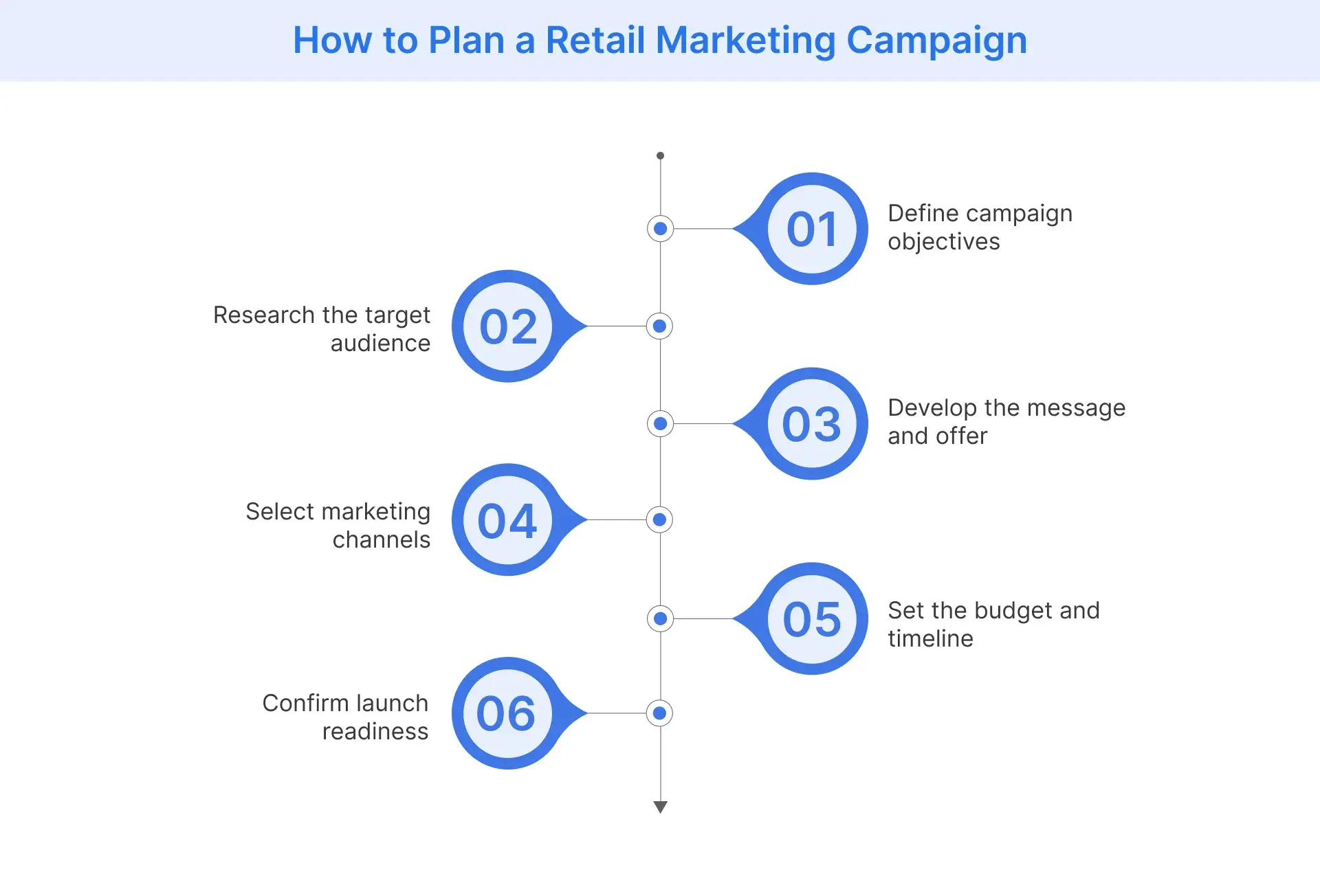
Planning a marketing campaign involves turning business objectives into coordinated activities that reach the intended audience. Retailers also need to ensure their products, promotional offers, and operational teams are prepared to support the campaign.
The following steps can guide the planning process:
- Define measurable campaign objectives. Identify the specific outcome the campaign should achieve, such as increasing sales within a product category or attracting first-time buyers. Set realistic targets and a timeframe for evaluating progress.
- Research the target audience. Use customer data, purchase patterns, and market research to understand who the campaign should reach. Identify relevant customer needs, shopping preferences, and purchasing behaviors to inform the campaign’s direction.
- Develop the campaign message and offer. Determine what customers should know about the products being promoted and why the offer is relevant to them. Establish clear messaging, promotional terms, and a call to action that encourages the intended response.
- Choose appropriate marketing channels. Select channels based on where the target audience is most likely to engage. Consider how social media, email campaigns, search advertising, and in-store communications can work together while maintaining consistent product information and offers.
- Set the budget and campaign timeline. Allocate resources across advertising, content production, and promotional activities. Establish launch dates, deadlines for creative assets, and responsibilities for each stage of execution.
- Confirm operational readiness before launch. Check product availability, promotional pricing, discount codes, and relevant website or checkout functionality. Coordinate with sales, merchandising, and fulfillment teams to ensure the business can deliver what the campaign promises.
Once the campaign launches, retailers should monitor its performance and address operational issues as they arise. The results can inform adjustments during the campaign and improvements to future marketing efforts.
How Can Retailers Measure Marketing Campaign Performance?
Retailers measure marketing campaign performance by comparing results against the objectives and targets established before launch. The most relevant key performance indicators (KPIs) depend on whether the campaign aims to increase awareness, attract customers, generate purchases, or encourage repeat business.
Common marketing campaign metrics include:
- Reach: The number of unique people exposed to campaign content. It helps retailers assess how widely their message was distributed.
- Click-through rate (CTR): The percentage of impressions that result in clicks. It indicates how effectively an advertisement or promotional message encourages people to take the next step.
- Conversion rate: The percentage of visitors or other defined interactions that result in a desired action, such as completing a purchase. Retailers should use a consistent definition when comparing campaign results.
- Customer acquisition cost (CAC): The average cost of acquiring a new customer, calculated by dividing relevant acquisition spending by the number of new customers acquired.
- Return on ad spend (ROAS): The revenue attributed to advertising divided by advertising expenditure. It helps evaluate advertising efficiency but does not account for all business costs or measure profitability directly.
- Repeat purchase rate: The percentage of customers who make more than one purchase within a specified period. It is useful for assessing campaigns focused on customer retention.
Retailers should evaluate these metrics in relation to campaign goals rather than treating every KPI as equally important. For example, reach may be more relevant to an awareness campaign, while conversion rate and ROAS provide useful information about a campaign intended to generate sales.
Performance data should also be reviewed across relevant marketing channels, with attention to differences in attribution and reporting methods. Comparing results against initial targets can help retailers identify ineffective spending, refine campaign messaging, and make better-informed decisions for future campaigns.
What Are the Common Challenges of Retail Marketing Campaigns?
Retail marketing campaigns can face challenges that affect customer engagement, campaign performance, and sales. Some problems arise from marketing decisions, while others involve inventory, fulfillment, or difficulties tracking results.
Common challenges include:
- Poor audience targeting: Campaigns may reach consumers who have little interest in the products being promoted. This can reduce engagement and waste advertising spend. Retailers need reliable customer insights to identify relevant audience segments.
- Budget limitations: Limited marketing budgets can restrict campaign reach, creative production, and testing. Spreading resources across too many channels may also make it difficult to achieve meaningful results.
- Inconsistent messaging: Conflicting product information, promotional offers, or discount terms across marketing channels can confuse customers and weaken trust. Retailers should ensure that campaign messages reflect the offers customers actually receive.
- Poor channel coordination: Differences in promotional timing or execution can disrupt the customer journey. For example, an advertisement may promote an offer before the corresponding landing page has been updated.
- Inventory shortages: A successful promotion can generate demand that exceeds available stock. This may lead to canceled orders, delayed fulfillment, and customer dissatisfaction, particularly during seasonal campaigns.
- Difficulty measuring results: Incomplete tracking, inconsistent reporting, and attribution challenges can make it difficult to determine which activities contributed to sales. Retailers should assess the reliability of their performance data before drawing conclusions.
Addressing these challenges requires coordination between marketing and operational teams, accurate customer and inventory data, and consistent reporting throughout the campaign.
Conclusion
Successful retail marketing campaigns require clear objectives, an understanding of the target audience, and coordination between marketing activities and business operations. Their value ultimately depends on whether they deliver results that support the retailer’s goals.
Key takeaways include:
- Set measurable objectives. Define what the campaign should achieve before selecting promotional activities.
- Coordinate campaign execution. Align marketing channels, promotional offers, and inventory availability to deliver a consistent customer experience.
- Use performance data. Evaluate relevant KPIs to identify what worked, address weaknesses, and improve future campaigns.
For retailers operating retail media networks, Flipkart Commerce Cloud’s Retail Media platform supports self-service advertising campaign management, audience targeting, and performance reporting. Book a demo to see how advertisers can manage campaigns, reach relevant audiences, and evaluate results using the platform.

FAQ
Ten widely recognized marketing campaigns include Nike’s “Just Do It,” Apple’s “Think Different,” Coca-Cola’s “Share a Coke,” Dove’s “Campaign for Real Beauty,” Old Spice’s “The Man Your Man Could Smell Like,” Spotify Wrapped, Airbnb’s “We Accept,” Always’ “#LikeAGirl,” Absolut’s “Absolut Perfection,” and Snickers’ “You’re Not You When You’re Hungry.” These campaigns are notable for their creative approaches and cultural impact, rather than representing a definitive ranking.
A marketing campaign plan should document the campaign’s SMART goals, defined audience, core message, and campaign strategy. It should also specify the marketing materials, key channels, budget, timeline, and responsibilities of the marketing team. Include measurable KPIs and reporting arrangements so the team can evaluate campaign results against its original objectives.
A marketing campaign coordinates activities such as content marketing, social media marketing, email marketing, and direct mail to achieve a business objective. An advertising campaign focuses on promotional messages delivered through paid placements, such as display ads or sponsored social media content. Both can support brand awareness, customer acquisition, or sales.
The duration of a retail marketing campaign depends on its objectives, audience, budget, and promotional period. Flash sales may run for a few days, while product launches and seasonal campaigns can extend over several weeks. Longer brand awareness initiatives may require months of sustained activity to influence customer recognition and purchasing behavior.
A retailer’s campaign budget should reflect its objectives, target audience, expected costs, and potential return. Expenses may include advertising, creative production, promotional incentives, and marketing technology. Retailers can use customer acquisition cost and customer lifetime value to assess spending, then adjust their media mix based on performance and profitability.