
May 6, 2026
All About Online to Offline Commerce (O2O Commerce)
O2O commerce, or online-to-offline commerce, is a retail strategy that uses digital channels to attract customers and convert their interest into in-store purchases or physical interactions. It connects a brand's online presence with its offline channels to create a unified shopping experience across touchpoints.
Drishti, Manager - Digital Marketing

Table of Contents
- What Is O2O Commerce?
- How Does O2O Commerce Work?
- What Are the Main Types of O2O Commerce?
- What Are Some O2O Commerce Examples?
- What Are the Benefits of O2O Commerce?
- O2O Commerce vs. Ecommerce: What Is the Difference?
- How Can Retailers Implement O2O Commerce?
- Conclusion
All About Online to Offline Commerce (O2O Commerce)
O2O commerce has become a defining retail strategy as traditional retailers seek to connect their online presence with physical store locations in measurable ways. It gives businesses a structured way to turn digital discovery into real-life retail transactions across channels.
The model has reshaped how retail sales are planned and measured in markets such as the United States and across Asia. Small businesses and large omnichannel retailers alike now treat O2O commerce as a core business strategy rather than an optional add-on.
TL;DR
- O2O commerce helps retailers convert online research into foot traffic at physical store locations.
- The strategy uses digital tools to guide online customers toward completing purchases offline.
- Retailers gain a competitive advantage by connecting digital engagement with in-store buying journeys.
- O2O commerce creates measurable results by linking online campaigns directly to offline purchases and store visits.
What Is O2O Commerce?
O2O commerce is a retail strategy that uses online channels to attract potential customers and convert their interest into a physical in-store purchase or visit. Retailers deploy digital ads, mobile app promotions and email campaigns to pull shoppers from online platforms into physical store environments.
The model works in both directions: online activity drives offline commerce and offline interactions push customers toward digital channels for further engagement. A shopper who visits a store location may later receive personalized follow-up through a mobile app based on their in-store purchase history.
Retailers use digital tools such as QR codes, digital coupons and location-based offers to bridge the gap between their online store and physical channels. This approach makes the buying journey more connected and improves the overall customer experience across every touchpoint.
How Does O2O Commerce Work?
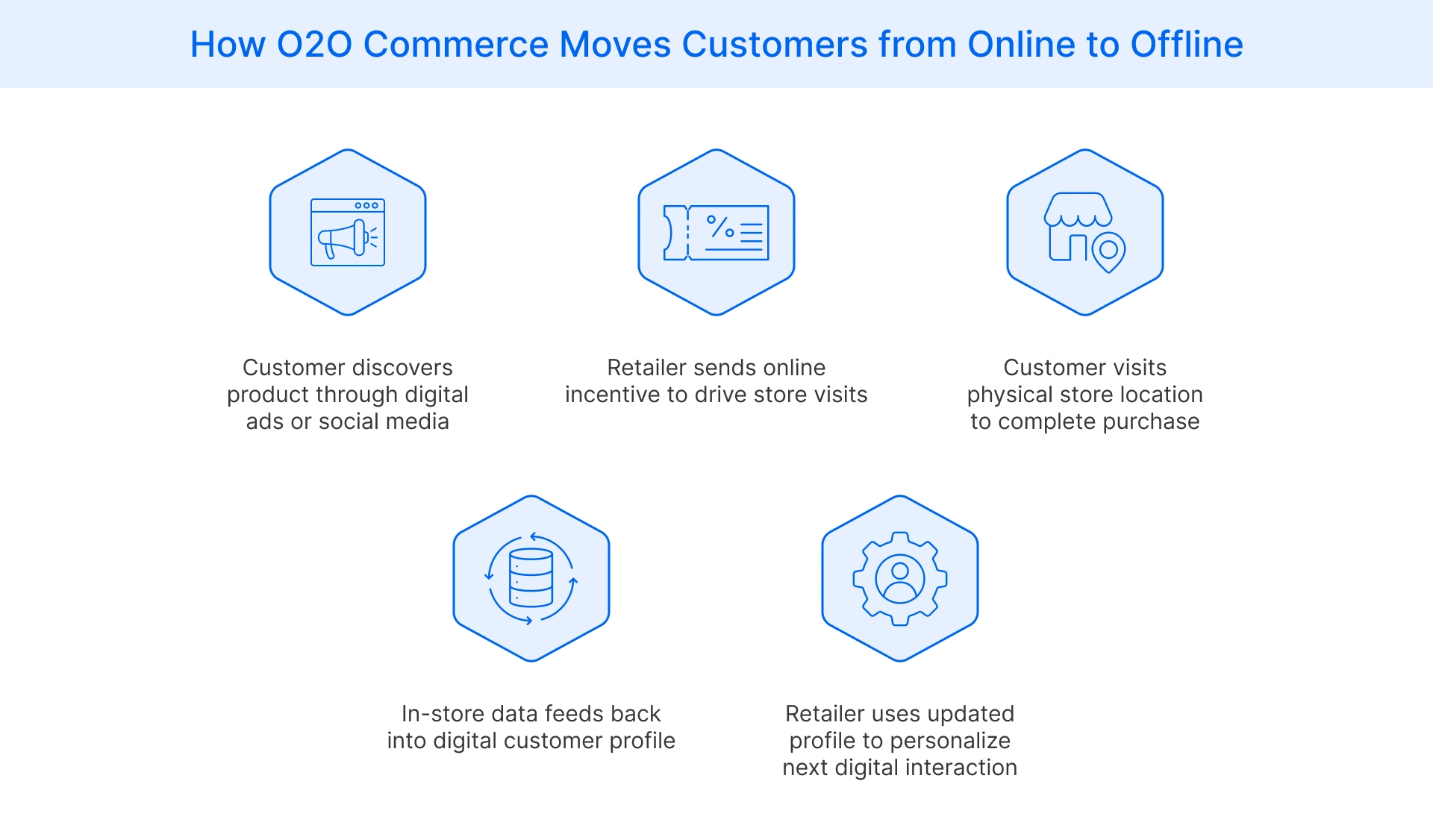
O2O commerce follows a sequence of digital and physical interactions that moves customers from online discovery toward an in-store transaction.
- Digital Discovery: A customer discovers a product or promotion through a digital channel such as a social media post or mobile app advertisement. This moment of digital discovery marks the beginning of the O2O commerce journey for most online shoppers engaging with a retailer's brand.
- Online Incentive: The retailer uses online incentives, such as exclusive in-store discounts or curbside pickup, to encourage customers to visit the physical store. These offers provide a clear reason for online customers to bridge the gap between digital engagement and an in-store purchase.
- Offline Transaction: The customer completes the transaction or experience in person at the physical store, a pickup point or a brand-operated physical location. This offline commerce moment delivers instant gratification that a purely digital shopping experience cannot replicate for potential customers who want immediate access.
- Data Feedback Loop: Data from the offline interaction feeds back into the retailer's digital systems, enriching purchase history and improving future targeting for that customer. This continuous feedback loop makes each subsequent O2O commerce interaction more relevant and personalized across both online and offline channels.
What Are the Main Types of O2O Commerce?
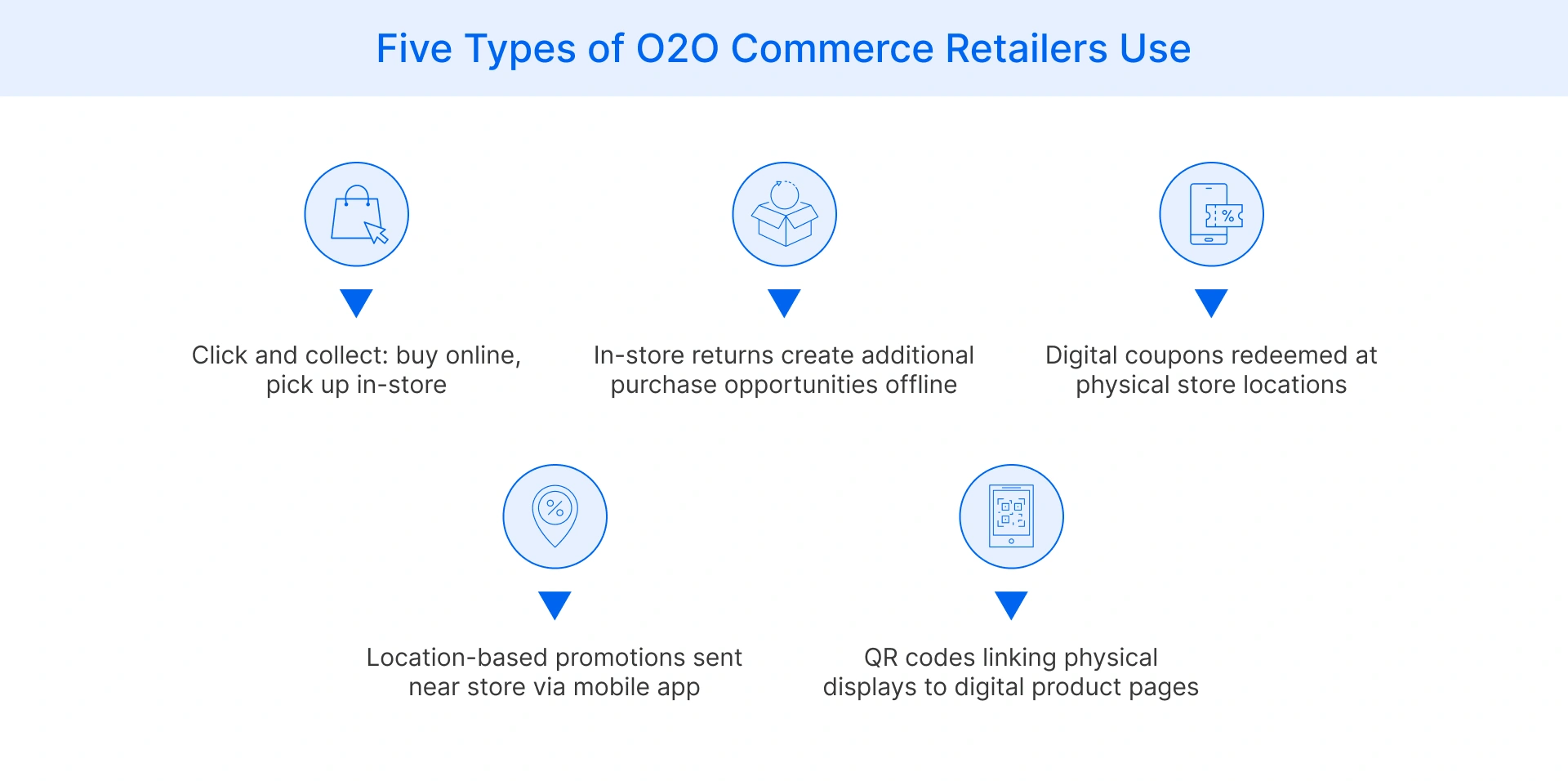
O2O commerce can take various forms depending on how retailers connect their digital tools with physical store locations and offline channels.
-
Click and Collect: Customers purchase on an online store and pick up their order at a physical store, combining digital convenience with immediate product access.
-
Example: A shopper orders electronics online and collects from a nearby store within two hours.
-
In-Store Returns for Online Orders: Customers return online orders at a physical location, creating an additional touchpoint that frequently leads to further in-store purchases and additional purchases.
-
Example: A shopper returning a jacket online discovers a new collection during the in-store visit.
-
Digital Coupons and Vouchers: Retailers distribute promotional codes through online channels that customers redeem at physical store locations, directly converting digital engagement into measurable offline commerce.
-
Example: A beauty retailer sends a 20% off coupon via mobile app, redeemable at mortar stores only.
-
Location-Based Promotions: Retailers send targeted offers to online customers near a store location using geofencing and mobile app notifications to drive immediate store visits.
-
Example: A zip code-triggered push notification offers a same-day discount to shoppers within 2 miles of a store.
-
QR Code Integration: Physical store displays include QR codes that direct shoppers to product pages, reviews or loyalty programs directly on their mobile devices.
-
Example: A QR code on a shelf tag links to video demos and customer ratings for that product.
What Are Some O2O Commerce Examples?
O2O commerce operates across multiple retail categories. Here are some prominent examples:
- Grocery Click and Collect: A supermarket allows customers to order groceries through its online store and pick them up curbside. It helps with maintaining a physical touchpoint without requiring a full in-store visit. This model reduces time pressure on store associates while keeping offline channels active for online shoppers.
- Food Delivery Platforms: Apps such as DoorDash and UberEats connect online customers with local restaurant partners who fulfill online orders through a physical kitchen and home delivery operation. The physical experience of food preparation and the digital discovery of the order represent a clear O2O commerce model in action.
- Fashion Try-Before-You-Buy: Apparel brands allow customers to reserve items through a mobile app and try them in physical store locations before committing to a purchase. This approach reduces return rates, improves the shopping experience and generates additional purchases during the in-store visit from digital interactions.
What Are the Benefits of O2O Commerce?
O2O commerce delivers measurable advantages for retailers, connecting their digital and physical channels into a unified business strategy.
- Higher Foot Traffic: Online campaigns and digital ads drive potential customers to physical store locations, increasing store visits without proportionally raising acquisition costs. Retailers that run targeted email campaigns and location-based promotions consistently see stronger store traffic from their existing online customer base.
- Improved Customer Data: Connecting online purchase history with offline transaction data gives retailers a better picture of the customer journey across all channels. This unified data enables accurate omnichannel marketing decisions and reduces reliance on assumptions about offline customer behavior.
- Reduced Cart Abandonment: Click-and-collect and curbside pickup options give online shoppers an alternative to home delivery, removing a common barrier to completing online orders. Offering flexible offline channels to fulfill online orders increases the overall conversion rate across a retailer's digital platforms.
- Stronger Customer Loyalty: Customers who interact with a brand across online and offline channels exhibit higher retention rates and greater lifetime value. Omnichannel retail experiences that blend digital engagement with physical experience create deeper brand connections than single-channel approaches alone.
- Increased Average Order Value: Customers who visit a store location to pick up an online order often make additional purchases during that visit. This behavior makes O2O commerce a great way for retailers to grow basket sizes beyond what online sales alone typically generate.
O2O Commerce vs. Ecommerce: What Is the Difference?
O2O commerce and ecommerce both rely on digital channels to engage customers, but they differ significantly in how and where transactions are completed. Ecommerce keeps the entire customer journey online, from discovery to delivery. O2O commerce uses digital interactions as a bridge to physical store visits and offline purchases, making the physical location central to the model.
|
Basis of Difference |
O2O Commerce |
Ecommerce |
|
Channel |
Combines online and offline touchpoints |
Operates entirely through digital channels |
|
Transaction Completion |
Frequently completed or fulfilled in-store |
Completed and fulfilled online |
|
Customer Interaction |
Includes a physical in-person component |
No physical interaction required |
|
Foot Traffic Goal |
Actively drives customers to physical locations |
Drives traffic to websites or apps only |
|
Data Collection |
Captures online and offline behavioral data |
Captures digital behavioral data only |
How Can Retailers Implement O2O Commerce?
Retailers can implement O2O commerce through the following steps, which connect digital tools to physical store operations.
- Step 1: Unify Customer Data: Connect digital and in-store customer data into a single profile to enable hyper-personalization and targeting across all channels.
- Step 2: Enable Click and Collect: Set up an online-to-in-store pickup workflow that gives online shoppers a reliable offline fulfillment option at nearby store locations.
- Step 3: Deploy Location-Based Promotions: Use geofencing and mobile app notifications to send relevant offers to potential customers near physical store locations in real time.
- Step 4: Sync Inventory in Real Time: Integrate online and offline inventory systems to ensure accurate product availability across all store locations and digital channels simultaneously.
- Step 5: Measure Cross-Channel Conversion: Track store visit rates, QR code scans and in-store conversion from online sources to assess O2O commerce performance accurately.

Conclusion
Connecting online and offline channels into a single measurable experience is the central challenge of O2O commerce for retailers today. Doing this well requires unified customer data, synchronized inventory and targeted digital marketing that drives real store traffic and offline purchases.
FCC's Omnichannel CRM unifies customer data from digital and physical touchpoints into a single profile, enabling consistent personalization across every channel. Retailers can use deep segmentation and automated email campaigns to push targeted promotions that drive store visits from online audiences at scale.
FCC's Order Management System keeps inventory synchronized across online and physical store locations in real time, ensuring click-and-collect and in-store fulfillment workflows run without errors. Our Promotion Management tools convert digital engagement into offline purchases through targeted vouchers and location-based offers.
Book a demo to see how FCC powers connected O2O commerce for retailers at scale.

FAQ
O2O in commerce refers to the online-to-offline model where retailers use digital channels to attract customers and direct them toward physical store visits and in-store purchases. The strategy bridges digital discovery with offline commerce to create a connected buying journey. It is widely used across grocery, fashion and food delivery retail categories.
O2O stands for online-to-offline, describing a retail business model that connects digital engagement with physical store transactions. Some practitioners also use it to mean offline-to-online, where in-store interactions push customers toward digital channels for further engagement. Both directions are active components of a complete O2O commerce strategy.
O2O commerce is expected to grow as omnichannel retail becomes the standard expectation among online shoppers in markets across the United States and Asia. Advances in mobile app personalization, real-time inventory visibility and location-based marketing will make O2O strategies more precise and cost-effective. Small businesses will increasingly adopt the model as digital tools become more accessible.
O2O commerce applies across multiple sectors, including food and beverage, healthcare, automotive services, and financial services alongside traditional retail. Any business with both an online presence and a physical location can benefit from an O2O business strategy. The model is particularly effective where customers value instant gratification or require an in-person experience before purchasing.
O2O marketing uses digital ads, email campaigns, social media and mobile app promotions to attract online customers and drive them toward offline store visits. Retailers track which digital interactions lead to physical store conversions using QR codes, coupon redemptions and store visit data. This approach links digital marketing spend directly to measurable offline commerce outcomes.