
April 29, 2026
Recommended Retail Price (RRP): Meaning, Calculation, and Retail Use
Recommended Retail Price (RRP) is the price a manufacturer suggests that retailers charge end customers for a specific product across all sales channels. It serves as a pricing reference point throughout the supply chain, helping maintain consistent product value perception across different stores and markets.
Drishti, Manager - Digital Marketing

Table of Contents
- What Is Recommended Retail Price (RRP)?
- What Is the Difference Between RRP and Retail Price?
- How Is Recommended Retail Price (RRP) Calculated?
- Why Does RRP Matter in Retail Pricing Strategy?
- How Should Retailers Use RRP When Setting Prices?
- How Does RRP Differ from Minimum Advertised Price (MAP)?
- What Factors Affect the Recommended Retail Price?
- Conclusion
Recommended Retail Price (RRP): Meaning, Calculation, and Retail Use
Recommended Retail Price (RRP) gives manufacturers and retailers a common reference point for pricing products across stores, marketplaces, and other sales channels. While retailers are generally free to set their own selling prices, RRP can influence how products are positioned, discounted, and compared in the market. This article explains what RRP means, how it is calculated, how it differs from the actual retail price and MAP, and how retailers can use it when setting prices.
What is Recommended Retail Price (RRP)?
Recommended Retail Price (RRP) is the price a manufacturer or supplier recommends that retailers charge customers for a product. It serves as a reference price rather than a mandatory selling price, so retailers can generally sell above or below the RRP depending on their pricing strategy, costs, and market conditions.
RRP is also referred to as Suggested Retail Price (SRP) or Manufacturer’s Suggested Retail Price (MSRP) in some markets. In retail, the RRP gives sellers a common benchmark for positioning products, planning discounts, and shaping their broader retail pricing strategy.
What Is the Difference Between RRP and Retail Price?
Recommended Retail Price (RRP) is the price a manufacturer or supplier recommends for a product, while the retail price is the amount a retailer actually charges the customer.
A retailer may sell at, above, or below the RRP depending on costs, competitor pricing, demand, inventory levels, and promotional plans.
|
Recommended Retail Price (RRP) vs. Retail Price |
||
|---|---|---|
|
Criteria |
Recommended Retail Price (RRP) |
Retail Price |
|
What it means |
Suggested selling price for a product |
Actual price charged to the customer |
|
Who sets it |
Manufacturer or supplier |
Retailer |
|
Purpose |
Provides a pricing reference or benchmark |
Determines what the customer actually pays |
|
Can it differ from RRP? |
Serves as the reference price |
May be equal to, higher than, or lower than RRP |
How Is Recommended Retail Price (RRP) Calculated?
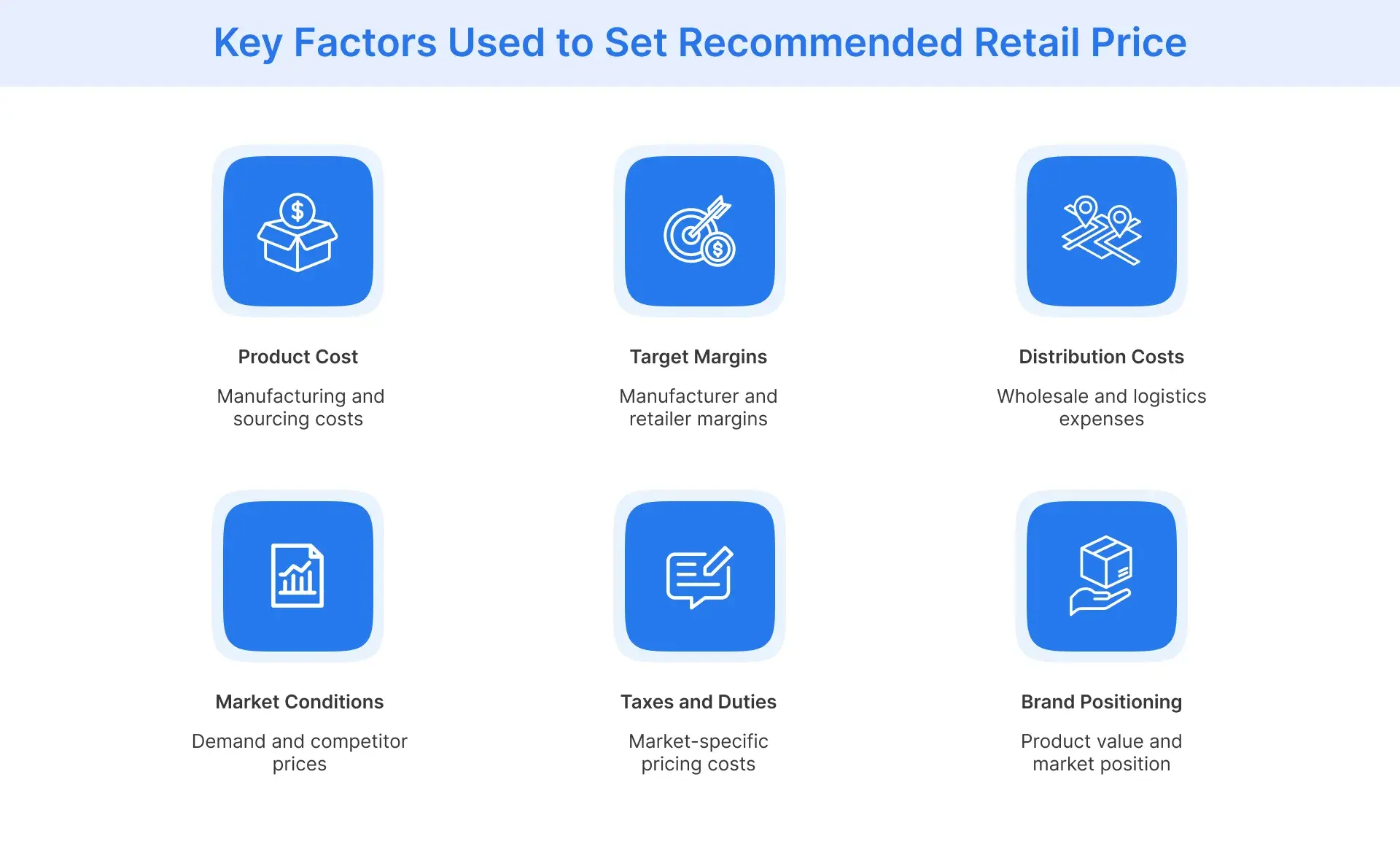
There is no single universal formula for calculating Recommended Retail Price. Manufacturers typically consider the product’s cost, expected margins across the supply chain, retailer margin requirements, taxes, market demand, competitor prices, and the product’s intended market position.
One common method is to work backward from the retailer’s target gross margin:
RRP = Wholesale Price ÷ (1 − Target Retail Margin)
For example, if a retailer buys a product for $70 and the target retail margin is 30%:
RRP = $70 ÷ (1 − 0.30) = $100
The manufacturer may then adjust the recommended price based on competitor pricing, consumer demand, taxes, distribution costs, and brand positioning. Because RRP is generally a recommendation rather than a mandatory selling price, the retailer may ultimately charge more or less than this figure.
Why Does RRP Matter in Retail Pricing Strategy?
Recommended Retail Price gives manufacturers and retailers a common pricing reference that can support product positioning, promotional planning, and price comparisons across sales channels.
- Price Consistency Across Channels: RRP provides a common benchmark for retailers selling the same product across stores, marketplaces, and other channels. Retailers can still set their own prices, but the reference point makes large price differences easier to identify and manage.
- Brand Positioning: Manufacturers can use RRP to communicate the intended market position and perceived value of a product. Consistent reference pricing can also help retailers understand whether a product is positioned as premium, mid-market, or value-focused.
- Promotional Planning: Retailers can compare promotional or sale prices against RRP when planning discounts. This gives teams a recognizable reference point for evaluating the size of a discount while still considering margins, demand, and competitor prices.
- Shopper Price Comparison: RRP can help shoppers understand how the price offered by a retailer compares with the manufacturer’s recommended price, particularly when evaluating discounts or promotions.
How Should Retailers Use RRP When Setting Prices?
Retailers should use Recommended Retail Price as a benchmark rather than a fixed selling price. The final retail price should also reflect the retailer’s costs, target margins, competitor prices, demand, inventory levels, and promotional strategy.
-
Review competitor prices: Compare how other retailers are pricing the same or similar products against the RRP to understand the current market range.
-
Calculate costs and target margins: Account for landed costs such as purchasing, freight, storage, and handling before deciding how far the selling price can move above or below RRP.
-
Consider brand positioning: A retailer may price close to RRP to maintain the product’s intended positioning or adjust the price when its customer and market strategy supports doing so.
-
Plan for promotions: Retailers can use RRP as a reference when setting sale prices and measuring the size of a discount, while ensuring promotions still meet margin requirements.
-
Monitor and adjust prices: Use competitive intelligence, sales performance, demand, and inventory data to review whether the current selling price remains appropriate as market conditions change.
How Does RRP Differ from Minimum Advertised Price (MAP)?
Recommended Retail Price (RRP) is the price a manufacturer recommends that retailers charge customers, while Minimum Advertised Price (MAP) sets the lowest price a retailer may publicly advertise for a product under an applicable MAP policy.
The key difference is what each price controls. RRP serves as a recommended benchmark for the final selling price, whereas MAP applies to the advertised price shown in listings, ads, and promotions. Retailers can generally sell above or below RRP, while advertising below MAP may violate the terms of a manufacturer’s MAP policy.
|
Recommended Retail Price (RRP) vs. Minimum Advertised Price (MAP) |
||
|---|---|---|
|
RRP |
MAP |
|
|
Meaning |
Manufacturer-recommended selling price |
Minimum price a retailer may publicly advertise under a MAP policy |
|
Applies to |
Final selling price |
Advertised price |
|
Flexibility |
Retailers can generally price above or below RRP |
Advertised prices must follow the applicable MAP policy |
|
Purpose |
Provides a pricing benchmark and supports consistent product positioning |
Helps manufacturers manage advertised pricing across resellers |
Caption: Recommended Retail Price (RRP) vs Minimum Advertised Price (MAP)
What Factors Affect the Recommended Retail Price?
Several internal and external factors can influence the Recommended Retail Price a manufacturer sets. These factors help determine whether the suggested price is commercially viable, competitive, and aligned with the product’s intended market position.
External Factors
- Competitive Market Conditions: Manufacturers consider the prices of comparable products when setting RRP. Strong competition may limit how high the recommended price can reasonably be, while less direct competition may allow greater pricing flexibility.
- Consumer Purchasing Power: Income levels and price sensitivity can influence how a product is positioned across different markets. Manufacturers may adjust recommended prices when customer willingness or ability to pay differs significantly by region.
- Taxes and Duties: VAT, import duties, and other taxes can increase the cost of bringing a product to market and may affect the recommended price, particularly across countries with different tax structures.
- Supply Chain Structure: Products moving through distributors, wholesalers, and other intermediaries may accumulate additional costs and margin requirements before reaching retailers. A shorter supply chain can reduce some of these pricing pressures.
Internal Factors
- Product Cost: Manufacturing, sourcing, packaging, and other product-related costs help establish the base from which a manufacturer determines a viable RRP.
- Business Objectives: Pricing may vary depending on whether the manufacturer is prioritizing market penetration, profitability, premium positioning, or volume growth.
- Product Life Cycle: Manufacturers may revise RRP as a product moves from launch to maturity. New products may be positioned differently from established products as demand, competition, and costs change.
- Brand Positioning: The intended market position of the product also matters. Premium brands may recommend higher prices to support their positioning, while value-focused brands may set a lower RRP to remain accessible to their target customers.
Conclusion
Recommended Retail Price gives manufacturers and retailers a shared pricing benchmark while allowing retailers to respond to changing costs, demand, competition, and market conditions.
- RRP is a recommended price, not necessarily the final price a retailer charges.
- Retailers can price above or below RRP based on their costs, margins, and market conditions.
- RRP can support product positioning, promotional planning, and price comparisons across channels.
- Effective pricing decisions still require visibility into competitor prices, demand, and inventory.
FCC’s Competitive Intelligence solution helps retailers track competitor prices across retail channels and understand how their pricing compares with the wider market.
Our Dynamic Pricing software automates price adjustments using signals such as demand, inventory levels, and competitor movements. FCC Pricing Optimizer uses ML-powered recommendations to help retailers make more informed pricing decisions at scale.
Book a demo to see how FCC can help you build a smarter, more responsive retail pricing strategy.

FAQ
RRP, or Recommended Retail Price, is a manufacturer’s suggested selling price and serves as a pricing benchmark. MRP, or Maximum Retail Price, is a legal price ceiling in markets where MRP rules apply, such as India. Retailers may sell below MRP but cannot exceed it where those rules apply.
RRP is often used as a product’s list price or reference price, but it is not necessarily the final price a shopper pays. Different retailers may sell at RRP, offer a lower price, or set another product price based on promotions, market demand, competitive pricing, and profit margins.
In many markets, yes. Different sellers can price products above RRP because it is generally a recommendation rather than a mandatory ceiling. Retailers should still consider local pricing laws, supplier agreements, market demand, and brand reputation before setting a selling price above the recommended retail price.
RRP and SRP both describe a manufacturer's recommended price for a product without legally binding retailers to that figure. The two pricing terms are functionally identical and the terminology simply varies by region and industry convention. Both serve as a reference point for consistent retail pricing across different stores and online retailers.