
April 29, 2026
Yield Management Pricing Strategy
Yield management pricing is a variable pricing strategy that adjusts prices based on customer demand to maximize revenue from fixed or perishable inventory. The approach helps businesses sell the right product to the right customer at the right price and at the right time.
Drishti, Manager - Digital Marketing

Table of Contents
- What Is Yield Management Pricing?
- How Does Yield Management Pricing Work?
- How Do You Calculate Yield Management Pricing?
- What Industries Use Yield Management Pricing?
- What Are the Benefits and Challenges of Yield Management Pricing?
- What Is the Difference Between Yield Management and Revenue Management?
- How Does Yield Management Enable Smart Inventory Utilization?
- Maximize Revenue with Flipkart Commerce Cloud Pricing Solutions
Yield Management Pricing Strategy
Yield management pricing strategy gives businesses a structured way to respond to demand fluctuations and maximize revenue from a fixed inventory base. Retailers, airlines and hospitality businesses rely on this approach to capture the highest possible value from every available unit.
Robert Crandall, former CEO of American Airlines, developed the foundational principles of yield management pricing in the airline industry. Since then, the strategy has expanded across hotel revenue management, retail and ecommerce sectors worldwide.
- Yield management pricing uses demand patterns and historical data to determine the most profitable selling price.
- The strategy adjusts prices in real time as market conditions and demand periods shift.
- Effective yield management relies on customer segmentation to serve different prices to different segments.
- Retailers apply yield management strategies to manage perishable inventory and capture revenue during peak times.
What Is Yield Management Pricing?
Yield management pricing strategy adjusts prices based on customer demand to maximize revenue from fixed or perishable inventory. It treats available inventory as a time-sensitive asset, with the selling price reflecting current demand rather than a fixed rate.
The strategy works by analyzing demand patterns, market conditions and consumer behavior to set optimal prices at each point in time. Businesses apply different prices to the same product or service depending on booking patterns, demand forecasts and the volume of remaining inventory.
Yield management pricing is most effective when inventory cannot be stored or replenished, such as airline seats, hotel rooms and event tickets. Retailers also apply it to seasonal stock and high-demand product categories to boost revenue.
How Does Yield Management Pricing Work?
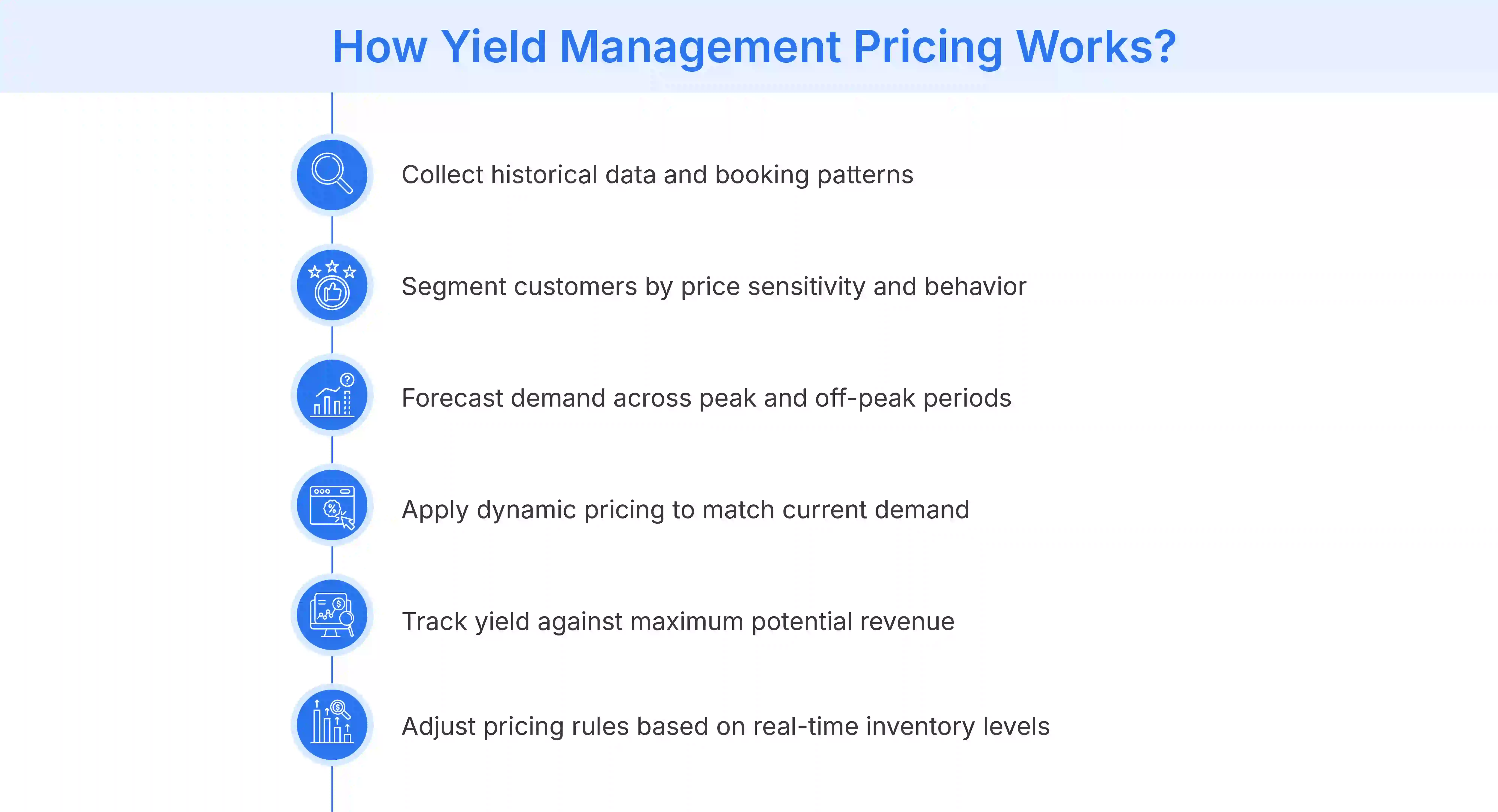
Yield management pricing strategy operates through a connected set of processes that translate demand data into optimized price decisions for every customer segment.
- Data Collection: Businesses collect historical data on customer bookings, demand patterns, seasonal trends and competitor pricing to build a reliable foundation for yield management decisions. This data forms the basis for all downstream forecasting and pricing adjustments across demand periods.
- Market Segmentation: Market segmentation divides customers into groups based on purchasing behavior such as business travelers versus leisure travelers to enable price discrimination. Each customer segment receives a price point matched to their price sensitivity and booking behavior within the yield management system.
- Demand Forecasting: Demand forecasting uses statistical models and historical data to predict future demand across different demand periods and market conditions. Accurate demand forecasts allow businesses to anticipate peak periods and set prices proactively rather than reactively adjusting them after the fact.
- Dynamic Pricing: Dynamic pricing adjusts prices in real time as demand increases during peak periods or decreases during off-peak times within the direct bookings window. This variable pricing mechanism ensures the selling price always reflects current demand and remaining inventory levels across distribution channels.
How Do You Calculate Yield Management Pricing?
The yield management formula measures how efficiently a business converts its maximum potential revenue into actual revenue across a given period.
The formula is:
(Actual Revenue Achieved ÷ Maximum Potential Revenue) × 100
Let’s understand this formula with the help of an example.
A hotel with 50 rooms priced at $300 has a maximum potential revenue of $15,000 at full occupancy. If the hotel sells 35 rooms at an average daily rate of $250, actual revenue reaches $8,750. Applying the yield management formula gives $8,750 divided by $15,000, which equals a yield of 58.3%. This figure helps hotel revenue management teams identify how much additional revenue opportunity remains.
What Industries Use Yield Management Pricing?
Yield management pricing strategies apply across any sector where inventory is fixed, perishable or time-sensitive and demand patterns vary significantly.
- Airlines: Airlines adjust ticket prices based on travel season, booking window, seat availability and competitor pricing across all distribution channels. American Airlines pioneered this approach, and the airline industry now treats yield management as standard pricing practice for airline seats.
- Hotels: Hotels change room rates based on day of week, seasonal demand, local events and occupancy forecasts within their hotel yield management systems. The number of rooms available relative to demand drives the average daily rate the hotel applies across its booking window.
- Car Rentals: Car rental companies vary rates depending on location, vehicle availability, season and rental duration to reflect shifting market demand. Effective yield management in this sector ensures that available vehicles generate maximum revenue during peak times rather than sitting idle.
- Event Venues and Entertainment: Event venues and entertainment operators use yield pricing based on seat location, demand pace and days remaining until the event. Tiered pricing structures allow these businesses to charge premium prices to early high-demand buyers while filling remaining capacity closer to the event date.
- Retail and E-commerce: Retail and ecommerce businesses apply yield management strategies to clear seasonal inventory and respond to demand surges across product categories. Dynamic pricing software like Flipkart Commerce Cloud enables retailers to automate these adjustments across millions of SKUs in real time.
What Are the Benefits and Challenges of Yield Management Pricing?
Here are the benefits and challenges of the yield management pricing strategy:
Benefits
- Maximized Revenue: Optimizing prices based on demand increases overall revenue without adding costs or expanding inventory capacity. Each demand period presents an opportunity to extract greater value from the same fixed asset base through strategic price adjustments.
- Better Resource Utilization: Fixed assets such as hotel rooms and airline seats generate more revenue through strategic yield-management pricing than through flat-rate structures. Businesses avoid leaving revenue on the table during high demand while still filling capacity during slower demand periods.
- Competitive Advantage: Real-time pricing adjustments help businesses respond faster to market conditions and competitor pricing than those using static pricing strategies. This agility allows yield management practitioners to capture additional revenue opportunities before competitors.
- Customer Segmentation: Different price points attract both premium customers willing to pay higher rates and price-sensitive buyers who respond to lower-demand period offers. This segmentation approach broadens the customer base and maximizes revenue across customer segments.
Challenges
- Customer Perception: Frequent price changes can frustrate customers who perceive yield management pricing as unfair or inconsistent across the same product. Transparent communication about variable pricing helps retailers manage negative perceptions and maintain trust in their pricing strategies.
- Technical Complexity: Implementing yield management requires advanced revenue management software, data analytics infrastructure and trained personnel to operate effectively. Businesses without the right yield management system risk making pricing decisions based on inaccurate data.
- Price Wars: Aggressive yield pricing can trigger competitive responses from rivals, reducing industry-wide profitability across affected market segments. When multiple competitors apply yield management strategies simultaneously, the bottom-line benefits for businesses diminish.
- External Disruptions: Unexpected external factors such as weather events or economic shifts can make demand forecasts inaccurate and undermine yield management decisions.
What Is the Difference Between Yield Management and Revenue Management?
Yield management focuses narrowly on adjusting the selling price and controlling inventory to maximize revenue from a fixed, perishable asset. Revenue management takes a broader view, covering all revenue streams including ancillary services, distribution channels and long-term strategic planning. Both approaches share the goal of optimizing overall revenue, though they differ significantly in scope and application.
Table Title: Yield Management vs Revenue Management
|
Basis of Difference |
Yield Management |
Revenue Management |
|
Scope |
Focuses narrowly on price and inventory control |
Broader strategy covering all revenue streams |
|
Primary Goal |
Maximize revenue from fixed inventory |
Optimize total profitability across the business |
|
Time Horizon |
Tactical and short-term pricing decisions |
Long-term strategic planning and growth |
|
Key Variables |
Price adjustments and capacity utilization |
Pricing, marketing, distribution and ancillary services |
|
Application |
Specific products or services with limited inventory |
Entire business operations and revenue sources |
Caption: Comparing yield management and revenue management
How Does Yield Management Enable Smart Inventory Utilization?
Yield management pricing strategy turns fixed inventory into a dynamic revenue asset by ensuring every available unit sells at its maximum viable price.
- Yield management prevents revenue loss from unsold perishable inventory by adjusting prices to attract buyers before capacity expires.
- Overbooking strategies account for historical cancellations and no-shows to ensure maximum inventory utilization without leaving capacity unused.
- Price segmentation fills remaining inventory with lower-priced offers after premium inventory sells at higher rates to higher-value customer segments.
- Real-time inventory tracking ensures the selling price reflects current availability and adjusts automatically as remaining capacity decreases toward zero.
Maximize Revenue with Flipkart Commerce Cloud Pricing Solutions
Flipkart Commerce Cloud's Pricing Solution provides ML-powered dynamic pricing capabilities that optimize revenue across millions of SKUs and hundreds of categories. The algorithms are built on demand elasticity and game-theoretic principles to deliver consistent pricing performance at scale.
Our Dynamic Pricing software continuously analyzes competitor pricing, demand signals, inventory levels, and category performance in real time. This enables automated, market-aligned price adjustments while giving retailers full control through a customizable rules engine.
To further strengthen decision-making, FCC's Pricing Optimizer includes an output simulator that lets retailers test yield management strategies across different business scenarios before full deployment. Backed by high-quality retail data and scale-tested ML models, our solutions ensure reliable, data-driven pricing decisions at every stage.
Book a demo to see how FCC helps retailers maximize revenue through smarter pricing.

FAQ
A hotel increases room rates during a major local event when demand exceeds available capacity, then lowers rates during quieter periods to fill remaining rooms. A retailer applies the same logic by raising prices on high-demand seasonal products and discounting slow-moving stock. Both examples reflect the core yield management formula in action.
The main types include dynamic pricing, tiered pricing, price segmentation, overbooking, peak-period pricing, early-bird pricing, last-minute pricing and group-rate pricing. Each type targets a different customer segment or demand period to extract maximum revenue from fixed inventory. Retailers and hospitality businesses combine several of these types within a single yield management system.
Yield management is moving toward AI-driven automation that processes larger volumes of real-time data faster than traditional revenue management software allows. Machine learning models will improve demand forecasting accuracy and enable more precise price segmentation across customer segments. Integration with inventory management and distribution channels will make yield management decisions faster and more responsive.
The three core types are capacity yield measuring inventory utilization, revenue yield measuring actual versus potential revenue, and market yield measuring performance against competitor pricing. Each type gives businesses a different perspective on how well their yield management pricing strategy is performing. Tracking all three together gives a complete picture of revenue efficiency.
Yield management pricing can damage customer trust when shoppers notice significant price differences for the same product across demand periods. The strategy requires sophisticated revenue management software and trained staff, making implementation costly for smaller retailers. Inaccurate demand forecasts driven by unexpected external factors can also cause pricing decisions that reduce rather than increase overall revenue.