
December 4, 2025
What is Conversational Commerce?
Conversational commerce refers to the intersection of social messaging apps and shopping. It allows brands to sell products and services through chat interfaces or virtual assistants. This approach enables personalized assistance at scale for online shoppers.
Drishti, Manager - Digital Marketing

Table of Contents
- What is Conversational Commerce?
- What are the different types of conversational commerce?
- How does conversational commerce work?
- Key Benefits of Conversational Commerce
- Best Practices for Effective Conversational Commerce
- Top Use Cases for Retailers
- Implement Conversational Commerce To Push Sales
What is Conversational Commerce?
Conversational commerce is the process where online retailers sell products and services via social media platforms, messaging apps, or voice assistants. This method shifts the online shopping experience from static web pages to a dynamic dialogue, indicating that the retail industry is moving from ‘command-based’ commerce to ‘consultative commerce.’
Command-based systems require users to click buttons and navigate menus. Consultative commerce utilizes artificial intelligence to mimic human dialogue to guide the shopper. This shift enables brands to provide personalized recommendations and support at scale. It effectively bridges the gap between digital convenience and in-store service, often overlapping with social commerce.
Recent data indicate strong momentum for retail adoption. The global conversational AI market is projected to reach $61.69 billion in 2032, which reflects rapid enterprise-level investment. Shoppers engaging through conversational commerce experiences also show a 10% higher average order value in 2025. This highlights the growing demand for interactive conversational marketing that delivers immediate answers.
Retailers adopting these conversational commerce tools are seeing higher customer engagement rates and improved satisfaction scores across all digital channels.
What are the different types of conversational commerce?
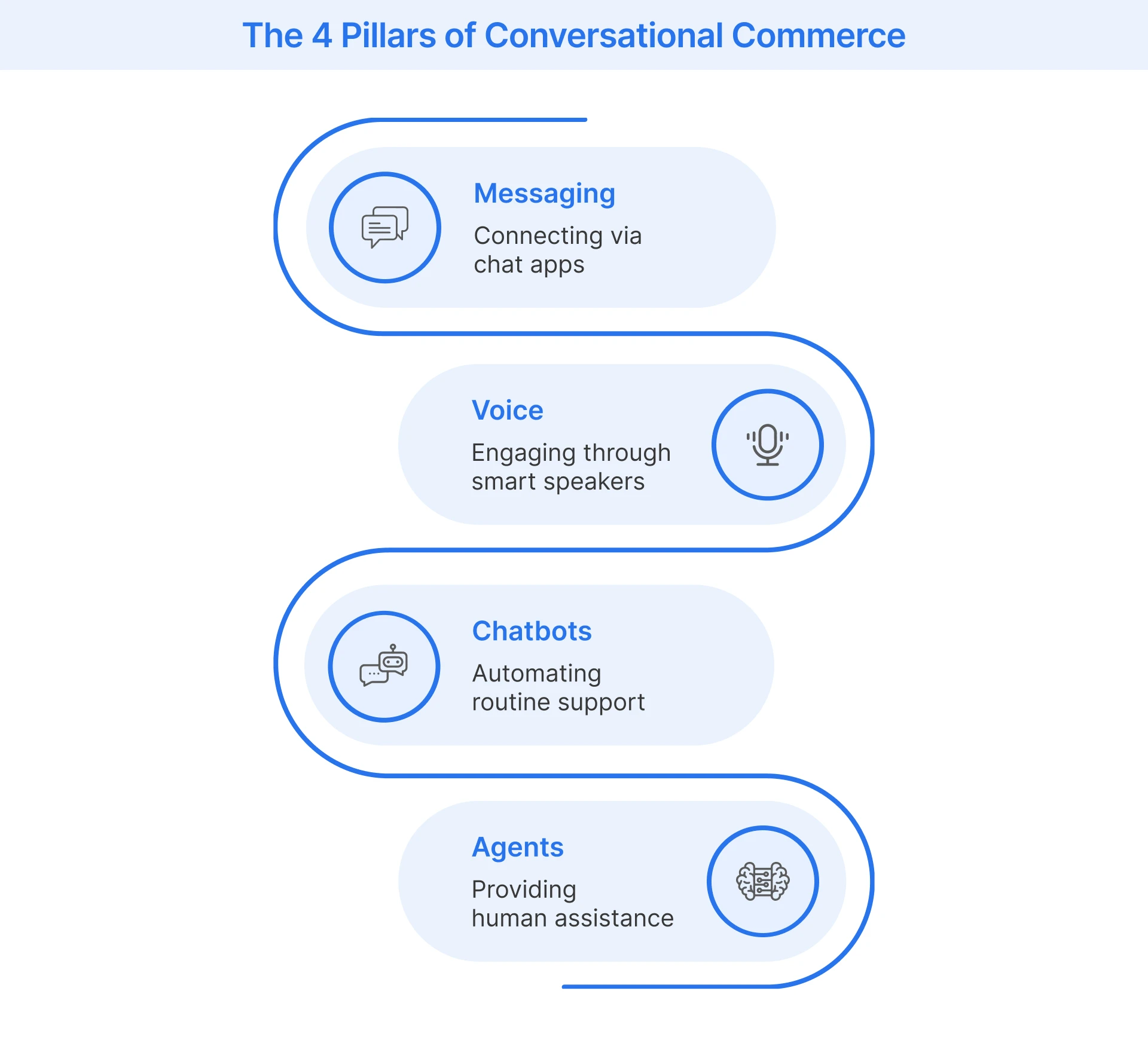
You have several methods to implement this technology in your business to engage customers where they are most active. Here are common examples of conversational commerce.
- Social Messaging Apps (WhatsApp, Facebook Messenger, LinkedIn Message, etc.): You engage customers on social media platforms they already use daily. Whether via a direct text message or an app like WhatsApp, you facilitate complete transactions within familiar interfaces.
- Chatbot and AI: You deploy virtual assistants to handle routine inquiries around the clock. These systems answer questions and guide users through product catalogs while freeing up agents for complex issues.
- Live Chat (Flight Ticket Sales, etc.): You connect real agents with visitors browsing your site to resolve specific doubts during the critical purchasing decision. This human touch works exceptionally well for high-ticket items like jewelry or electronics.
- Voice Assistants (Google Assistant, Alexa, Siri): You optimize your store for voice-activated devices like Google Assistant to enable hands-free product searching. Customers use simple voice commands to reorder household staples quickly.
How does conversational commerce work?
Here is the technical analysis of how these interactions function smoothly to deliver a seamless customer experience.
- The Interface - Where the user is (WhatsApp, Website, Messenger): This component acts as the digital storefront located within a chat app or website widget for your users. You meet the customer exactly where they choose to engage which creates a seamless entry into the shopping experience.
- The Brain (NLP) - How the AI understands intent: This component uses Natural Language Processing and Machine Learning to decipher what a user actually means. It understands that "kicks" means sneakers and translates human speech into structured data.
- The Stack - How the AI checks your inventory: The backend system connects the chat interface to your inventory management tools to check stock levels and logistics. It retrieves pricing information in real time to ensure you never sell an item that is currently out of stock.
- The Response - Delivering the answer: The system delivers the correct product recommendation instantly. It often includes an interactive "Buy" button or a link to shopping carts to create an immediate path to purchase.
Key Benefits of Conversational Commerce
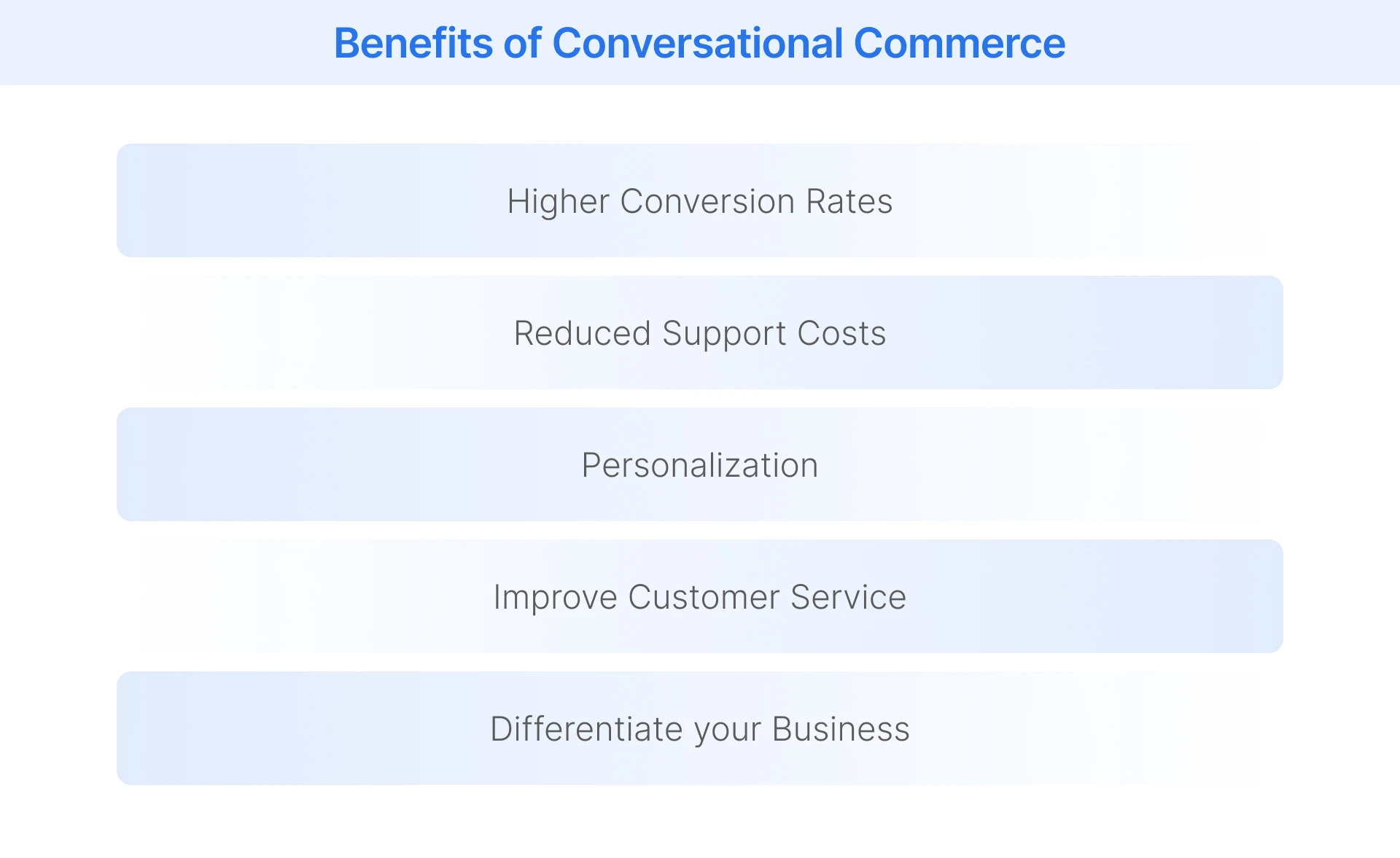
Implementing conversational commerce offers measurable advantages for your retail operations by effectively streamlining the path to purchase.
- Higher Conversion Rates: You guide customers through the sales funnel with real-time assistance that reduces hesitation and answers objections instantly. Direct engagement results in significantly more completed purchases than static product pages that lack interactivity.
- Reduced Support Costs: You automate responses to repetitive queries regarding order status or returns to reduce the workload on your support team. You save money while maintaining constant availability for shoppers who expect immediate answers at any time of day.
- Personalization: You collect customer data from conversations to offer tailored suggestions that match customer preferences. This helps you understand specific needs and treat every visitor like a VIP.
- Improve Customer Service: You provide instant answers without making customers wait on hold, which satisfies the modern expectation for immediate gratification. Happy customers are more likely to return and recommend your brand when their problems are solved quickly and efficiently.
- Differentiate your Business: You stand out from competitors who rely solely on traditional browsing by offering a unique and interactive shopping experience. This innovative approach positions your brand as forward-thinking and customer-centric in a crowded digital marketplace filled with static options.
Best Practices for Effective Conversational Commerce
Follow these strategic guidelines to ensure your conversational commerce initiatives deliver maximum value and customer satisfaction scores.
- Prioritize user experience and accessibility: You must design interactions that are intuitive and easy to navigate on mobile devices for all types of users. A clumsy interface will frustrate users and drive them away so ensure the design is fully accessible to everyone.
- Use advanced conversational AI capabilities: Leverage Generative AI and Agentic AI to handle complex queries effectively. Advanced AI ensures customer conversations feel natural and helpful even when users deviate from the expected path.
- Consider omni-channel experiences: You need to connect your chat data with other customer touchpoints to ensure a consistent brand experience everywhere. A unified view of the customer prevents disjointed conversations whether they shop online or in a physical retail store.
- Continuously monitor and optimize performance: You must regularly review chat logs to identify bottlenecks or misunderstandings that cause friction for your customers. Use this feedback to refine your AI responses and scripts to keep up with changing customer needs and trends.
Top Use Cases for Retailers (That Actually Drive Revenue)
You do not need to overhaul your entire business overnight to start seeing results from this technology. If you want to see quick wins, these are the three areas where conversational commerce pays for itself.
1. Guided Selling
- The Problem: Your customer struggles to find specific items because your search bar only understands exact keywords like "maxi dress." They get frustrated scrolling through hundreds of irrelevant results and eventually leave your site without buying anything.
- The Fix: You deploy an AI agent that acts like an in-store associate to ask questions about style and budget. It interacts naturally to understand the specific vibe or occasion the customer is shopping for currently.
- The Result: The system filters thousands of products down to the perfect three options that match their exact criteria perfectly.
- Why it wins: It eliminates choice paralysis effectively because customers are more likely to buy when choices are curated for them.
2. Abandoned Cart Recovery
- The Problem: A customer adds several items to their cart but leaves the site without completing the purchase process. They might get distracted by external factors or second-guess the total price before clicking the checkout button.
- The Fix: You send a personalized message via WhatsApp or Messenger to remind them of the items left behind. You can also offer a small time-sensitive discount to encourage them to complete the transaction immediately.
- The Result: This gentle nudge brings the customer back to the checkout flow and recovers potentially lost revenue successfully.
- Why it wins: A direct message feels more urgent and personal than a generic email buried in a crowded inbox.
3. Post Purchase Support
- The Problem: Customers often feel anxious about their order status immediately after buying and flood support lines with questions. This volume of "Where is my order" tickets overwhelms your support staff and significantly slows response times.
- The Fix: An automated bot sends proactive updates regarding shipping and delivery status directly within the chat interface instantly. It provides real-time tracking links so customers can monitor their packages without needing to contact human support agents.
- The Result: This strategy keeps the customer informed without human intervention and drastically reduces the volume of unnecessary inquiries.
- Why it wins: Proactive communication builds trust and eliminates anxiety to confirm you value their business even after payment.
4. Real Time Feedback
- The Problem: You typically do not know why a customer is unhappy until they leave a damaging public review. By that time, it is often too late to fix the relationship or address their specific concerns privately.
- The Fix: The AI agent requests an immediate rating after a purchase or interaction to gauge sentiment. It prompts unhappy users to explain their issue right away so you can capture negative feedback privately.
- The Result: You can address the concern immediately to turn a potentially negative experience into a positive brand interaction.
- Why it wins: Customers are more likely to tap a star rating in a chat than complete long surveys.
Implement Conversational Commerce To Push Sales
Conversational commerce is transforming how retailers interact with consumers by bridging the gap between digital convenience and service. You engage shoppers in meaningful dialogue to drive sales and turn passive browsing into active buying effectively. This strategy creates a more human connection that builds loyalty and increases the lifetime value of every customer.
Processing the vast data from these interactions can be challenging for retailers looking to scale their operations efficiently. This is where Flipkart Commerce Cloud (FCC) steps in to help leverage deep retail intelligence for your growing business. We simplify the complexity of managing large-scale data to provide you with actionable insights that drive real growth.
FCC offers robust solutions that integrate seamlessly with your existing infrastructure to power your digital transformation journey. Our tools utilize advanced technology to understand intent and automate complex retail workflows for better operational efficiency. We ensure that your technology stack works in harmony to deliver the best possible experience for your customers.
Our ecosystem supports your growth by optimizing every customer interaction to deliver the right message at the right time. We enable you to deliver personalized experiences that help you scale your conversational strategy effectively across all channels. Our goal is to equip you with the tools needed to innovate and succeed in a competitive market.

FAQ
Traditional ecommerce relies on users searching static pages while conversational commerce uses dialogue to guide the user. It mimics the experience of speaking with a knowledgeable sales associate in a physical store rather than browsing alone. The interaction creates a two-way exchange rather than a solitary search process for the user.
You should track conversion rates from chat interactions to measure the direct sales impact of the tool. Customer satisfaction scores and average response times are also crucial for assessing overall efficiency and success of the implementation. Retention rates will indicate if the strategy is successfully building long-term loyalty with your audience.
Chatbots handle routine tasks and simple queries to save time but they do not replace human agents entirely. The best strategy involves a blend of AI efficiency and human empathy to ensure appropriate care for everyone. This ensures that complex or sensitive issues are handled by people who can provide the necessary support.
You start by identifying high-impact areas like customer support or guided selling to determine your initial focus. Then you choose a partner like Flipkart Commerce Cloud to provide the AI infrastructure and retail expertise. We help you integrate these tools smoothly to ensure a successful launch without disrupting your current operations.