
January 26, 2026
Order Cycle Time
Order cycle time measures the total duration between placing an order and receiving the package. It tracks the efficiency of your warehouse operations and shipping partners to ensure timely delivery.
Drishti, Manager - Digital Marketing

Table of Contents
- Order Cycle Time
- What Is Order Cycle Time?
- What are the Benefits of Order Cycle Time?
- Difference Between Order Cycle Time vs. Lead Time
- The 4 Stages of the Order Cycle
- The Order Cycle Time Formula
- What Causes Slow Order Cycles?
- How to Reduce Order Cycle Time
- How Flipkart Commerce Cloud Accelerates Your Cycle
Order Cycle Time
Order cycle time serves as a critical Key Performance Indicator (KPI) for retailers aiming to optimize supply chain speed. It reveals how effectively an organization manages inventory and processes distinct customer requests.
High-performing brands monitor order cycle time closely to identify bottlenecks within the fulfillment center or logistics network. Reducing this timeframe directly correlates with higher customer retention rates and repeat business.
- A shorter cycle creates a competitive advantage by delivering products faster than market competitors.
- It highlights inefficiencies in the warehouse picking process or delays caused by shipping carriers.
- Tracking this metric helps businesses forecast inventory needs accurately to prevent stockouts or overstocking.
- Reliable delivery times build trust with shoppers who expect transparency regarding their package arrival.
What Is Order Cycle Time?
Order cycle time is the average amount of time it takes to fulfill a customer order from the moment the purchase is made until it arrives at their doorstep. You track this to understand the speed of your entire operation. It covers every step, including order processing and final delivery to the end consumer.
You use this metric to gauge how well your internal systems communicate with your external logistics partners to satisfy the buyer's expectations for speed. It is a good indicator of your overall performance and warehouse flow.
What are the Benefits of Order Cycle Time?
Optimizing order cycle time transforms your business operations while driving substantial growth across your entire retail organization. Let’s understand how:
- Customer Satisfaction (CSAT): Shoppers expect speed when they click the buy button on your ecommerce site. You build immense loyalty and create exceptional customer experiences when you deliver packages faster than the estimated date. Meeting these expectations encourages buyers to return for future purchases without hesitation.
- Cash Flow: A faster cycle means you convert inventory into cash much more quickly than before. You reduce the carrying costs associated with holding stock in the warehouse. This liquidity allows you to reinvest capital into marketing or product development.
- Scalability: Efficient processes allow you to handle a surge in order volume during peak seasons. You can expand into new markets without worrying about fulfillment bottlenecks slowing you down. It ensures your infrastructure grows alongside your increasing customer demand.
Difference Between Order Cycle Time vs. Lead Time
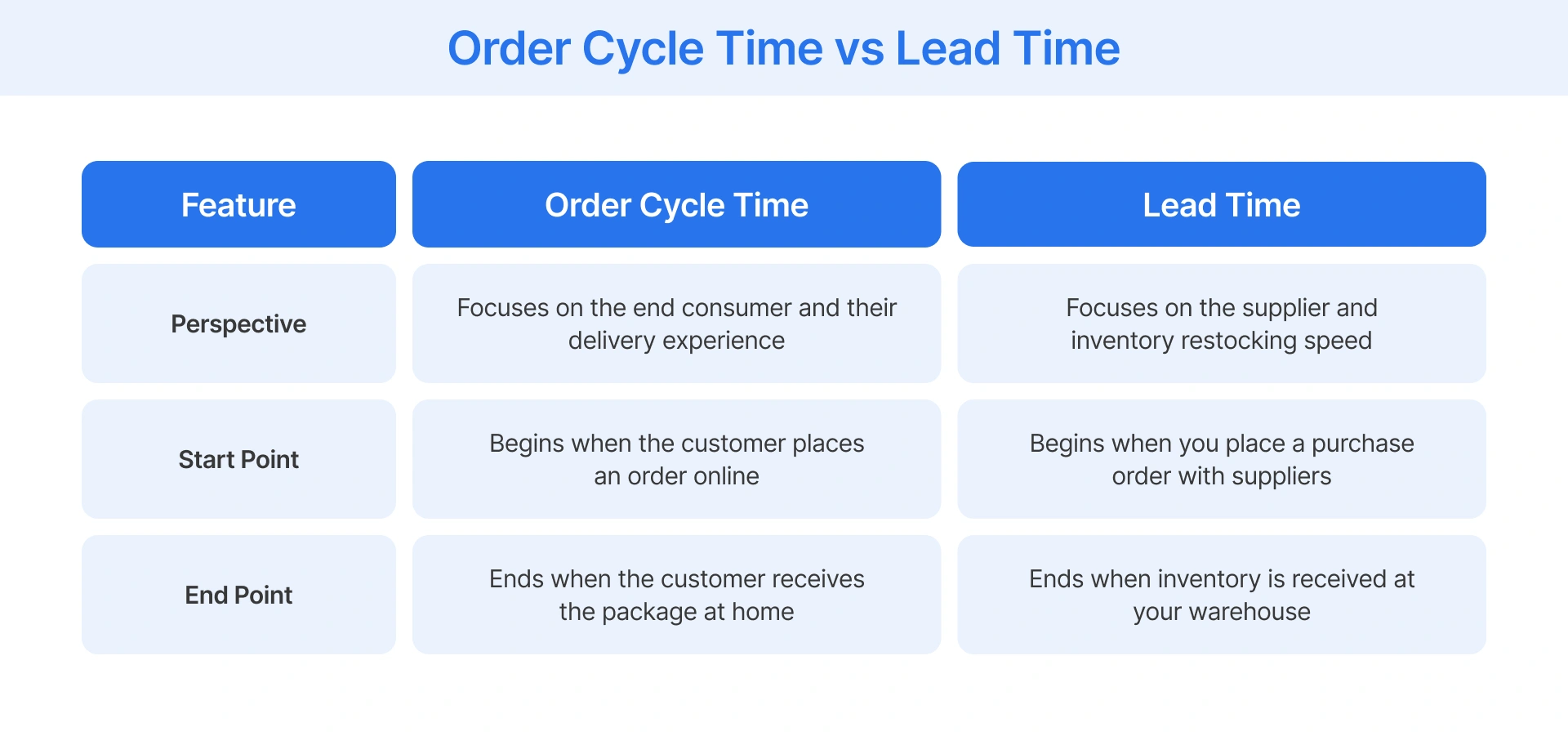
These two terms often get confused in supply chain management discussions regarding speed. Order cycle time focuses strictly on the customer experience from purchase to delivery. Lead time looks at the supply chain from when you place a supplier order to when stock arrives at the warehouse.
The 4 Stages of the Order Cycle
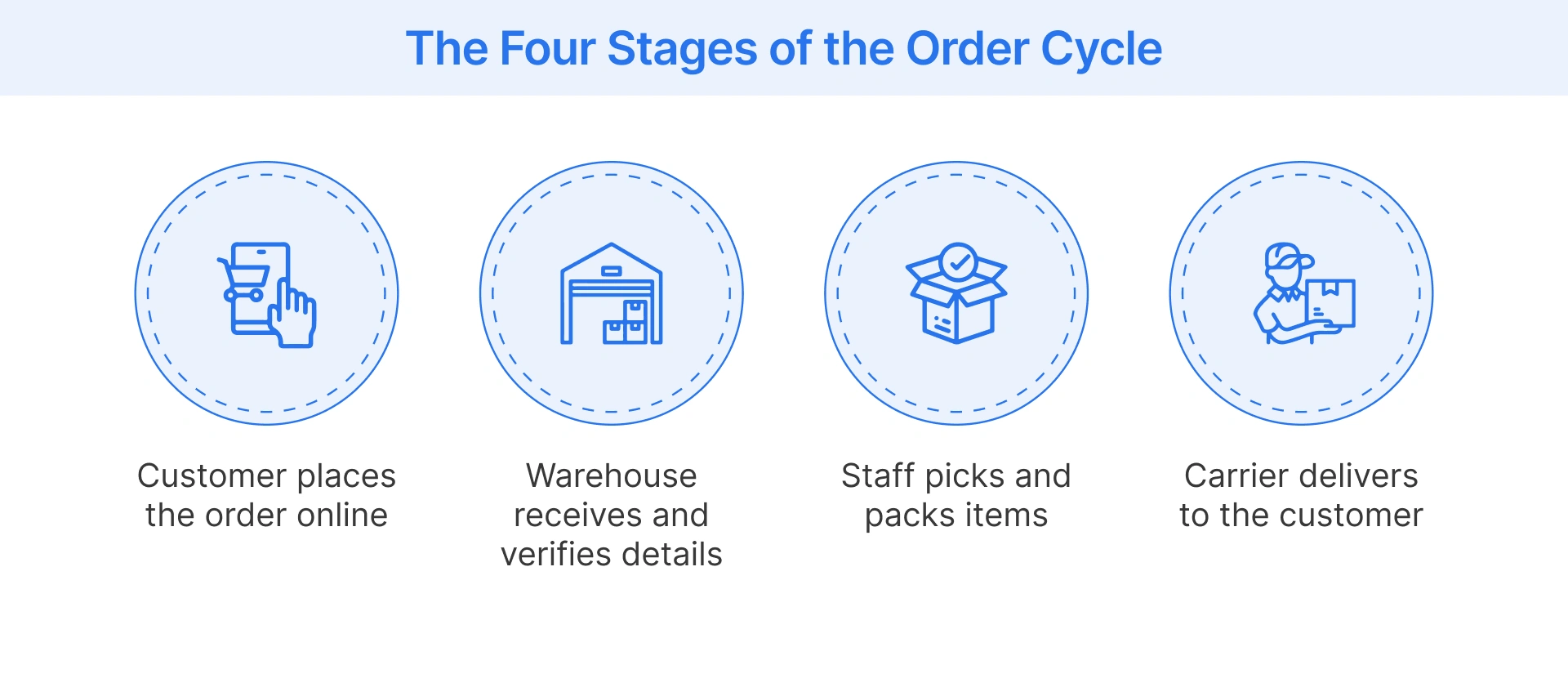
You must manage four distinct phases that make up the complete lifecycle of every single customer order.
Order Transmission
This initial phase occurs immediately after a customer clicks buy on your digital storefront. Your system captures the data and sends it to the warehouse management software. You must ensure this digital handshake happens instantly to avoid initial delays.
Order Processing
Your team reviews the details to verify payment authorization and check stock availability levels. You prepare the necessary paperwork or digital tickets for the warehouse staff. This step ensures that the order is legitimate and ready for physical handling.
Picking and Packing
Warehouse associates locate the specific items on the shelves using the generated pick list. You pack the goods securely in appropriate boxes with protective materials. This physical handling stage requires accuracy to prevent shipping the wrong items to customers.
Shipping and Delivery
The packed box leaves your facility and enters the carrier's logistics network for transport. You hand off the package to the courier for final mile delivery. This stage ends exactly when the customer receives the parcel at their address.
The Order Cycle Time Formula
You can calculate this crucial metric easily by using a standard formula that tracks your overall fulfillment speed.
Order Cycle Time = (Delivery Date – Order Date) / Total Orders Shipped
Here is an example to illustrate how it works in practice.
Let’s assume you shipped 1,000 orders in December for your store. The total number of days between order placement and delivery for all these packages is 5,000. To get the average order cycle time, divide 5,000 by 1,000.
This means your average order cycle time is 5 days.
What Causes Slow Order Cycles?
You might face several operational inefficiencies that inflate your order cycle time and frustrate your customers.
- Manual Data Entry: Relying on humans to type order details into systems invites errors and slows progress. You risk typos that cause incorrect shipping addresses or wrong product selections. Automation eliminates this lag to ensure data moves instantly between your sales channels.
- Inventory Discrepancies: You cannot ship what you cannot find on the warehouse shelves due to bad data. Stockouts occur when your system says an item is available while the bin is empty. This forces you to cancel orders or wait for replenishment.
- Disorganized Warehouses: A chaotic floor plan forces pickers to walk unnecessary miles to locate products. You waste valuable time when popular items are stored far from the packing stations. Optimizing the layout reduces travel time and speeds up the picking process.
How to Reduce Order Cycle Time
Implement the following strategic improvements to accelerate your fulfillment speed and delight your loyal customer base.
- Automate the Handshake: Stop manually transferring order data between your ecommerce platform and warehouse management system. You should use integration tools to instantly send order details to the floor. This removes the latency caused by human intervention, speeding up processing time.
- Optimize Warehouse Layout: Place your best-selling products near the packing stations to minimize pickers' travel time. You should organize inventory by velocity to ensure high-demand items are readily accessible. This logical arrangement saves minutes on every order you process.
- Use Predictive AI: Advanced inventory management software helps you anticipate demand surges in real time. You can position inventory in fulfillment centers closer to your customers based on forecasts. This proximity drastically cuts down the shipping leg of the order cycle.
How Flipkart Commerce Cloud Accelerates Your Cycle?
Reducing order cycle time is essential for staying competitive in the fast-paced retail landscape. Retailers struggle with fragmented data and slow manual processes and need robust infrastructure to streamline the entire order management workflow.
At Flipkart Commerce Cloud, we offer an intelligent Order Management System (OMS) that unifies your inventory. Our solution provides real-time visibility across all channels to prevent stockouts. We automate order routing to the nearest fulfillment center to ensure faster delivery.
Our predictive analytics tools help you forecast demand accurately to optimize stock placement. We empower you to meet customer expectations for speed without increasing your operational costs.
Schedule a personalized demo to see how we can accelerate your fulfillment today.

FAQ
A good benchmark varies by industry and product type. However, most ecommerce customers expect delivery within three to five days. You should aim to process the order within twenty-four hours of receipt. Beating the industry average sets you apart and increases the likelihood of repeat purchases from satisfied buyers.
This depends on your specific operational schedule and carrier agreements. If your warehouse operates seven days a week, you count weekends. However, most standard calculations exclude non-working days unless you offer premium shipping options. You must clarify this policy to set accurate delivery expectations for your online shoppers.
A shorter order cycle time allows you to hold less safety stock because replenishment is faster. You turn over inventory more frequently which frees up valuable warehouse space. Faster cycles reduce the risk of holding obsolete products. This efficiency improves your overall cash flow and reduces storage costs significantly.