
January 24, 2026
Addressable Advertising
Addressable advertising allows brands to deliver specific ads to selected audiences based on individual data. This method moves beyond broad demographics to target verified households across various devices.
Drishti, Manager - Digital Marketing

Table of Contents
- Addressable Advertising
- What Is Addressable Advertising?
- How Does Addressable Advertising Actually Work?
- What is the difference between addressable and programmatic advertising?
- Why Addressable Advertising Is a Game Changer for Retail Media
- When Should You Use Addressable Ads?
- Key Channels for Addressable Campaigns
- Ready to Make Your Ads Addressable?
Addressable Advertising
Thanks to new technologies, the marketing sector is shifting from broad broadcasting to precise individual targeting with the evolution of data capabilities. Brands now leverage advanced data signals to effectively identify specific households within a larger audience pool.
Addressable advertising eliminates wasted impressions by ensuring that your advertising efforts reach only the right audience. Retailers can tailor creative content to verified viewer attributes rather than estimates.
- Advertisers serve relevant messages to different households watching the same program at the same time.
- Brands leverage first-party data to connect with the right people (high-intent shoppers) across various digital platforms.
- This approach combines the scale of television with the precision of digital performance marketing strategies.
- Addressable advertising reduces ad spend waste by focusing budget solely on qualified and valuable prospects.
What Is Addressable Advertising?
Addressable advertising, also referred to as addressable marketing, is the ability to show different ads to specific households or individuals watching the same content or browsing the same page. By using first-party data and precise targeting signals, it allows brands to move beyond broad demographics and engage the addressable audience they want to reach.
This strategy empowers brands to engage the exact audience they desire to reach with highly relevant messaging based on individual preferences. This precision drives better results by ensuring that every media dollar targets households with the highest probability of conversion, making it a highly efficient form of advertising.
How Does Addressable Advertising Actually Work?
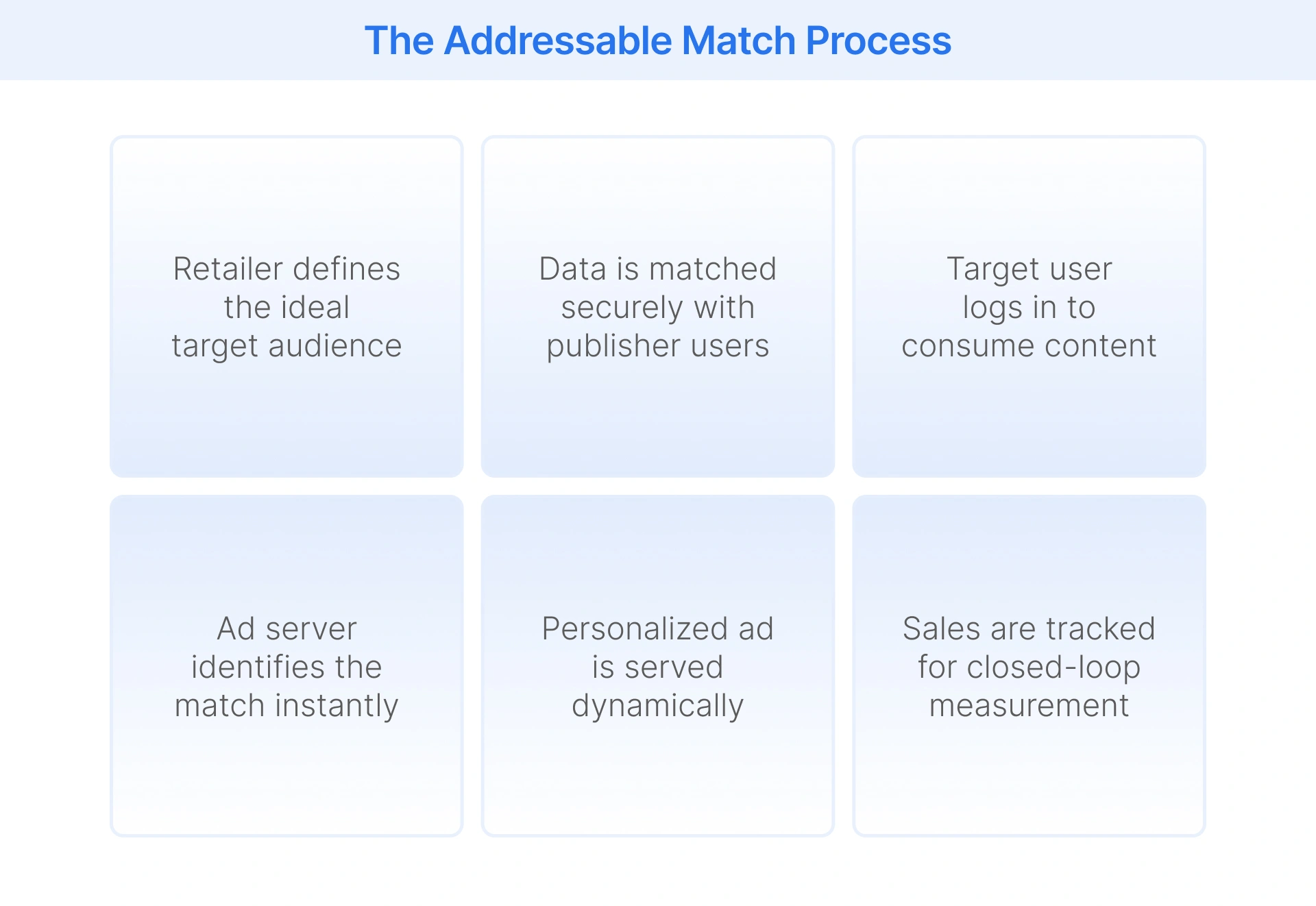
Addressable advertising relies on matching a brand’s audience with a media owner’s audience. Let’s understand how it works in practical situations:
- The Identification: You define your ideal customer profile using your own customer data and purchase history. This step involves careful data collection to select specific households that align with your current retail campaign objectives.
- The Match: Technology matches your target list against the publisher’s user base using secure identity resolution. This process effectively bridges the gap between your known customers and the available inventory on the media platform.
- The Delivery: The system identifies the user in real time when that specific user logs in or tunes in. It signals the ad server that a qualified target is currently available for engagement.
- The Ad Serve: Instead of a generic placeholder, the system optimizes ad delivery by inserting your specific ad into their feed or stream. You deliver a tailored message that resonates with that household while neighbors see something entirely different.
What is the difference between addressable and programmatic advertising?
Traditional linear TV methods prioritize broad reach by selling time slots, often at the expense of precision. Traditional mass advertising typically targets broad groups, whereas programmatic advertising improves efficiency by automating the purchase of inventory based on data. Addressable advertising fundamentally shifts this dynamic by improving advertising addressability, allowing you to buy specific audiences directly rather than just the media placement they consume.
|
Feature |
Traditional (Linear) |
Programmatic |
Addressable |
|
How You Buy |
You buy specific time slots or content placements manually. |
You use software to purchase ad space automatically. |
You buy specific audiences regardless of the content. |
|
Targeting |
You target broad groups based on general demographics. |
You target users based on behavior or context. |
You target verified individuals or households one-to-one. |
|
Precision |
Low precision; you hit everyone regardless of relevance. |
Medium precision; varies based on data quality used. |
Very high precision; you eliminate all wasted impressions. |
Why Addressable Advertising Is a Game Changer for Retail Media?
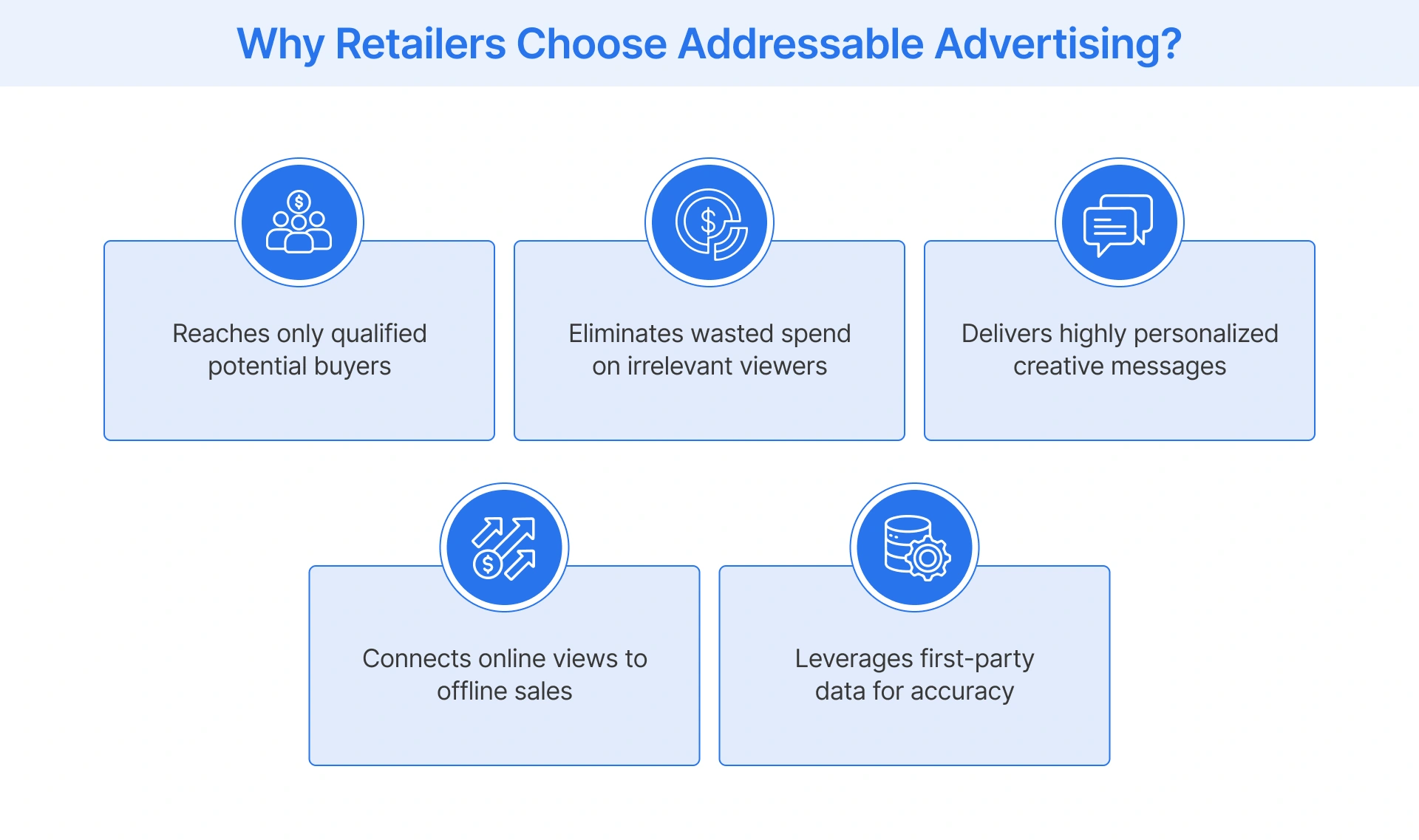
Retailers adopt addressable advertising to maximize efficiency and drive measurable outcomes from their media investment. It fundamentally changes how you connect ad spend to actual sales revenue.
- Zero Wasted Spend: You stop paying for impressions that reach irrelevant viewers outside your target market. Every dollar funds communication with households that match your ideal consumer data profile to ensure maximum budget efficiency.
- Closed-Loop Measurement: You can directly attribute offline or online sales to specific ad exposures. This capability allows you to track exactly which households converted, proving conversion rates and ROI.
- Better Shopper Experience: Your customers receive ads that actually align with their interests. This relevance drives higher engagement and decreases ad fatigue while improving overall brand perception.
- First-Party Data Power: You unlock the full potential of your CRM data by activating it across media channels. This integration lets you extend your relationship with existing customers through highly personalized messaging at the right time.
- Higher Conversion Rates: By targeting only those most likely to buy, you naturally achieve higher conversion rates compared to broad-spray campaigns.
When Should You Use Addressable Ads?
Deploy addressable advertising when your campaign requires precise targeting to influence specific consumer behaviors or distinct household segments.
- To Steal Market Share from a Rival: Target households that have purchased your competitor’s brand in the last six months but haven't bought yours yet. You can show them a compelling "Switch and Save" offer they can’t refuse to disrupt their routine and capture their loyalty effectively.
- Sell High-Ticket Item: Don’t waste money showing ₹80,000 OLED TV ads to college students with limited budgets. Use specific income and lifestyle signals to target only high-net-worth households who actually have the financial capacity to purchase your premium products immediately.
- To Win Back Old Customers: Target specific users who bought diapers three months ago but haven't returned to your store since. Remind them you are still here with a personalized message and maybe offer a small discount to incentivize their return and reduce churn.
Key Channels for Addressable Campaigns
Advertisers execute addressable advertising campaigns across various digital and traditional environments where user identity is verifiable. You can leverage the following channels to reach your specific audience segments effectively.
Connected TV (CTV) & OTT
Streaming services require user logins, which makes them perfect for addressable targeting. You deliver television-quality commercials to specific households watching content on smart TVs or streaming devices. This channel combines the impact of the big screen with the precision of digital data for superior engagement.
Retail Media Networks (RMNs)
These platforms possess rich purchase data that allows for highly accurate targeting within the shopping environment. You reach consumers who are already in a buying mindset on retailer websites or apps. It offers a direct path to purchase with closed-loop attribution capabilities.
Digital Display & Video
Publishers and social platforms enable addressable targeting through authenticated user data across the open web. You serve personalized banner or video ads to recognized users on their laptops or mobile devices. This ensures consistent messaging as your target audience moves across different websites.
Ready to Make Your Ads Addressable?
Addressable advertising represents the future of retail media efficiency and precision targeting. Retailers must adopt these advanced capabilities to compete effectively in a crowded marketplace while maximizing their return on ad spend.
Flipkart Commerce Cloud helps you unlock the value of your first-party data through our robust Retail Media Platform. We empower you to build a white-label addressable ecosystem that connects brands with high-intent shoppers using superior, privacy-first technology.
You can further streamline operations with the FCC Ads Manager, which offers a self-serve portal for your advertisers to execute precise campaigns. You should schedule a demo today to see how we can transform your data into a powerful revenue engine.
FAQ
A common example involves two neighbors watching the same live sports event on cable. One household sees a commercial for a luxury car while the other sees an ad for family vacation packages. The content remains identical while the advertising adjusts based on household income data.
The four main categories generally include display advertising found on websites and social media ads. Video advertising covers streaming platforms while native advertising blends into content. Search engine marketing targets users actively looking for specific keywords or products on search platforms.
Addressable advertising increasingly relies on stable identifiers like email addresses or subscriber IDs rather than third-party cookies. This shift ensures that targeting remains accurate across different devices and browsers. It provides a durable solution for reaching specific people in a privacy-compliant manner.
Legitimate addressable vendors operate within strict privacy frameworks by using anonymized data matching processes. They ensure that personal information remains secure and is never directly exposed to advertisers. Users typically provide consent for data usage through terms of service agreements with publishers.
The initial cost per thousand impressions often appears higher than traditional broad-reach media buying. However the effective cost per acquisition usually ends up lower because you eliminate wasted spend. You pay only for impressions that reach your qualified target audience which improves overall efficiency.