
January 24, 2026
Private Marketplace Ads
Private Marketplace ads refer to exclusive programmatic auctions where publishers invite selected advertisers to bid. This method ensures high-quality ad placements and enhances brand safety for retailers.
Drishti, Manager - Digital Marketing

Table of Contents
- What Are Private Marketplace Ads?
- How Does a Private Marketplace Work?
- What Is the Difference Between a Private Marketplace and an Open Exchange?
- What Are the Different Types of PMP Deals?
- What Are the Benefits of PMP Ads?
- Upgrade Your Ad Inventory with Flipkart Commerce Cloud
Private Marketplace Advertising and the Value of Premium Ad Access
Digital advertising gives retailers access to a wide range of audiences and ad placements, but not every advertising environment offers the same level of quality, transparency, or control. For brands looking to be more selective about where their ads appear, access to premium inventory can make a meaningful difference.
Private marketplace advertising gives selected advertisers access to inventory that publishers do not make widely available through open exchanges. This can give both advertisers and publishers greater control over who participates, where ads appear, and how premium inventory is bought and sold.
In this article, we discuss what private marketplace ads are, how they work, the different types of PMP deals, how they compare with open exchanges, and the benefits they offer advertisers and publishers.
What Are Private Marketplace Ads?
Private Marketplace ads are a programmatic buying method in which premium publishers offer inventory to a selected group of buyers. This invitation-only environment uses real-time bidding technology and restricts participation to whitelisted advertisers who meet the publisher's specific criteria.
Retailers use PMP ads to bypass some of the unpredictability of open exchanges and gain access to premium ad placements. This model combines the efficiency of automated buying with the exclusivity of direct sales to ensure that ads appear in brand-safe contexts.
Does a Private Marketplace Work?
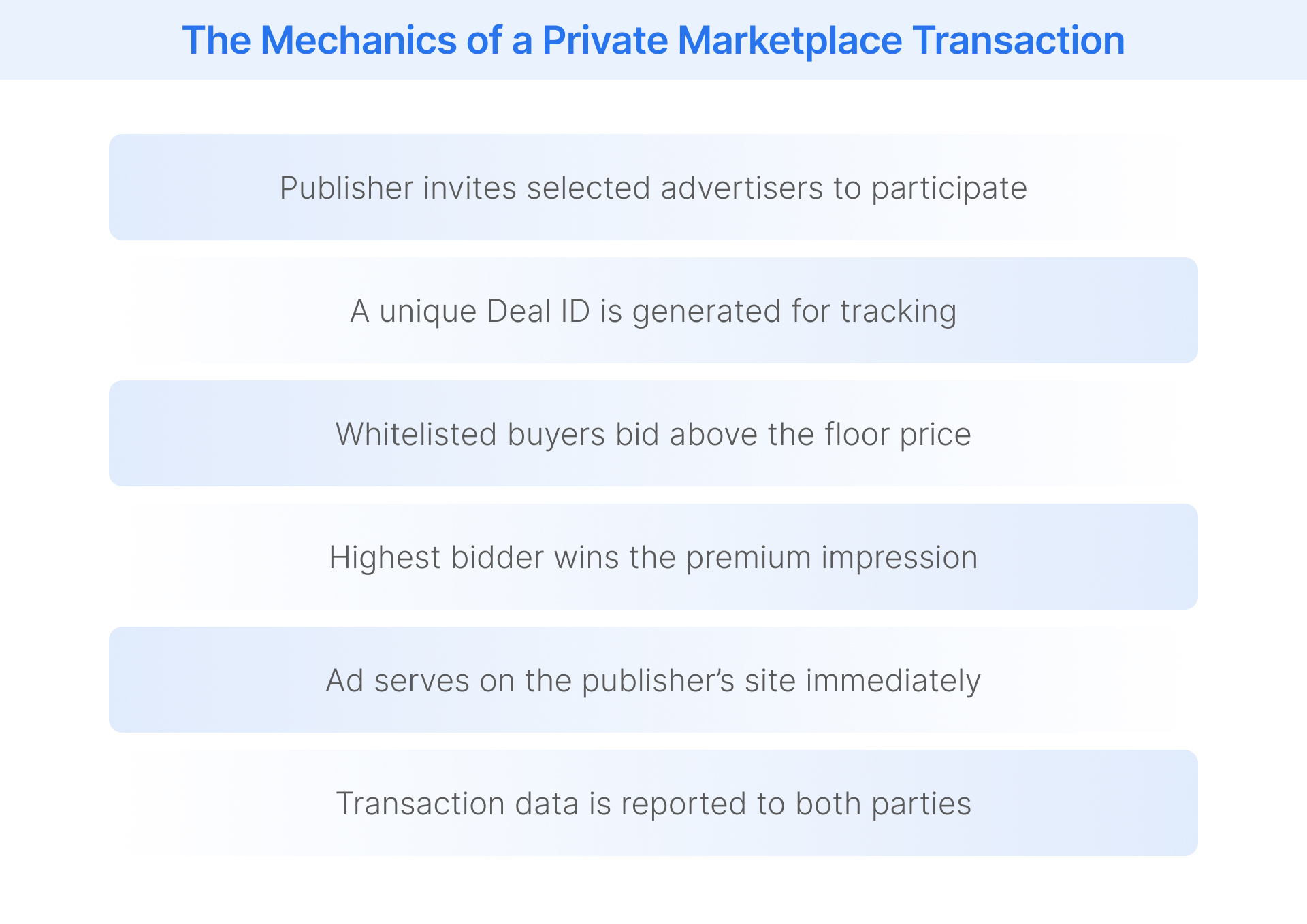
The process begins when a publisher decides to create a controlled environment for their premium ad space. They select specific buyers and provide unique access codes for participation.
Let’s understand how a private marketplace works:
- The Invitation: Participation is not open to every advertiser in the digital ecosystem. Publishers whitelist specific buyers based on their brand quality to create an exclusive bidding environment.
- The Deal ID: This unique piece of code acts as the mandatory ticket to the auction. It matches the buyer to the specific inventory while ensuring the transaction occurs correctly.
- The Auction: The buying process remains an auction-based on Real-Time Bidding principles. Fewer participants compete for the inventory compared to open exchanges, which results in higher win rates.
What Is the Difference Between a Private Marketplace and an Open Exchange?
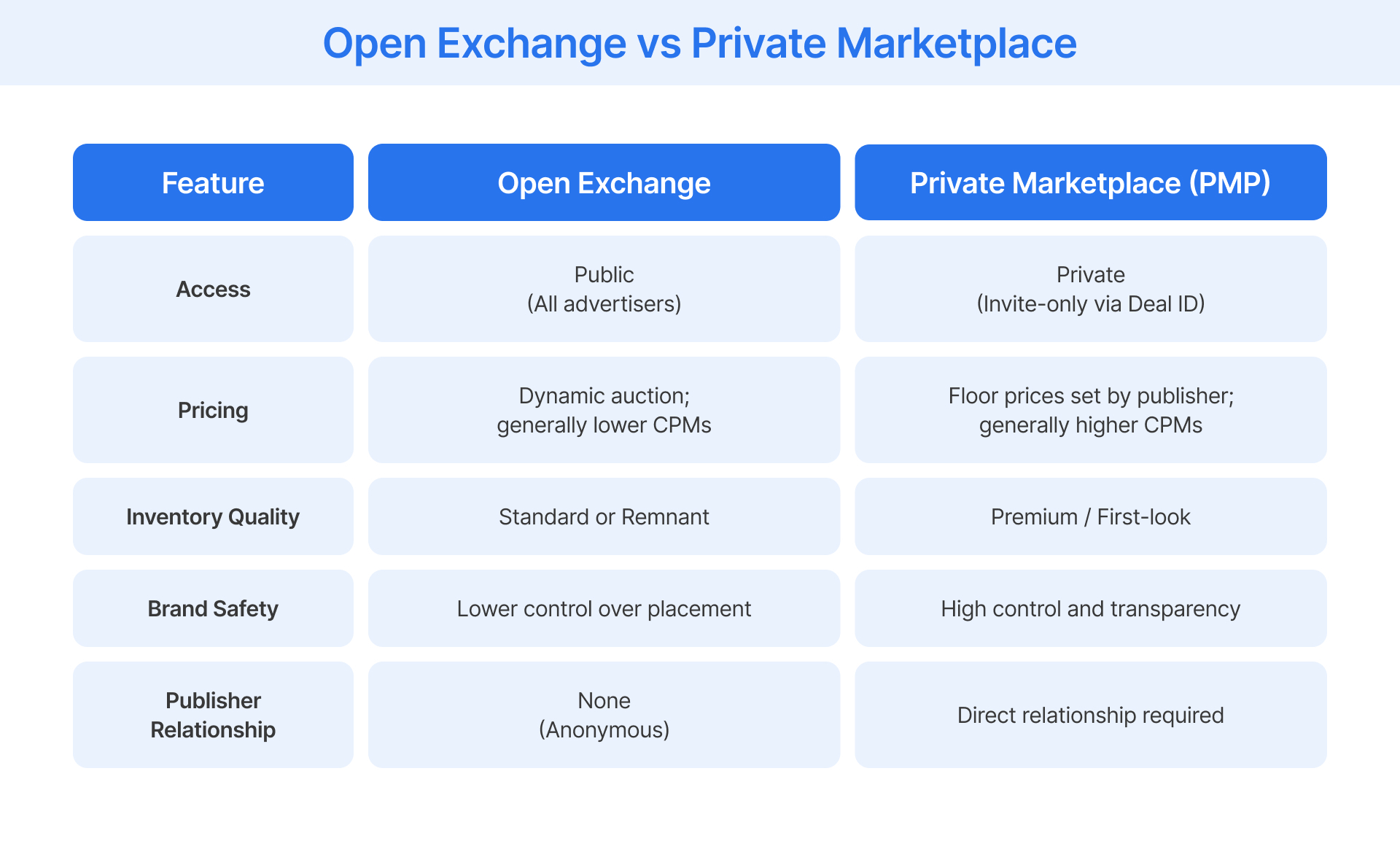
Programmatic advertising relies on two primary ecosystems to facilitate the automated buying and selling of digital inventory: Private Marketplace and Open Exchange. These frameworks serve different strategic objectives by balancing the need for massive scale against the requirement for exclusivity.
The Open Exchange (Open Auction)
The Open Exchange involves a Real-Time Bidding environment where publishers make their inventory available to the general market. Any advertiser can bid on impressions without a direct relationship.
- Accessibility: It functions as a public auction where barriers to entry remain low for most digital advertisers seeking scale.
- Inventory Type: The available space often consists of remnant inventory that was not sold through direct deals.
- Transparency: Advertisers may not know the exact URL where their ad will run during the campaign.
- Primary Use Case: This method works best for advertising campaigns prioritizing maximum reach plus lower Cost Per Mille across sites.
The Private Marketplace (PMP)
A Private Marketplace ads setup functions as an invite-only auction. Publishers invite specific advertisers to bid on their premium inventory using a unique identifier known as a Deal ID.
- Accessibility: Participation remains restricted to a select list of buyers who receive an invitation from the publisher.
- Inventory Type: Publishers offer their premium inventory or first-look access to high-quality placements on their digital properties.
- Transparency: The level of transparency is high as buyers know exactly where their ads will appear.
- Primary Use Case: Brands utilize this for campaigns prioritizing ad quality plus brand safety and exclusive first-party data access.
What Are the Different Types of PMP Deals
Advertisers can access Private Marketplace ads through various deal structures, depending on their specific campaign goals and budgets.
- Private Auctions: This format represents the standard PMP setup where a small group bids above a set floor price. The highest bidder wins the impression while the publisher maintains a minimum value.
- Preferred Deals: You get the first look at inventory at a fixed price before it goes to open auction. If you choose to pass on the opportunity the impression moves to the general market.
- Programmatic Guaranteed: You agree to buy a specific amount of impressions at a negotiated price. It functions as a direct deal executed automatically to ensure the campaign is delivered on the publisher site.
What Are the Benefits of PMP Ads?
Implementing Private Marketplace ads offers distinct advantages for both sides of the advertising ecosystem. Retailers and publishers gain better control over their media buying and selling processes.
Let's have a look at the range of benefits of PMP advertising:
For Advertisers
- Brand Safety: You know exactly where your ad is running which prevents awkward placements next to questionable content. This transparency ensures that your brand message aligns with high-quality environments.
- First-Party Data Access: Publishers in a PMP often share richer data layers that are not available on the open web. Retail Media Networks use this to provide access to high-intent shopper data.
For Publishers
- Higher Yield: Premium inventory commands premium CPMs because advertisers are willing to pay more for quality. Publishers maximize their revenue potential by packaging their best assets for a select group.
- Control: You decide who is allowed to advertise on your site and maintain strict quality standards. This prevents low-quality ads from degrading the user experience while fostering long-term relationships.
Upgrade Your Ad Inventory with Flipkart Commerce Cloud
Private marketplace advertising gives retailers greater control over how premium ad inventory is made available to selected advertisers. This can be especially valuable for retailers looking to monetize high-intent audiences while maintaining stronger standards around ad quality, placement, and brand safety.
Flipkart Commerce Cloud helps retailers build on this opportunity through its Retail Media Platform, giving them the infrastructure to manage and monetize advertising across their digital properties. Retailers can use their first-party shopper data to create more relevant advertising opportunities while maintaining control over how inventory is offered and where ads appear.
FCC Ads Manager further supports this by providing advertisers with a self-serve environment to create and manage campaigns. Together, these capabilities can help retailers simplify advertising operations, give brands easier access to valuable retail audiences, and create additional revenue from their existing digital traffic.

FAQ
Programmatic Direct and Private Marketplace ads are distinct concepts. Programmatic Direct involves a one-to-one relationship where inventory is guaranteed and sold at a fixed price without an auction. PMP involves an auction environment where a select group of buyers bid against each other above a floor price.
A Deal ID is a unique numeric or alphanumeric code that identifies a specific agreement between a publisher and a buyer. Advertisers use this identifier to bid on the invitation-only inventory within the demand-side platform. It ensures that the bid is recognized as part of the exclusive PMP arrangement.
Private Marketplace ads generally cost more than open exchange ads because of the quality of the inventory. Advertisers pay a premium for brand safety plus transparency and access to exclusive first-party data. The higher CPM is justified by the increased performance and reduced risk associated with these premium placements.
You access a Private Marketplace by establishing a relationship with a publisher or a supply-side platform. The publisher must whitelist your account and provide a Deal ID for the specific inventory. You then enter this ID into your demand-side platform to begin bidding on the exclusive inventory available there.
A Private Marketplace (PMP) does not completely eliminate fraud, but private marketplace advertising significantly reduces ad fraud risks compared to an open ad exchange. Granting exclusive access to a select group of advertisers and vetted publishers creates a secure environment that drastically limits invalid traffic, domain spoofing, and bot impressions common in the open market