
June 24, 2026
What Is Price Dumping?
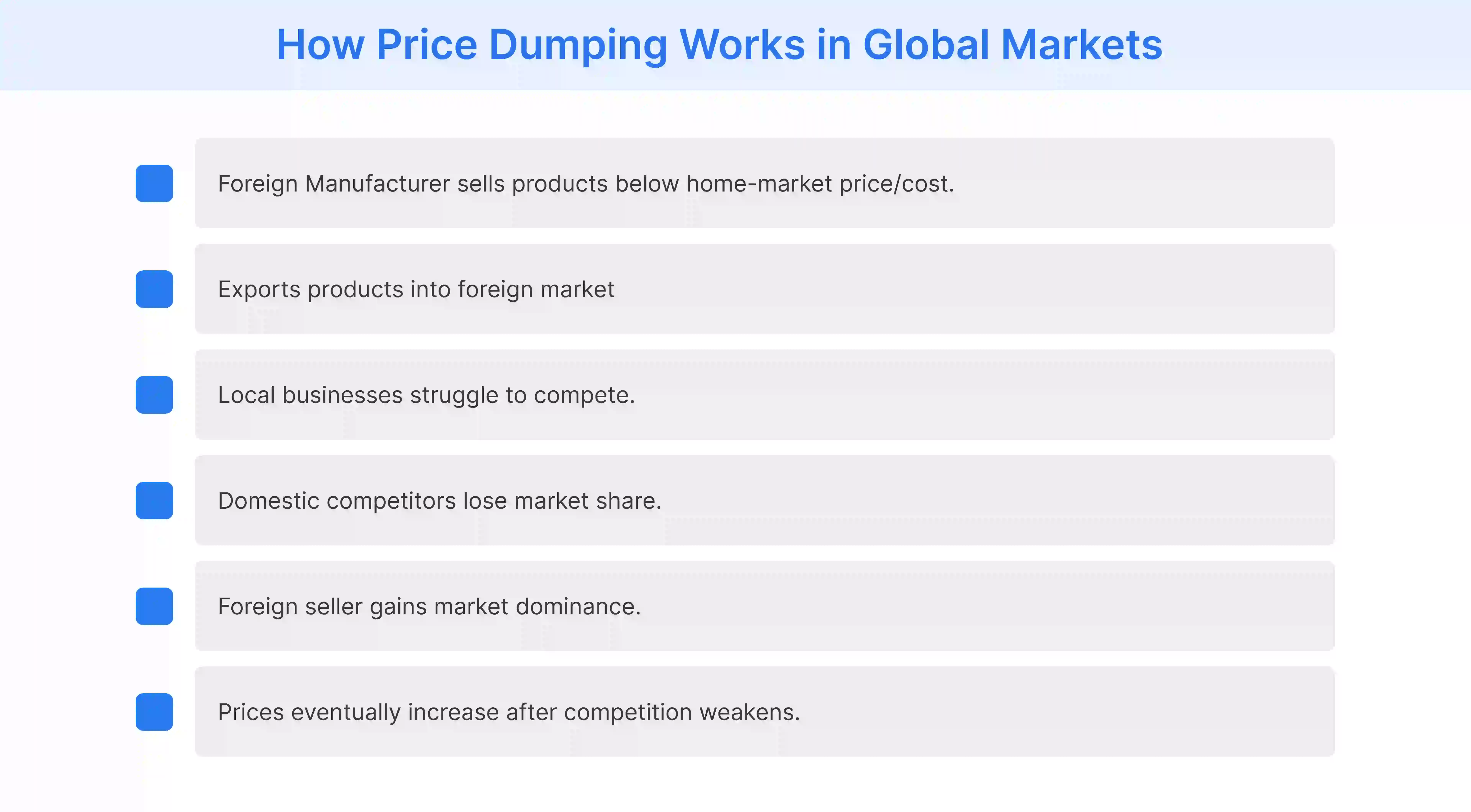
Price dumping is an unfair trade practice where a company sells products in a foreign market at prices below its home-market price or production cost to gain market share and weaken local competitors.
Drishti, Manager - Digital Marketing

Table of Contents
- What Is Price Dumping?
- Types of Price Dumping in International Trade
- Key Characteristics and Market Impacts of Price Dumping
- Real-World Examples of Price Dumping in Ecommerce
- How to Calculate Dumping Margin
- How Governments Combat Price Dumping and Protect Markets
- Strategy to Protect Your Ecommerce Channels From Price Dumping
- Price Dumping vs. Predatory Pricing vs. Loss Leader Pricing
- Conclusion
What Is Price Dumping?
Price dumping occurs when a manufacturer or exporting country introduces products into a foreign market at a price below the normal value of that product in its home market, or below its cost of production. Under the World Trade Organization's Anti-Dumping Agreement, a product is formally considered dumped when its export price is less than the comparable price charged in the ordinary course of trade in the domestic market of the exporter.
The objective is to flood the importing country with artificially low prices, undercutting local businesses, eroding domestic industry, and positioning the foreign company to gain market share or establish long-term pricing control in that market. While buyers may benefit temporarily from lower prices, such practices cause lasting damage to domestic producers and distort free trade.
Types of Price Dumping in International Trade
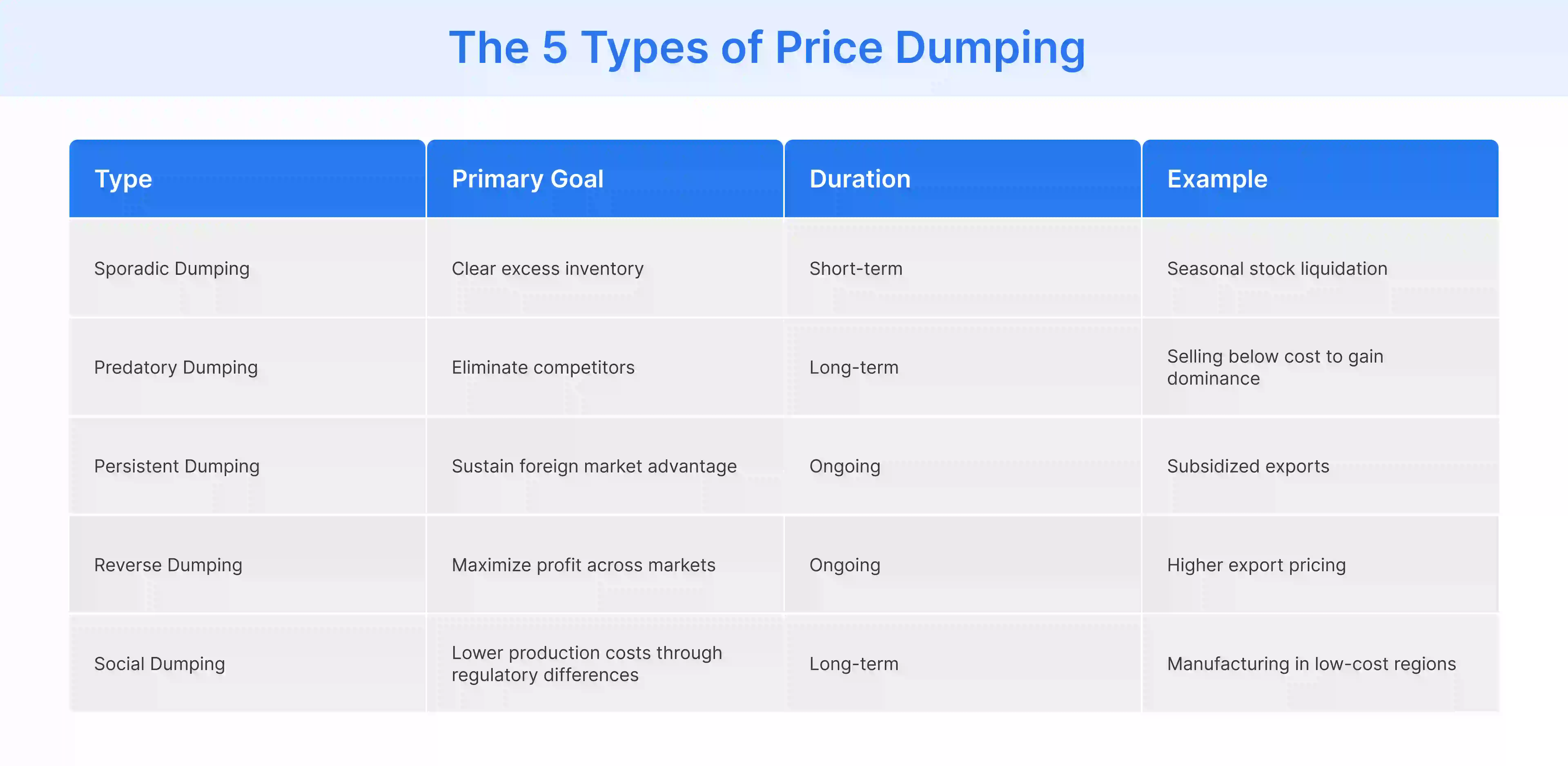
Price dumping takes different forms depending on the intent, duration, and market context of the exporting country. Understanding the different types of dumping helps domestic companies and regulators identify which legal remedies apply.
Sporadic Dumping
Occurs when a brand has an unexpected surplus of unsold inventory and unloads it into a foreign market at a much lower price to clear warehouse space. It is short-term and typically not driven by a strategic intent to harm local industries, but it still disrupts domestic market pricing when it happens.
Predatory Dumping
The most harmful type. A foreign company deliberately sells goods in the importing country at a price below production costs, absorbing losses in the short term, with the explicit goal of driving domestic producers out of business. Once local competition is eliminated, the exporting company raises prices to recoup losses and dictates terms. Predatory dumping is a direct form of unfair competition and is the primary target of anti-dumping investigations globally.
Persistent Dumping
A long-term strategy where a foreign producer continuously charges lower prices in foreign markets than in its home country, typically sustained by foreign government subsidies. Persistent dumping systematically undermines the domestic industry of the importing country over time and is the most difficult to combat because it is structurally embedded in the exporter's pricing model.
Reverse Dumping
An inverted scenario where a brand sets a lower price in its highly competitive home market to maintain market share domestically, while charging a premium price in foreign markets where demand is high and competition is low. Less common, but it illustrates how different markets can produce different prices for identical goods from the same producer.
Social Dumping
Occurs when a foreign producer gains a competitive edge by operating in a country with significantly lower labor standards, wages, or environmental regulations, allowing them to manufacture at a fraction of the production costs of domestic companies in the importing country. Social dumping is a form of unfair competition that is harder to address through standard anti-dumping duties because the price advantage stems from systemic regulatory gaps rather than direct pricing manipulation.
Key Characteristics and Market Impacts of Price Dumping
- Non-Cost Related Price Reductions: The price of a product being dumped has no relationship to genuine manufacturing efficiency gains or lower raw materials costs. The price drop is deliberate and strategic, designed to disrupt the domestic market of the importing country, not to pass on real savings.
- Asymmetrical Regional Pricing: The exporting country maintains profitable prices in its home market while running at a loss in the target foreign market. This situation of international price discrimination, different prices in different markets for the same product, is the definitional basis for a dumping determination under the WTO framework.
- Destruction of Local Competition: Artificially low prices from dumped goods force local industries to match unsustainable price floors or exit the market entirely. Domestic companies that cannot absorb losses at the same scale as a subsidized foreign producer have no viable competitive response.
- Long-Term Consumer Harm: While the importing country's buyers enjoy temporary bargains, once local businesses are displaced, the dumping entity raises prices sharply. The short-term price benefit converts into long-term market dependency on a foreign producer with no remaining domestic competition to check its pricing behavior.
Real-World Examples of Price Dumping in Ecommerce
- Cross-Border Counterfeit Flooding: Unverified manufacturers list replica goods on global online marketplaces at extremely low-cost prices, bypassing the production costs of legitimate brands. These dumped goods undercut authorized sellers, damage brand equity in the foreign market, and break intellectual property law simultaneously.
- Surplus Inventory Unloading: Large international apparel platforms dump end-of-season warehouse inventory into a foreign market's digital channels at a loss to clear space. The sudden influx of goods at a much lower price than local boutique ecommerce stores can match constitutes sporadic dumping, even when it is not strategically intended.
- Marketplace Platform Penetration: Well-funded foreign brands launch an aggressively low-price entry across international digital storefronts, subsidizing temporary losses through venture capital or foreign government support to push domestic producers off search rankings and capture market share. This is predatory dumping executed through ecommerce channels, and it is increasingly the subject of trade complaints filed with the International Trade Commission and the Department of Commerce in the United States.
How to Calculate Dumping Margin?
The dumping margin is the legally defined difference between the normal value of a product in the exporting country's domestic market and its export price in the importing country. Authorities conducting anti-dumping investigations use a fair comparison between these two figures to establish whether dumping has occurred and by how much.
|
Formula: Dumping Margin = Normal Value (Domestic Price in Exporting Country) − Export Price (Price in Importing Country) |
Example: A foreign producer sells a consumer device for $100 in its home country but exports it to the importing country's ecommerce market for $60. The dumping margin is $40. If this margin exceeds the de minimis threshold, set at 2% of the export price under the WTO Anti-Dumping Agreement, it qualifies as actionable dumping and can trigger the imposition of anti-dumping duties.
The normal value of the product is calculated using three WTO-approved methods:
- The price in the exporter's domestic market
- The price charged by the exporter in a third country, or
- A constructed value based on production costs plus reasonable profit margins.
How Governments Combat Price Dumping and Protect Markets?
Governments use several regulatory instruments to counter dumped goods and restore fair conditions for domestic industries. Under the General Agreement on Tariffs and Trade (GATT) Article VI, members of the WTO are permitted to take action against dumping where sufficient evidence of material injury to the domestic industry can be demonstrated.
- Anti-Dumping Duties: Special tariffs applied by the government of the importing country to the allegedly dumped product, calibrated to close the gap between the export price and the normal value. Anti-dumping duties are the primary corrective tool and are applied on a product-specific and country-specific basis following a formal investigation. In the United States, the Department of Commerce determines dumping margins, and the International Trade Commission determines injury. In the European market, the European Commission administers this review process.
- World Trade Organization (WTO) Framework: The WTO does not directly penalize companies engaged in price dumping. Instead, it sets the global legal rules, through the Anti-Dumping Agreement, that allow the government of the importing country to investigate and impose provisional measures and final duties where relevant evidence of dumping and material injury is established. All members of the WTO are bound by this framework.
- Countervailing Duties (CVD): Extra duties applied specifically to neutralize the pricing advantage created by foreign government subsidies. Where a foreign producer's low prices are sustained by state support rather than genuine efficiency, CVDs are imposed alongside or instead of anti-dumping duties to create a level playing field for domestic companies. Steel products are among the most frequently subject to both anti-dumping and countervailing duty actions globally.
- Price Undertakings: An alternative to anti-dumping duties where the exporting country or foreign producer agrees to raise their export price to an agreed minimum level, removing the dumping margin without imposing a formal tariff. The European market commonly uses this mechanism as part of negotiated trade settlements.
Strategy to Protect Your Ecommerce Channels From Price Dumping
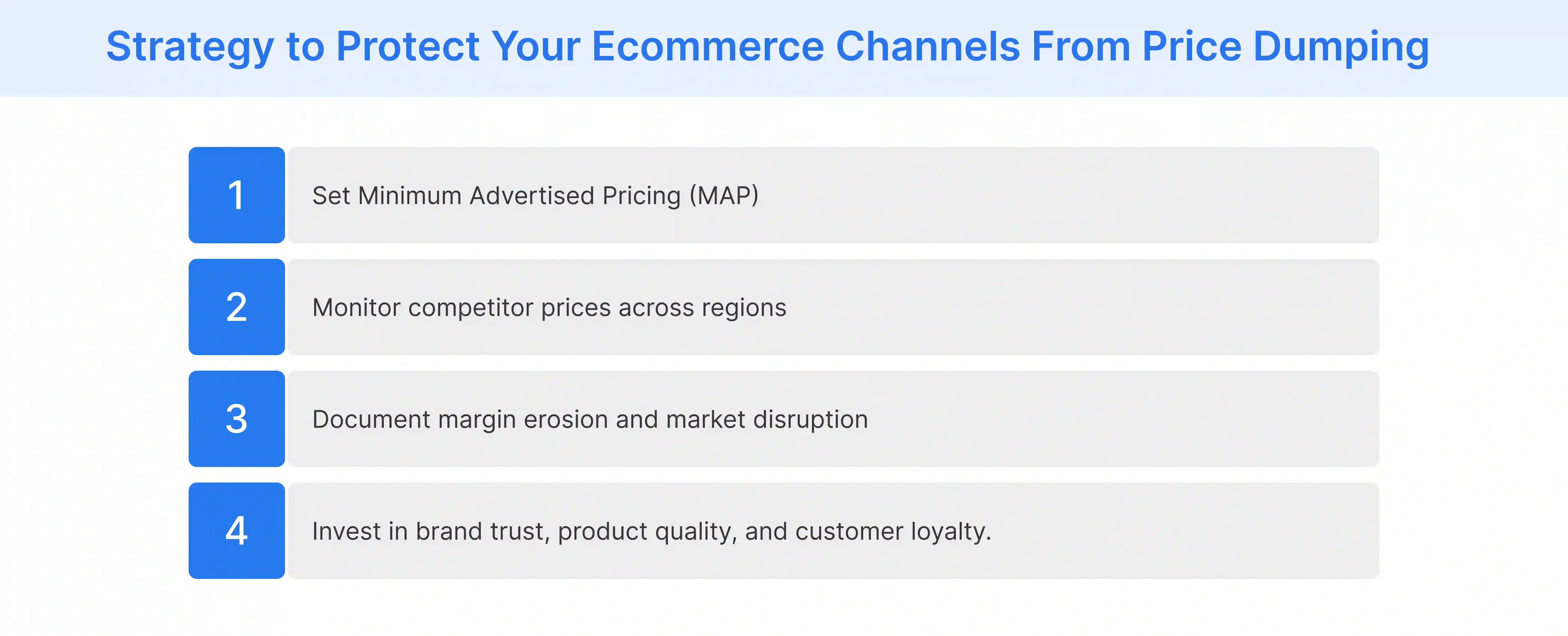
- Enforce Minimum Advertised Pricing (MAP): Set legally binding pricing floors with all authorized distribution partners. MAP agreements prevent unauthorized discounting that can be mistaken for, or exploited alongside, dumped goods flooding the same channel.
- Monitor Competitor Pricing Across Regions: Use automated price tracking tools to detect abnormal price drops from foreign competitors in real time. Identifying a pattern of artificially low prices across different markets early is essential for building a causal link between the dumped goods and injury to your domestic industry, a requirement for any formal trade complaint.
- Document Market Disruption: Maintain detailed logs of your sales data, margin erosion, and competitor pricing behavior. Relevant evidence and relevant economic factors, including lost market share, declining production costs recovery, and price suppression, are required to support an anti-dumping filing with the International Trade Commission or equivalent authority in your jurisdiction.
- Build Brand Equity That Price Cannot Replicate: Invest in customer loyalty, product differentiation, and brand narrative. A strong presence built on genuine quality and customer trust makes it significantly harder for dumped goods at a much lower price to displace your customer base, particularly among buyers who have moved beyond pure price comparison.
Price Dumping vs. Predatory Pricing vs. Loss Leader Pricing
All three involve selling at low prices, but their geographic scope, intent, and legal status are distinct.
- Loss Leader Pricing: A completely legal retail strategy where a product is sold at or below cost to drive traffic and increase purchases of other full-margin goods.
- Predatory Pricing: Illegal under domestic antitrust and competition law. A company sells below cost within its own domestic market to eliminate a specific competitor, with the intention of raising prices once that competitor exits.
- Price Dumping: Selling across international borders. A foreign company or exporting country sells goods in the importing country at a price below the normal value in its home country, not to attract foot traffic, but to gain market share, displace domestic producers, or achieve a long-term monopoly in the foreign market.
|
Pricing Tactic |
Target Geographic Scope |
Primary Intent |
Legal and Regulatory Status |
|
Loss Leader Pricing |
Local retail stores or single websites |
Attracting traffic to buy full-priced goods |
Completely legal; standard retail practice |
|
Predatory Pricing |
Domestic or nationwide market |
Intentionally bankrupting local competitors to build a monopoly |
Illegal under national antitrust and competition laws |
|
Price Dumping |
International borders and foreign market |
Flooding foreign markets to displace domestic industry and dominate global trade |
Subject to anti-dumping duties and WTO trade penalties |
Conclusion
Price dumping distorts international trade by introducing goods into a foreign market at artificially low prices that domestic producers cannot compete with on equal terms. Whether sporadic, predatory, or persistent, it causes measurable harm to local industries and, ultimately, to the consumers who lose domestic competition as a result.
For cross-border ecommerce brands, surviving international pricing disruptions requires both market vigilance and operational precision. Tracking shifting regional tariffs, monitoring multi-country pricing positions, and maintaining compliant catalog data manually creates compounding operational friction. Flipkart Commerce Cloud provides the automation backbone to manage this at scale, combining ML-powered pricing tools with advanced [Demand Forecasting] so cross-border brands can set localized pricing guardrails that adapt to local market realities. This protects your [Catalog Management] and [Inventory Management Systems] from accidental pricing violations, keeping your online business compliant, competitive, and shielded from cross-border pricing shocks.

FAQ
Price dumping in simple terms is when a foreign company exports products to another country at a price significantly below what it charges in its home market or below its cost of production. The goal is to undercut local businesses, capture market share, and drive domestic producers out of the importing country's market through artificially low prices.
Dumping is not the same as price discrimination, but it involves a similar mechanism. Price discrimination means charging different prices in different markets for the same product. Dumping is a specific situation of international price discrimination where the export price falls below the normal value in the exporting country, making it actionable under the WTO Anti-Dumping Agreement and domestic trade law.
The different types of dumping are sporadic, predatory, persistent, reverse, and social dumping. Each type differs in intent and duration: sporadic dumping clears surplus inventory, predatory dumping eliminates domestic competition, persistent dumping is sustained by foreign government subsidies, reverse dumping charges more abroad than at home, and social dumping exploits lower labor or regulatory costs to undercut production costs in the importing country.
Dumping is considered a form of unfair competition because it uses artificially low prices, not genuine efficiency or innovation, to displace domestic industries in the importing country. It distorts free trade, causes material injury to domestic producers, and ultimately harms consumers by eliminating the local competition that keeps markets healthy and prices accountable over the long term.
The difference between dumping and predatory pricing is jurisdiction and legal framework. Predatory pricing occurs within a domestic market and is illegal under national antitrust law. Price dumping crosses international borders, a foreign producer sells in the importing country below normal value, and is governed by international trade law, specifically the WTO Anti-Dumping Agreement and GATT Article VI.
Price dumping creates short-term benefits for buyers in the importing country through lower prices and gives the exporting country a temporary competitive edge in foreign markets. The costs are high: domestic producers face unfair competition they cannot sustain, local industries contract or collapse, jobs are lost, and once competition is removed, the foreign company raises prices, eliminating the original consumer benefit.
To deal with competitor price dumping, enforce Minimum Advertised Pricing agreements with your distribution partners, monitor pricing across international channels using automated tools, and document all relevant evidence of market disruption, lost market share, margin erosion, and pricing patterns. If sufficient evidence of material injury exists, file a formal complaint with the International Trade Commission or the relevant authority in your jurisdiction. Flipkart Commerce Cloud's pricing automation helps brands track cross-border price anomalies in real time, supporting faster detection and response.