
March 26, 2026
Tiered Discounts
Tiered discounts are a structured pricing strategy where businesses offer progressively better price reductions as a customer's order quantity or spend increases. Each threshold a buyer crosses unlocks a greater level of savings, making larger purchases financially attractive.
Drishti, Manager - Digital Marketing

Table of Contents
- What Are Tiered Discounts?
- How Do Tiered Discounts Work?
- Different Types of Tiered Discounts
- What Is the Importance of Tiered Discounts?
- How Does a Tiered Discount Differ From a Volume Discount?
- How to Implement Tiered Discounts on Ecommerce Platforms
- What Are the Common Pitfalls of Tiered Pricing?
- Real-World Use Cases of Tiered Discounts
- Optimize Your Pricing Strategy With Flipkart Commerce Cloud
Tiered Discounts
Retailers across ecommerce and wholesale markets use pricing strategies designed to encourage customers to spend more while delivering measurable value at every purchase level they reach. Competitive markets demand smarter approaches, and tiered discounts have emerged as a great way to align retailer business goals with customer buying behavior, driving higher sales across product categories.
The flexibility of a tiered discount structure allows businesses to serve both budget-conscious shoppers and high-volume buyers within a single pricing model. This adaptability makes tiered discounts a proven path to higher revenue in retail environments where customer behavior and average order size vary widely across the product catalog.
- Tiered discounts give businesses a structured way to reward customers who purchase larger quantities consistently and repeatedly.
- Retailers use tiered discount structures to increase average order value and clear excess inventory faster and more efficiently.
- Shoppers gain better price points at each threshold, making larger purchases feel rewarding and genuinely worthwhile for the buyer.
- This pricing model helps retailers build a loyal customer base while driving higher conversion rates across the product catalog.
What Are Tiered Discounts?
Tiered discounts are a pricing strategy where businesses offer different pricing tiers with progressive price reductions based on the quantity a customer purchases in a single transaction. The more a buyer orders, the greater the discount they receive at each successive level.
This approach works by setting clear quantity thresholds that unlock progressively better deals for the shopper. Retailers define these thresholds in advance, so customers understand exactly how much they need to spend to qualify for the next discount level across the full price range they offer.
Unlike a flat discount applied to the entire order, tiered discounts apply different savings to different portions of the purchase. This structure is distinct from volume pricing, which applies one rate to all units, because it protects profit margins on lower-volume orders while encouraging customers to reach higher tiers for greater savings.
How Do Tiered Discounts Work?
Retailers must follow a clear set of steps to build an effective strategy using discount strategies that deliver strong results across online retail platforms.
- Step 1 - Identify High-Margin Products: Start by identifying high-margin products that can absorb price reductions without hurting profitability. Items with strong sales velocity and adequate markup are ideal starting points for a tiered pricing strategy.
- Step 2 - Set Quantity Thresholds: Select quantity thresholds that reflect realistic customer shopping behavior on your platform. Each milestone should feel attainable to buyers while remaining commercially sound for the business running the discount pricing strategy.
- Step 3 - Assign Tier Values: Display pricing tiers clearly on product pages so buyers see available savings before checkout. A well-presented tier breakdown reduces purchase hesitation and directly supports higher conversion rates across the platform.
- Step 4 - Promote the Structure: Promote the tiered pricing structure across email and social channels to maximize buyer awareness. Strong promotional reach drives new customers to attempt larger purchases from the beginning of their shopping journey.
- Step 5 - Monitor and Refine: Review sales data and key metrics to determine whether each discount level meets its revenue target. Performance insights help retailers continuously refine discount tiers and protect profit margins.
Different Types of Tiered Discounts
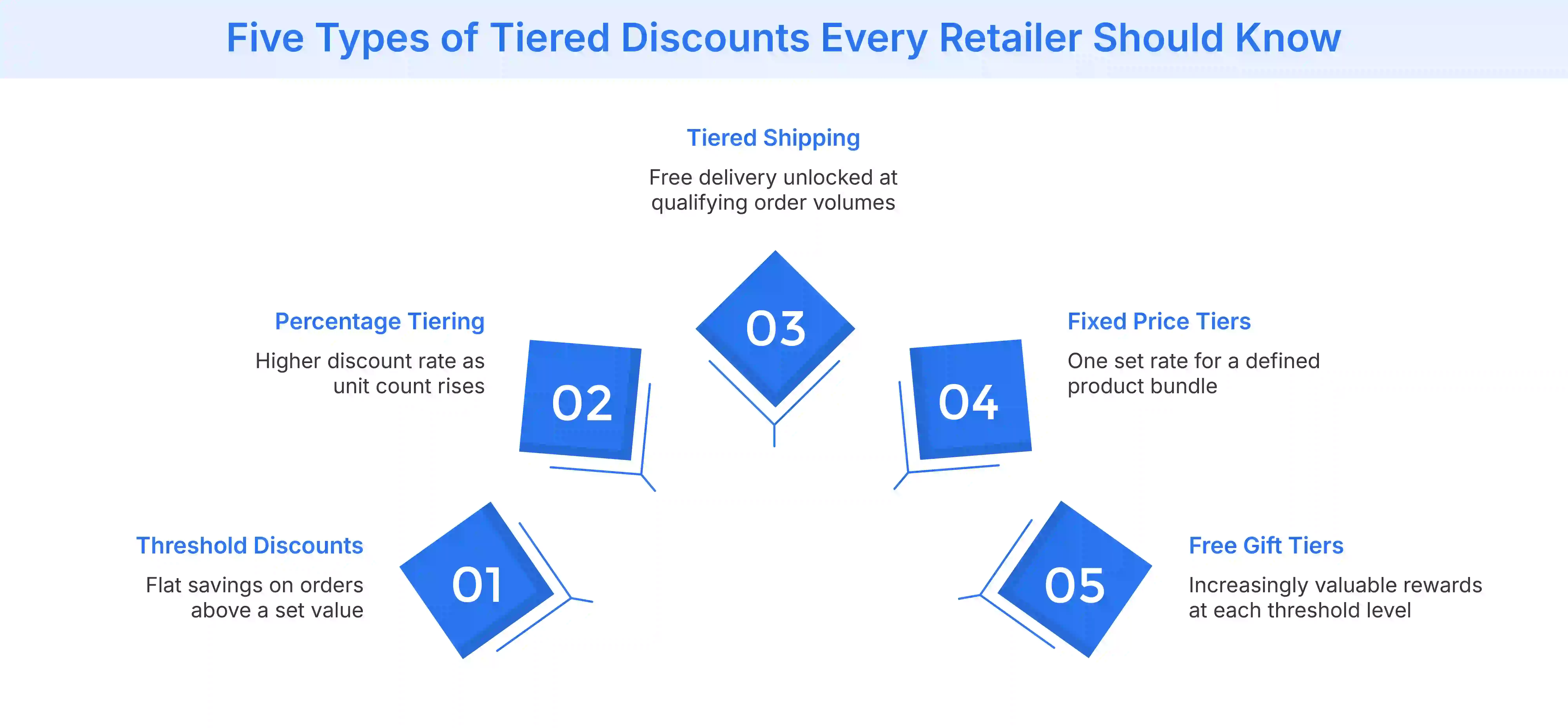
Tiered discounts exist in several forms, and each type serves a specific retail objective and customer purchasing pattern worth understanding.
- Threshold Discounts: Threshold discounts give customers a flat reduction when their total spending reaches a set amount. A retailer might offer 10% off any order that exceeds a specific monetary value at checkout, rewarding bigger cart sizes immediately.
- Percentage Tiering: Percentage tiering increases the discount rate as the unit count rises within a single order. A retailer might offer 5% off for orders of 10 units and 15% off for orders of 25 units across different pricing tiers.
- Tiered Shipping: Tiered shipping reduces or eliminates delivery costs once a customer's order reaches a qualifying volume. An ecommerce store might offer free shipping for orders above a defined cart value, rewarding buyers who make bigger purchases to qualify.
- Fixed Price Tiers: Fixed price tiers offer a set rate for a defined product bundle regardless of individual item costs within it. A retailer might sell any combination of 20 products from a selected category at a single flat price, giving buyers clear pricing options from the start.
- Free Gift Tiers: Gift tiers reward customers with increasingly valuable items as their order reaches higher thresholds. A store might offer a basic product sample at the basic tier and a premium item with distinct feature sets at the next level.
What Is the Importance of Tiered Discounts?
Tiered discounts deliver measurable benefits to retailers and shoppers alike, supporting customer satisfaction and customer retention well beyond the initial transaction.
- They help businesses clear out excess inventory quickly by giving customers a financial reason to purchase products in larger volumes.
- Stores see a significant increase in average order value as shoppers add more items to reach the next discount level.
- Shoppers feel they receive exceptional value from each transaction, which builds lasting trust and strengthens their loyalty to the brand.
- Retailers attract new customers who actively search for bulk purchasing deals and larger order discounts before making a buying decision.
- Companies improve cash flow by securing larger immediate sales rather than waiting for customers to return for multiple smaller purchases.
How Does a Tiered Discount Differ from a Volume Discount?
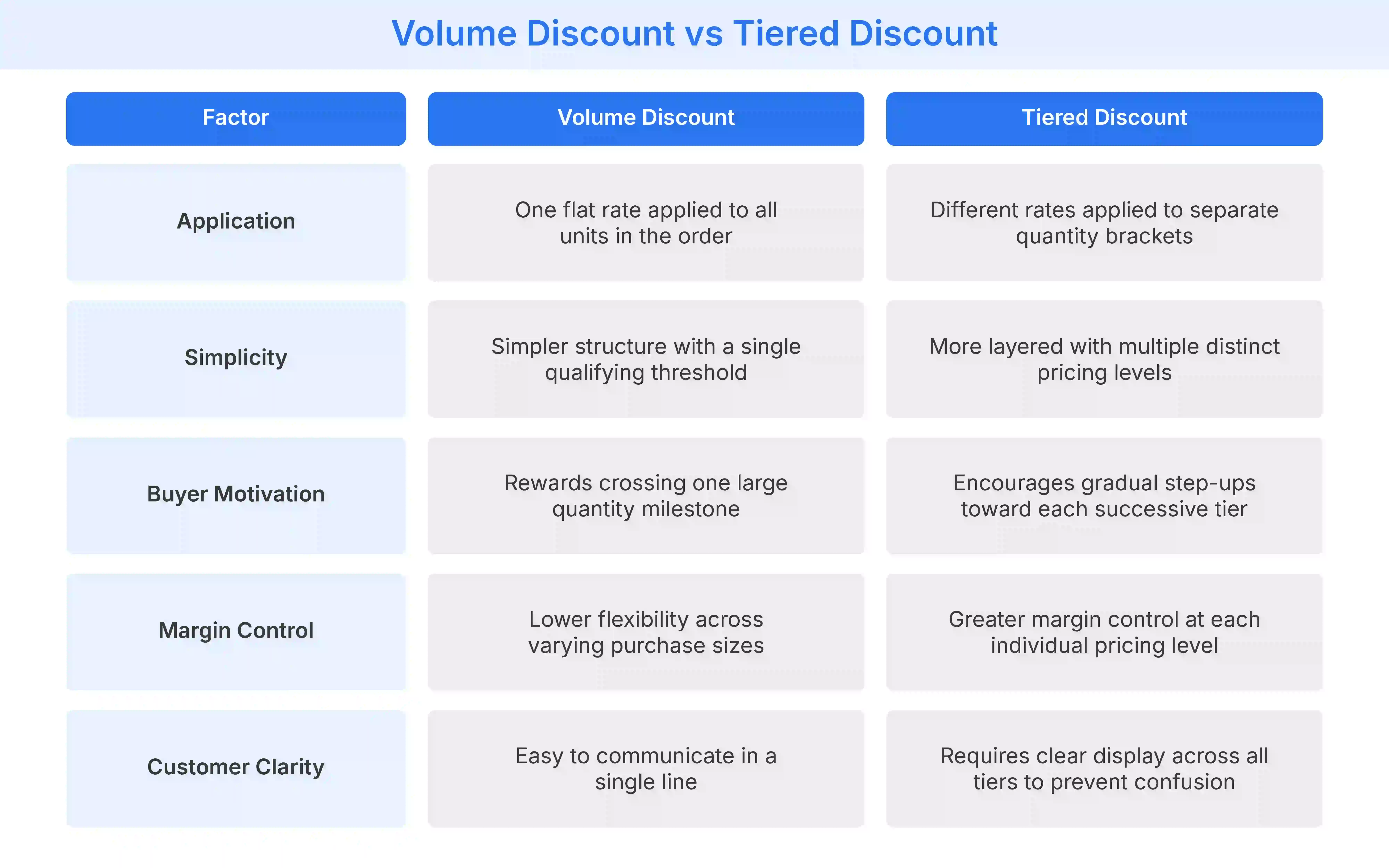
Volume discounts and tiered discounts both reward buyers for larger purchases, making them easy to confuse at first. The core difference lies in whether the discount applies to the total order or to specific quantity brackets within it.
Volume discounts apply a single rate to every unit once a threshold is reached, while tiered discounts apply different rates to different quantity ranges within the same order.
Let’s have a look at the key differences between these two pricing approaches:
Retailers managing high-volume order processing can explore FCC's order management system to see how automated workflows support complex discount and fulfillment operations.
How to Implement Tiered Discounts on Ecommerce Platforms?
Retailers follow a clear set of practical steps to build a tiered discount structure that performs well across ecommerce platforms.
- Step 1 – Identify Suitable Products: Start by identifying high-margin products that can absorb price reductions without hurting profitability. Items with strong sales velocity and adequate markup are ideal starting points for a tiered pricing strategy.
- Step 2 – Define Clear Milestones: Select quantity thresholds that reflect realistic customer shopping behavior on your ecommerce platform. Each pricing tier milestone should feel attainable to buyers while remaining commercially sound for the business.
- Step 3 – Display Tiers on Product Pages: Present each pricing tier clearly on product pages so buyers see available savings before proceeding to checkout. A well-structured tier breakdown reduces hesitation and supports higher conversion rates across the platform.
- Step 4 – Promote Across Channels: Promote the tiered pricing structure across email and social channels to maximize buyer awareness. Strong promotional reach drives new customers to attempt larger purchases from the beginning of their shopping journey.
- Step 5 – Analyze and Refine: Review sales data and key metrics to determine whether each discount level meets its revenue target. Performance insights allow retailers to refine discount tiers and protect profit margins over time.
What are the Common Pitfalls of Tiered Pricing?
Retailers must avoid several common mistakes when designing a tiered discount structure to keep it profitable and clear for buyers.
- Overcomplicating the pricing tiers with too many levels confuses customers and pushes them toward competitors with simpler pricing structures.
- Setting the entry threshold too high discourages casual shoppers from participating and reduces the strategy's impact on overall conversion rates.
- Offering discounts that are too deep at higher tiers erodes profit margins and makes the tiered pricing model financially unsustainable over time.
Real-World Use Cases of Tiered Discounts
Tiered discounts are widely used across industries, with each application designed around the specific buying behavior of the customer base.
- Software Subscriptions: Software providers charge full price for a base number of seats and apply a lower rate for additional users beyond that tier. This model makes scaling affordable for growing teams while increasing the software provider's customer lifetime value.
- Wholesale Purchases: In wholesale purchasing, buyers pay standard per-unit rates up to a defined quantity and receive lower rates beyond that level. This rewards bulk orders and helps retailers reduce the cost of goods through better inventory management approach.
- Retail Bundles: Retail stores apply tiered discounts to product ranges, charging full price for initial units and less for each additional one. A buyer paying standard price for two items might receive the next unit at a significantly lower rate within the same purchase.

Optimize Your Pricing Strategy With Flipkart Commerce Cloud
Designing an effective tiered discount structure requires a deep understanding of customer behavior and real-time market dynamics. Retailers must identify the optimal price points that drive revenue growth without reducing profit margins across their product lines.
Flipkart Commerce Cloud provides retailers with the advanced features needed to build and manage smarter pricing strategies at scale. Use the platform to monitor market shifts and respond to competitor pricing changes before they impact revenue across your key product categories.
FCC Pricing Manager applies machine learning to power demand forecasting and dynamic pricing across the product catalog. Retailers can monitor competitor prices and analyze historical data to set discount levels that protect profit margins and sustain sales volume.
With FCC, retailers gain full visibility into pricing performance and the tools to refine their tiered discount system over time. Request a demo today to see how Flipkart Commerce Cloud transforms pricing decisions into sustainable, measurable revenue growth for your business.

FAQ
Yes, tiered discounts work well for digital products such as software licenses and online course access. Businesses can set seat-based or feature-based pricing tiers that reward buyers who purchase additional licenses, making scaling more affordable for growing teams and businesses.
Retailers should review their tiered discount structure at least once per quarter. Seasonal demand shifts and changes in competitor pricing are strong signals to reassess and adjust discount levels to maintain both competitiveness and healthy profit margins across the catalog.
Tiered discounts are highly effective during holiday sales periods because shoppers are already motivated to spend more. Combining tiered pricing with seasonal promotions encourages larger cart sizes and helps retailers boost sales while managing inventory levels and cash flow more efficiently.
Dedicated pricing platforms, such as FCC Pricing Manager, calculate tiered pricing based on real-time data and machine learning. These tools eliminate manual errors and allow retailers to update discount tiers quickly without disrupting the live shopping experience for customers on the platform.
Tiered discounts encourage repeat purchases by giving customers an ongoing reason to return and spend more to reach the next discount level. Over time, this pricing strategy builds a loyal customer base that associates the brand with consistent value and rewarding shopping experiences.