
September 29, 2026
Multi-Store Ecommerce and the Growth of Connected Storefronts
Multi-store ecommerce is an approach that allows businesses to operate multiple online storefronts from a shared commerce environment while tailoring each store to different brands, markets, regions, or customer groups.
Drishti, Manager - Digital Marketing

Table of Contents
- What Is Multi-Store Ecommerce?
- How Does Multi-Store Ecommerce Work?
- Why Do Retailers Use Multi-Store Ecommerce?
- What Are the Benefits of Multi-Store Ecommerce?
- What Are the Challenges of Multi-Store Ecommerce?
- What Are Common Multi-Store Ecommerce Use Cases?
- What Is the Difference Between Multi-Store and Multi-Channel Ecommerce?
- What Should Retailers Look for in a Multi-Store Ecommerce Platform?
- How Can Retailers Manage Multiple Ecommerce Stores Effectively?
- Conclusion
Multi-Store Ecommerce and the Growth of Connected Storefronts
As an ecommerce business grows, it may need different storefronts to serve new markets, different brands, customer segments, regions, or business models. Each storefront may need its own products, pricing, content, and customer experience based on the audience it serves.
The challenge is giving individual stores enough flexibility without creating duplicated operations or fragmented systems. Managing separate storefronts independently can make product information, customer data, inventory, and other commerce operations harder to coordinate as the business expands.
Multi-store ecommerce provides a way to manage this growing complexity while allowing businesses to operate distinct storefronts for different markets and audiences. In this article, we discuss how multi-store ecommerce works, why retailers use it, its benefits and challenges, common use cases, and how multiple stores can be managed effectively.
What Is Multi-Store Ecommerce?
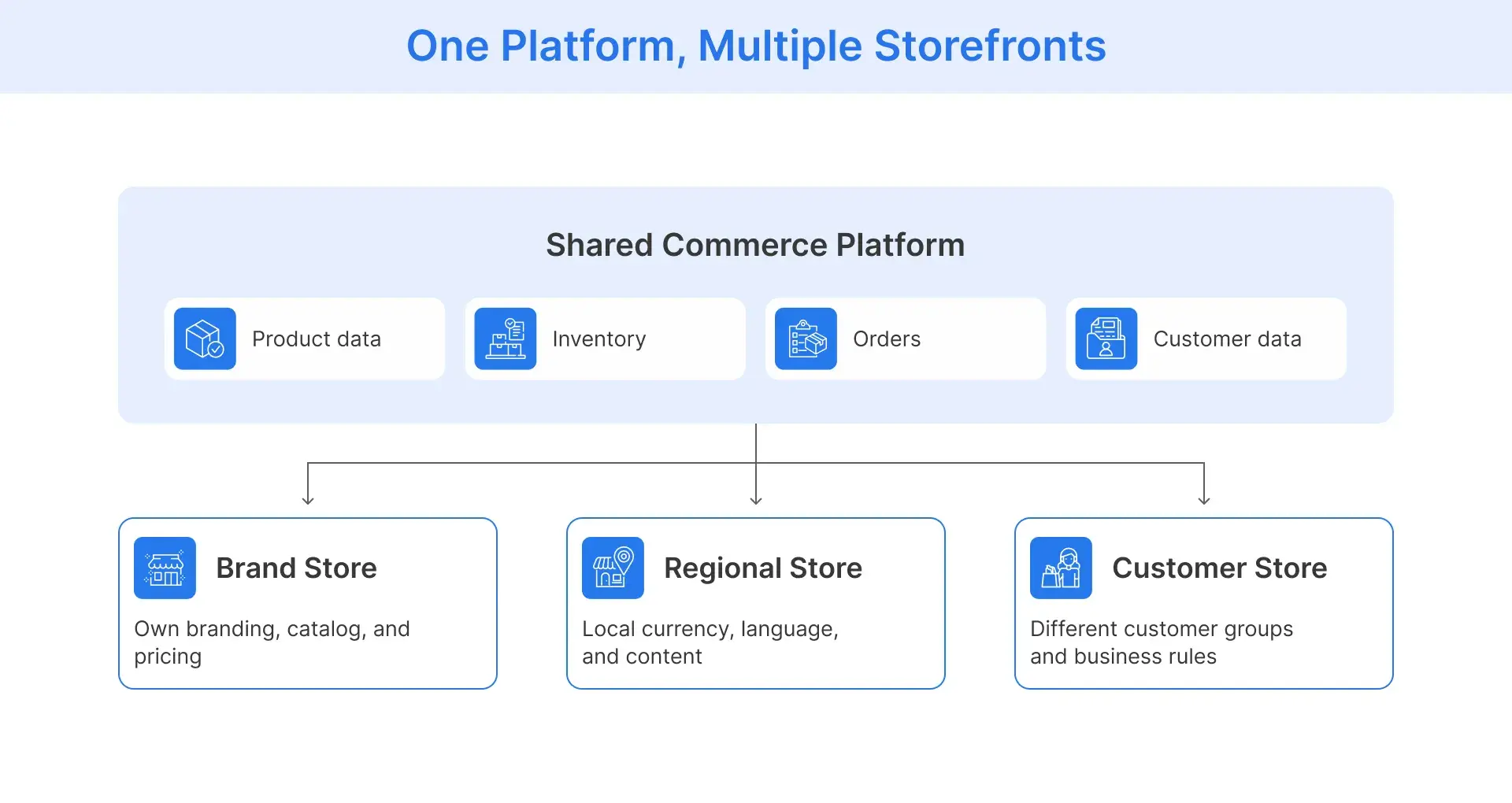
Multi-store ecommerce is an approach that allows businesses to operate multiple online storefronts within a shared commerce environment. Instead of building and managing each ecommerce store as a completely separate system, businesses can run several stores through shared infrastructure while maintaining store-specific configurations.
Each storefront can have its own domain, branding, product catalogs, pricing, currencies, languages, content, and business rules. This makes it possible to tailor each store to a specific market, region, brand, business unit, or customer group.
At the same time, selected technology, product data, customer information, and operational capabilities can be shared across stores, helping businesses avoid unnecessary duplication while preserving the independence of individual storefronts.
How Does Multi-Store Ecommerce Work?
Explain how multiple storefronts operate through shared commerce infrastructure while retaining store-specific configurations.
Cover centralized administration of areas such as product information, inventory, orders, integrations, and customer data where appropriate.
Explain how individual storefronts can maintain their own catalogs, prices, promotions, currencies, languages, content, domains, and customer experiences.
Introduce permissions and store-level rules that determine which information is shared and which can be managed independently.
Why Do Retailers Use Multi-Store Ecommerce?
Retailers use multi-store ecommerce when they need to serve different markets, brands, customer segments, or business models without building a completely separate commerce environment for each one.
- Expand into new markets: Retailers can launch storefronts for different regions and adapt pricing, currencies, languages, products, and content to local needs.
- Manage different brands: Businesses operating several brands can give each one a distinct storefront while sharing selected systems and operational capabilities.
- Serve different customer segments: Separate stores can be created for different audiences, customer groups, or niche markets with more relevant products and experiences.
- Support B2B and B2C operations: Retailers can operate different storefronts for business buyers and individual consumers while managing both through shared commerce infrastructure.
- Create localized shopping experiences: Storefronts can be tailored to the expectations, language, pricing, and product availability of specific markets.
- Use different pricing or product strategies: Individual stores can maintain different catalogs, prices, promotions, and commercial rules based on the market or audience they serve.
Using shared infrastructure helps reduce duplicated systems and administration while still giving different stores enough flexibility to serve their target audience effectively.
What Are the Benefits of Multi-Store Ecommerce?
Multi-store ecommerce allows retailers to manage multiple storefronts more efficiently while still tailoring each store to the market or audience it serves. Key benefits include:
- Centralized administration: Retailers can manage shared commerce operations from a central environment instead of maintaining separate systems for every store.
- Reduced duplication: Shared technology, product data, and operational processes can reduce repetitive work across different stores.
- Greater operational efficiency: Centralized management can make tasks such as catalog management, inventory updates, and store administration easier to coordinate.
- Easier expansion: Retailers can launch a new storefront for a different market, brand, or customer group without rebuilding the entire commerce environment.
- Greater control across stores: Businesses can determine which capabilities and information are shared while maintaining store-specific pricing, products, branding, currencies, languages, and customer experiences.
As the business grows, this shared foundation can make it easier to add additional storefronts and create more targeted shopping experiences and marketing strategies without duplicating the underlying commerce infrastructure.
What Are the Challenges of Multi-Store Ecommerce?
Managing multiple storefronts can create additional complexity, even when the stores share the same commerce infrastructure. Some of the main challenges include:
- Larger data volumes: Retailers need to manage growing amounts of product data, inventory information, orders, customer data, and content across different stores.
- Brand consistency: Different storefronts may need their own identity and positioning while still remaining consistent with broader brand standards.
- SEO and duplicate-content concerns: Similar product pages, descriptions, or content across stores can create SEO challenges if they are not managed carefully.
- Integrations: Connecting different storefronts with payment, fulfillment, marketing, analytics, and other systems can become more difficult as the operation expands.
- Store-specific configurations: Pricing, catalogs, currencies, languages, promotions, tax rules, and other settings may need to be managed separately for individual stores.
- Permissions and access: Businesses need clear controls over who can manage specific stores, data, and configurations.
- Additional resources: Operating multiple online stores can require more time, staff, and technical support as the number of storefronts grows.
- Operational coordination: Teams need to keep product information, inventory, orders, content, and other processes aligned across the wider multi-store operation.
Poorly configured shared infrastructure can also create problems if a change intended for one storefront affects another. Clear store-level rules, permissions, and controls help reduce this risk while preserving the flexibility each store needs.
What Are Common Multi-Store Ecommerce Use Cases?
Multi-store ecommerce can support different business models, markets, and customer groups while allowing businesses to manage several storefronts through shared commerce capabilities. Common use cases include:
- Managing multiple brands: A retailer with several brands can operate a separate storefront for each one while sharing selected technology, product data, and operational systems.
- International or regional storefronts: Businesses can create stores for different markets with localized currencies, languages, products, pricing, and content.
- B2B and B2C storefronts: A business can run separate stores for business buyers and individual consumers while managing both through the same commerce environment.
- Customer-specific stores: Retailers can create storefronts for particular customer groups, accounts, or audiences with tailored catalogs, pricing, or access.
- Niche or segmented storefronts: Businesses can operate stores focused on specific product categories, customer segments, or market needs.
- White-label operations: A company can support separate branded storefronts for different partners or business units while maintaining shared backend capabilities.
In each case, the storefronts can differ in how they look, what they sell, and who they serve while still sharing the underlying commerce infrastructure, data, and operational capabilities.
What Is the Difference Between Multi-Store and Multi-Channel Ecommerce?
Multi-store and multi-channel ecommerce both help retailers expand how they reach customers, but they refer to different approaches.
Multi-store ecommerce involves operating multiple distinct ecommerce storefronts, often through shared commerce infrastructure. Each store may serve a different brand, market, region, or customer group with its own products, pricing, content, and experience.
Multi-channel ecommerce, on the other hand, involves selling through multiple sales channels. These can include a retailer’s ecommerce website, online marketplaces, social commerce platforms, and other digital channels. A retailer can therefore use multi-store and multi-channel ecommerce at the same time. What is multi store ecommerc
|
Multi-Store vs. Multi-Channel Ecommerce |
||
|---|---|---|
|
Factor |
Multi-Store Ecommerce |
Multi-Channel Ecommerce |
|
Structure |
Multiple distinct ecommerce storefronts |
Multiple sales channels |
|
Purpose |
Serve different brands, markets, regions, or customer groups |
Reach customers through different selling channels |
|
Customer touchpoints |
Separate branded or localized storefronts |
Websites, marketplaces, social commerce, and other channels |
|
Management |
Stores may share infrastructure while retaining individual configurations |
Sales and operations are coordinated across different channels |
|
Example |
A retailer operates separate stores for different countries |
A retailer sells through its website, a marketplace, and social commerce |
What Should Retailers Look for in a Multi-Store Ecommerce Platform?
A multi-store ecommerce platform should make it easier to manage several storefronts without requiring a completely separate commerce system for each one. Key capabilities to look for include:
- Centralized store administration: Manage multiple stores from one environment while maintaining store-level control.
- Store-specific catalogs and pricing: Allow individual stores to maintain their own product catalogs, prices, promotions, and business rules.
- Inventory management: Coordinate stock levels across stores while preserving the flexibility to manage inventory differently where needed.
- Multiple currencies and languages: Support different markets with localized currencies, languages, and content.
- Product and catalog management: Make product data management easier across multiple storefronts while allowing local differences.
- Order management: Centralize order information and workflows across stores for better visibility and coordination.
- Integrations: Connect the ecommerce platform with payment, fulfillment, analytics, marketing, and other business systems.
- Permissions: Give teams the right level of access to specific stores, data, and configurations.
- Analytics: Monitor the performance of individual stores and the wider multi-store operation.
- SEO capabilities: Support store-specific URLs, metadata, content, and other SEO requirements.
- Scalability: Make it easier to launch a new storefront or expand into additional markets as the business grows.
The right platform should balance centralized control with enough flexibility for individual stores to manage the elements that need to remain unique.
How Can Retailers Manage Multiple Ecommerce Stores Effectively?
Managing multiple ecommerce stores effectively requires clear rules for what should be centralized and what should remain specific to individual stores. Some useful practices include:
- Define shared and store-specific responsibilities: Decide which data, processes, and capabilities should be managed centrally and which should remain under store-level control.
- Maintain accurate product information: Keep product information consistent across storefronts while allowing necessary local differences in catalogs, pricing, languages, and content.
- Coordinate inventory and orders: Connect inventory management and order management across stores to improve visibility into stock levels and order activity.
- Maintain brand consistency: Establish clear brand guidelines while allowing individual storefronts enough flexibility to serve their own markets and audiences.
- Use permissions and automation: Set appropriate access controls and use integrations, automation, and bulk updates to reduce repetitive administration across stores.
- Monitor storefront performance: Track each store individually while also reviewing performance across the wider multi-store operation.
As the number of stores grows, clear governance and centralized visibility can help retailers maintain control without limiting the flexibility individual storefronts need.
Conclusion
Multi-store ecommerce gives retailers the flexibility to operate distinct storefronts for different brands, markets, regions, and customer groups while sharing the commerce infrastructure and operational capabilities that do not need to be duplicated. The key is balancing centralized management with enough independence for each store to serve its own audience effectively.
Flipkart Commerce Cloud helps businesses build and scale digital commerce experiences across different storefronts and markets while maintaining centralized commerce capabilities. This makes it easier to manage growing multi-store operations without sacrificing the flexibility individual stores need as the business expands.

FAQ
A multi-store ecommerce solution enables businesses to build, manage, and scale multiple digital storefronts from a single dashboard. Merchants use this centralized architecture to control order fulfillment, process transactions, and manage catalog data across separate brands targeting different customer segments without operating isolated backend platforms.
Businesses adopt multi-store ecommerce software to target diverse customer segments, expand into new geographic markets, and manage distinct product lines effectively. Operating multiple web stores allows companies to customize localized pricing, payment methods, and marketing content, optimizing the customer journey while maintaining a master inventory database.
The best software for managing new stores depends on catalog size, technical complexity, and enterprise growth objectives. Robust enterprise platforms like Flipkart Commerce Cloud offer a unified system featuring centralized store management, enabling merchants to streamline inventory updates, process orders efficiently, and maintain complete operational control across expanding retail operations.
The difference between multi-store ecommerce and multi-vendor ecommerce comes down to ownership structure and brand administration. Multi-store architecture allows a single company to operate different digital storefronts using a single database, whereas multi-vendor marketplaces enable third-party sellers to list products on one shared site with a unified shopping cart.
Yes, multiple online storefronts can be managed seamlessly using a unified software platform that offers easy management. Retailers can update product details, manage marketing tools, adjust pricing rules, and handle customer support inquiries across all connected sales channels without logging into separate platforms or maintaining fragmented databases.
An example of multi-store ecommerce occurs when a retailer operates individual web stores for its primary consumer label, luxury boutique, and wholesale outlet. Each storefront features unique design, tailored branding, and localized catalog options, yet all connected sites share one underlying tech stack to drive higher conversion rates.