
November 26, 2026
What Is Price Margin and How Is It Calculated?
Price margin shows the percentage of a product’s selling price remaining after deducting its cost. Retailers use it to assess product profitability and guide pricing decisions.
Drishti, Manager - Digital Marketing

Table of Contents
- What Is Price Margin?
- How Is Price Margin Calculated?
- What Is an Example of Price Margin in Retail?
- How Do You Calculate Selling Price From a Target Margin?
- What Is the Difference Between Price Margin and Markup?
- Why Is Price Margin Important for Retailers?
- What Factors Affect Price Margins in Retail?
- What Are the Challenges of Maintaining Price Margins?
- How Can Retailers Protect and Improve Price Margins?
- Conclusion
What Is Price Margin and How Is It Calculated?
A product can generate steady sales without delivering the profit a retailer expects. Rising supplier costs, transportation expenses, and promotional discounts can reduce earnings from each sale, even when sales volumes remain strong.
Understanding price margins helps retailers assess how product costs and selling prices affect profitability. This article explains how to calculate price margin, interpret the results, distinguish margin from markup, and use margin information to make informed retail pricing decisions.
What Is Price Margin?
Price margin is the percentage of a product’s selling price that remains after deducting its cost of goods sold (COGS). The difference between the selling price and product cost represents gross profit in dollars, while expressing that difference as a percentage of the selling price gives the product’s gross profit margin.
In retail, price margin shows how much remains from each dollar of sales after covering the product’s cost, before other business expenses. It differs from a business’s net margin, which also accounts for additional costs such as rent, marketing, and taxes.
A higher selling price does not necessarily mean a higher margin. If product costs increase faster than the selling price, the retailer’s margin percentage can decline despite charging customers more.
How Is Price Margin Calculated?
To apply the margin formula, retailers need two figures: the selling price of a product and its cost of goods sold (COGS). Subtracting the product cost from the selling price gives the gross profit per unit. Dividing this amount by the selling price and multiplying by 100 expresses the margin as a percentage.
Price Margin (%) = [(Selling Price − Cost) ÷ Selling Price] × 100
The selling price is the denominator because price margin measures gross profit as a proportion of sales revenue. For example, a 30% margin means that 30% of the selling price remains after covering the product’s cost. Retailers can use this percentage to compare margins across products with different selling prices.
What Is an Example of Price Margin in Retail?
Suppose a retailer sells a backpack for $100, with a cost of goods sold of $70. The difference represents $30 in gross profit, giving the product a price margin of 30%.
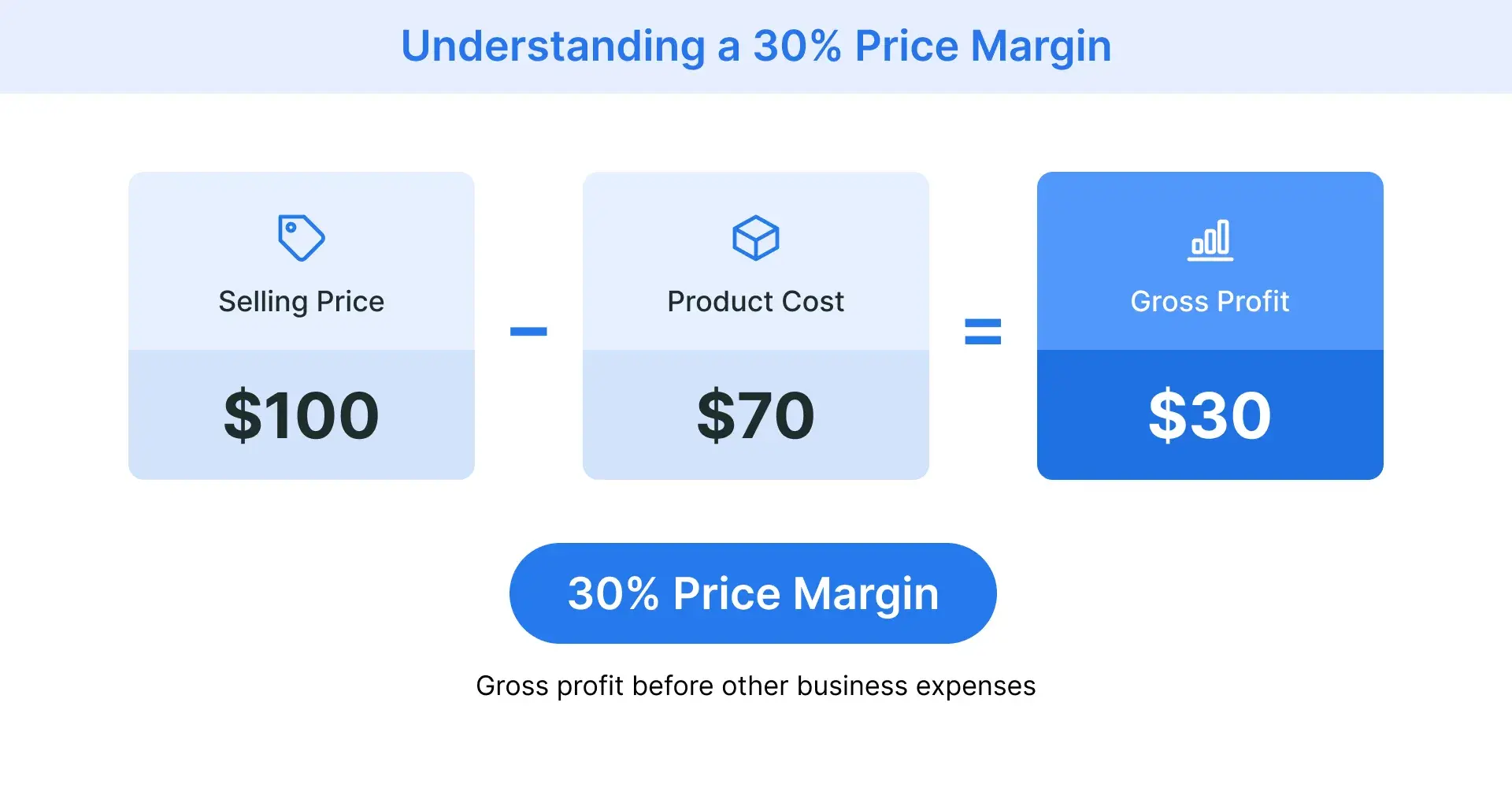
However, the $30 gross profit is not the retailer’s final net profit. Other business expenses, including rent, marketing, and administrative costs, must still be considered when assessing overall profitability.
How Do You Calculate Selling Price From a Target Margin?
Retailers can calculate the selling price needed to achieve a target profit margin by working backward from the product’s cost. Instead of applying a percentage increase to the cost, this calculation determines the selling price required for the desired margin.
Selling Price = Product Cost ÷ (1 − Target Margin Rate)
The target margin must be expressed as a decimal. For example, a 25% target margin becomes 0.25.
Suppose a retailer purchases a product for $60 and wants to achieve a 25% price margin.
- Product cost: $60
- Target margin: 25% (0.25)
- Required selling price: $60 ÷ (1 − 0.25) = $80
At a selling price of $80, the retailer earns $20 in gross profit, representing 25% of the selling price.
Simply adding 25% to the $60 product cost would produce a selling price of $75. That calculation represents a 25% markup, not a 25% margin. Understanding this distinction helps retailers avoid setting prices below their intended margin targets.
What Is the Difference Between Price Margin and Markup?
The main difference between price margin and markup is the basis used to calculate each percentage. Price margin measures gross profit as a percentage of the selling price, while markup measures how much is added to the product’s cost to determine its selling price.
Although both calculations involve cost and selling price, using the same percentage for margin and markup produces different results.
|
Price Margin vs. Markup |
||
|---|---|---|
|
Aspect |
Price Margin |
Markup |
|
Definition |
Percentage of selling price remaining after deducting product cost. |
Percentage added to product cost to establish a selling price. |
|
Calculation basis |
Selling price |
Product cost |
|
Formula |
[(Selling Price − Cost) ÷ Selling Price] × 100 |
[(Selling Price − Cost) ÷ Cost] × 100 |
|
Retail application |
Evaluating product profitability and comparing gross margins. |
Setting selling prices by adding a percentage to product cost. |
|
Example: $40 product cost, 20% target |
Requires a selling price of $50. |
Produces a selling price of $48. |
Retailers should distinguish between margin and markup when setting pricing targets. Confusing the two can result in selling prices that fall below the intended profit margin.
Why Is Price Margin Important for Retailers?
Price margin helps retailers understand how much gross profit different products generate relative to their selling prices. This information supports decisions about pricing, promotions, and product performance, particularly when businesses manage products with different costs and margins.
Key applications include:
- Comparing product profitability: Retailers can compare gross profit margins across products and categories to identify which items generate stronger returns relative to their selling prices.
- Evaluating selling prices: Margin information helps retailers assess whether proposed price changes will maintain their desired profitability levels.
- Assessing discounts and promotions: Retailers can evaluate how promotional discounts affect product margins and whether increased sales volumes compensate for reduced profit per unit.
- Monitoring product performance: Tracking margins over time helps retailers identify products whose profitability is declining, even when their sales revenue remains stable.
While price margins provide useful insights into product profitability, retailers must also consider operating expenses, sales volumes, and total revenue when assessing their overall financial health.
What Factors Affect Price Margins in Retail?
Price margins change when the cost of acquiring a product or the revenue earned from selling it changes. Retailers need to distinguish between these factors to understand what is affecting their gross profit margins.
Several factors can influence price margins:
- Supplier prices: Increases in wholesale or purchase prices raise the cost of goods sold (COGS). If retailers maintain the same selling price, their gross profit margin decreases.
- Acquisition costs: Transportation, import duties, and other direct costs of acquiring inventory can increase the total product cost, reducing margins unless selling prices are adjusted.
- Selling-price changes: Increasing a product’s selling price can improve its margin percentage when costs remain unchanged, while price reductions have the opposite effect.
- Promotional discounts and returns: Discounts reduce the revenue earned per sale, while refunds and costs associated with returned merchandise can affect the profitability of completed transactions.
- Competition and customer demand: Competitor prices and customers’ willingness to pay influence how much flexibility retailers have when setting prices. Strong price competition may limit their ability to pass rising costs on to customers.
While supplier and acquisition costs affect the expense side of the calculation, selling prices and discounts affect revenue per sale. Understanding which factor is responsible for a margin change helps retailers make more informed pricing decisions.
What Are the Challenges of Maintaining Price Margins?
Maintaining consistent price margins can be difficult when retailers face changing costs, competitive pressure, and incomplete financial information. Even when businesses establish margin targets, several challenges can prevent them from achieving those goals.
Common challenges include:
- Responding to cost fluctuations: Frequent changes in supplier prices and acquisition expenses can make existing margin targets difficult to maintain, particularly when retailers cannot adjust selling prices immediately.
- Matching competitor prices: In competitive markets, retailers may lower prices to protect market share, but this can result in lower margins. They must assess whether additional sales can offset the reduction in gross profit per unit.
- Managing excessive discounting: Frequent promotions can encourage customers to wait for discounts rather than purchase at regular prices, making it harder to maintain planned margins over the long term.
- Relying on inaccurate cost information: Missing freight charges, import duties, or other relevant inventory costs can overstate product margins and lead to pricing decisions based on unreliable figures.
- Confusing markup with margin targets: Applying a markup percentage when the business intends to achieve the same margin percentage can result in selling prices that are too low to meet its profitability objectives.
These challenges highlight why retailers need reliable cost information and a clear understanding of how pricing decisions affect gross profit.
How Can Retailers Protect and Improve Price Margins?
Retailers can protect price margins by setting clear profitability targets and regularly checking whether their pricing decisions support those goals. Rather than relying solely on price increases, businesses should focus on the relationship between product costs, customer demand, and gross profit.
The following steps can help:
- Maintain accurate product cost data: Keep purchase prices, freight charges, and other relevant inventory costs up to date. Reliable cost information helps retailers calculate margins correctly and identify when existing selling prices need review.
- Set realistic margin targets: Establish target gross margins for individual products or categories based on their costs, market demand, and competitive conditions. These targets provide a basis for evaluating proposed price changes.
- Evaluate discounts before launching promotions: Calculate the expected margin after applying a discount and assess whether selling a greater number of units could offset the reduction in gross profit per unit.
- Monitor margins across products and categories: Track margin performance over time and flag products with declining margins, even when sales remain strong. Investigating these changes helps retailers determine where pricing adjustments may be necessary.
- Review price changes against market conditions: Compare proposed price adjustments with competitor pricing, customer demand, and actual sales performance. Retailers should assess whether changes improve total gross profit rather than assuming that higher selling prices will always produce better results.
Regular monitoring allows retailers to refine their pricing strategies as product costs and market conditions change.
Conclusion
Understanding price margins helps retailers make informed pricing decisions and assess product profitability. Accurate calculations, a clear distinction between margin and markup, and regular reviews of product costs and selling prices help businesses maintain realistic margin targets.
Flipkart Commerce Cloud helps retailers manage margin-focused pricing decisions through its Pricing Solution. With configurable pricing rules, margin guardrails, and insights into competitor prices and market demand, retailers can evaluate price adjustments while keeping their profitability goals in view.
Book a demo to see how FCC can help your team identify which price adjustments support your margin targets and which ones could put them at risk.

FAQ
Margin pricing helps retailers set selling prices with product costs and profit targets in mind. Accounting for variable costs and practicing cost control can help protect margins, but neither guarantees a healthy net profit margin or higher net income. Other operating expenses still affect profitability.
There is no single good price margin for every retailer. Intense competition can limit margins on everyday grocery products, while some exclusive brands may support higher margins. Even high profit margins on individual products do not guarantee strong overall profitability.
No. Products differ in demand, supply chain costs, and competitive pressure, so one margin target may not suit every category. Retailers should assess each product’s profitability alongside sales volume and business performance rather than applying the same
Yes. A price margin becomes negative when the selling price falls below the cost of the product. Retailers may accept this in the short term for loss-leader promotions or clearance sales, but the transaction still generates a gross loss on that item.
Yes. Retailers can calculate price margins using spreadsheets or online margin calculators. For more advanced pricing needs, Flipkart Commerce Cloud’s Pricing Solution supports margin-based pricing rules and guardrails, helping retailers evaluate pricing decisions while maintaining control over their margin objectives.