
March 28, 2026
Search Personalization
Search personalization is the process of dynamically adapting ecommerce search results to match each shopper's individual preferences, behavioral history, and purchase intent. Rather than presenting identical results to every visitor, it uses user data and machine learning to surface the most relevant products for each person.
Drishti, Manager - Digital Marketing

Table of Contents
- How Does Search Personalization Work?
- What Data Powers Personalized Search?
- What is the Difference Between Search Personalization and Customization?
- What are the Main Types of Search Personalization?
- Key Benefits of Search Personalization
- Common Challenges of Search Personalization
- How Do Retailers Implement Personalized Search?
- How Does AI Improve Search Personalization?
- How Do You Measure the Success of Search Personalization?
- How Flipkart Commerce Cloud Powers Smarter Search Personalization
Search Personalization
Search personalization has become a key capability for ecommerce retailers looking to cut through catalog background noise and deliver a more relevant product discovery experience to every visitor.
Retailers that invest in this capability achieve stronger user engagement and higher revenue, making search personalization a strategic priority rather than a secondary feature in digital commerce.
This capability delivers clear value to online retailers in several ways:
- Shoppers receive results aligned with their purchase history and real-time browsing behavior on site.
- The search engine reads each user's intent and surfaces the products most likely to convert.
- Retailers gain improved visibility for high-margin products by leveraging individual shopper behavioral signals.
- The overall experience grows more intuitive as the system learns from each user interaction.
What is Search Personalization?
Search personalization is the process of tailoring ecommerce search results to match the individual preferences, behavior, and purchase intent of each shopper visiting an online store or digital marketplace.
It uses behavioral data and advanced algorithms to produce personalized results for each shopper, drawing on signals such as search history and past purchasing patterns to inform every result set.
Unlike standard search systems that return identical results to all visitors for the same query, personalized search adapts the output for different users based on each shopper's unique history and purchase intent.
How Does Search Personalization Work?
Search personalization works through a structured process that collects individual shopper data and applies it to produce the most relevant results for each query.
- Step 1 - Signal Collection: The search engine collects signals from each shopper's web history and active session behavior. These data points form the foundation of the individual shopper profile used for personalization.
- Step 2 - Profile Building: The system builds an individual profile for each shopper using collected behavioral signals and session data. This user profile is updated continuously with every new interaction on the platform.
- Step 3 - Query Interpretation: Each search query is processed against the shopper's existing profile, allowing the search algorithm to understand purchase intent. Results are then ranked based on what is most relevant to that user.
- Step 4 - Personalized Re-Ranking: Machine learning re-ranks results using relevance scores and each shopper's profile data. Products most aligned with the individual user profile move to the top of the search results page.
- Step 5 - Continuous Refinement: The system refines each shopper's profile from subsequent sessions using new behavioral signals. Results become more relevant the next time each shopper returns to the platform and searches.
What Data Powers Personalized Search?
Personalized search draws on several data categories to build an accurate picture of each shopper's preferences, purchase intent, and specific needs at any given moment.
- Behavioral Data: It captures actions such as clicks and time spent on product pages to reveal each shopper's browsing interests. A shopper who frequently explores running shoes will see athletic footwear ranked higher in their next search, reflecting clear user behavior patterns.
- Transactional Data: This data covers purchase history and cart additions to reveal established buying patterns for each shopper. A user who repeatedly purchases skincare products will see complementary items ranked higher in subsequent results, based on clear transactional signals from past purchases.
- Contextual Data: It captures various factors such as current location and time of visit to adapt results to each specific moment. A shopper browsing via a web browser may see local listings and regionally stocked products prioritized based on their device type and IP address.
- Explicit Data: This type of data comes from actions shoppers deliberately take, such as applying filters and saving size preferences on the platform. Some platforms also capture preferences shared through a Google account or social networks, enriching the shopper's explicit data profile with intentional signals.
What is the Difference Between Search Personalization and Customization?
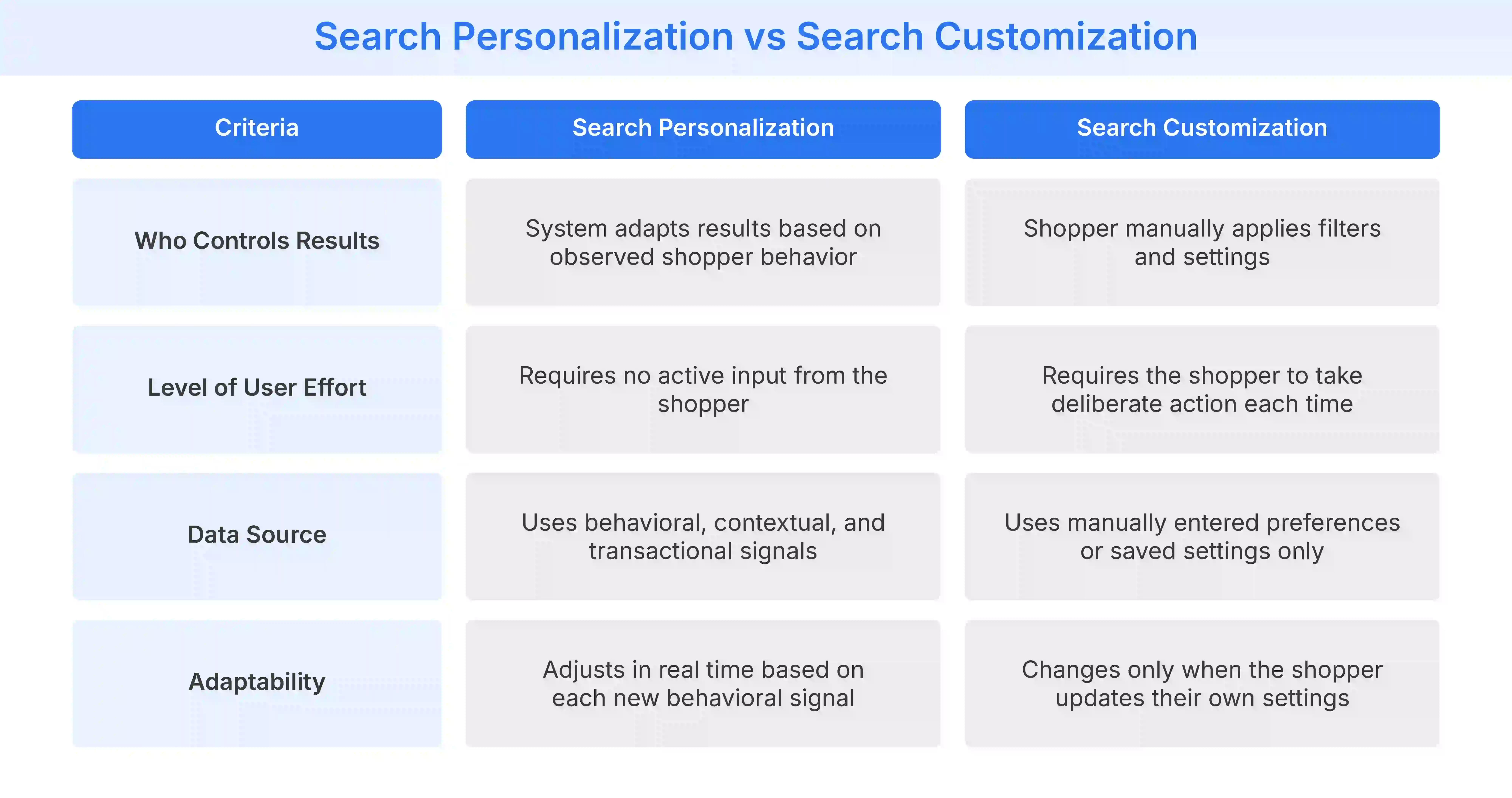
Search personalization and customization are related concepts that work in fundamentally different ways. Personalization happens automatically, with the system adapting search results based on observed shopper behavior without any input required. Customization is shopper-driven, with users manually applying filters and settings to control the results they see.
What are the Main Types of Search Personalization?
Search personalization takes several forms depending on the data used and how the system adapts results for individual shoppers.
- Behavioral Personalization: It adapts results based on a shopper's past clicks and browsing patterns on the platform. A shopper who regularly views formal wear will see suits and dress shirts ranked higher in subsequent results, based purely on observable user behavior.
- Collaborative Filtering: It surfaces products popular among shoppers with similar behavioral profiles and social connections on the platform. A shopper browsing baby products may see recommendations based on items frequently purchased by users with a comparable search history and purchase pattern. For a deeper look at how recommendation logic powers discovery, explore FCC's product recommendation engine.
- Semantic Search: This helps the search engine understand user intent beyond the exact search keywords typed in the search bar. A shopper searching for "cozy winter footwear" will see boots and slippers even without typing specific product names, as the engine reads intent rather than keywords alone.
- Real-Time Personalization: It dynamically shifts search results based on a shopper's live interactions within a single session. If a shopper starts browsing gym equipment, subsequent search results within that session will prioritize fitness-related products automatically, reflecting true real time responsiveness to user intent.
Key Benefits of Search Personalization
Here are the key benefits of search personalization:
- Shoppers who see relevant products from the moment they search are likely to click through and complete a purchase, delivering measurable gains in higher conversion rates.
- Displaying products that match each shopper's preferences opens stronger opportunities for cross-selling and upselling, increasing the Average Order Value (AOV).
- When personalized search results match shopper intent accurately, visitors spend less time browsing irrelevant products and exit the site far less frequently.
- Shoppers who consistently find what they are looking for, come back regularly and build stronger long-term loyalty with the retailer over time.
Common Challenges of Search Personalization
While search personalization offers significant advantages for ecommerce retailers, it also comes with several operational and technical challenges.
- New shoppers with no behavioral history on the platform create a cold start problem, making it difficult for the system to deliver meaningful personalization.
- Collecting user data across multiple markets requires retailers to navigate varying data privacy regulations while maintaining full compliance at every stage of data use.
- Heavy personalization can create a filter bubble where shoppers only see familiar products, limiting their exposure to new categories and reducing the overall diversity of the search experience.
How Do Retailers Implement Personalized Search?
Retailers can implement personalized search through a structured process that addresses data quality, personalization modeling, and deployment before going live across the platform.
- Audit Search Quality and Catalog Data: Retailers should begin by auditing existing search relevance to identify gaps in result quality and catalog data completeness. Well-defined product catalog management is the foundation on which personalization layers are effectively built.
- Build a Behavioral Data Pipeline: Setting up a data pipeline to capture behavioral signals from clicks, searches, and purchases across the platform is the next critical step. This unified data source powers accurate personalization modeling and supports intelligent result ranking.
- Select the Right Personalization Model: Retailers should choose a personalization model that matches their catalog size and traffic volume for optimal performance. A platform managing millions of SKUs requires a different approach compared to smaller ecommerce stores with lower traffic volume.
- Test and Validate With A/B Experiments: Before full deployment, retailers should test re-ranking logic with A/B experiments to validate impact on conversion rates. A control group receiving standard results provides a clear baseline for measuring the true performance of personalized results.
How Does AI Improve Search Personalization?
AI plays a central role in making search personalization accurate and responsive to each shopper's evolving preferences across the platform.
- Pattern Detection at Scale: AI models analyze large volumes of behavioral data to detect patterns that manual rule systems cannot identify at scale. These models adapt as shopper behavior shifts, continuously improving the accuracy of personalized results and delivering a more relevant search experience for each user.
- Natural Language Understanding: Natural Language Processing (NLP) enables the search engine to interpret each search query by intent rather than exact keyword matching. This allows the search bar to handle conversational or imprecise queries and return accurate, relevant results for each shopper across ecommerce sites.
- Continuous Model Retraining: Machine learning models retrain on new behavioral data continuously, keeping personalized results current rather than static like a Wayback Machine index. As online shoppers interact with results, the engine refines individual user profiles and improves the accuracy of search rankings with each new session.
How Do You Measure the Success of Search Personalization?
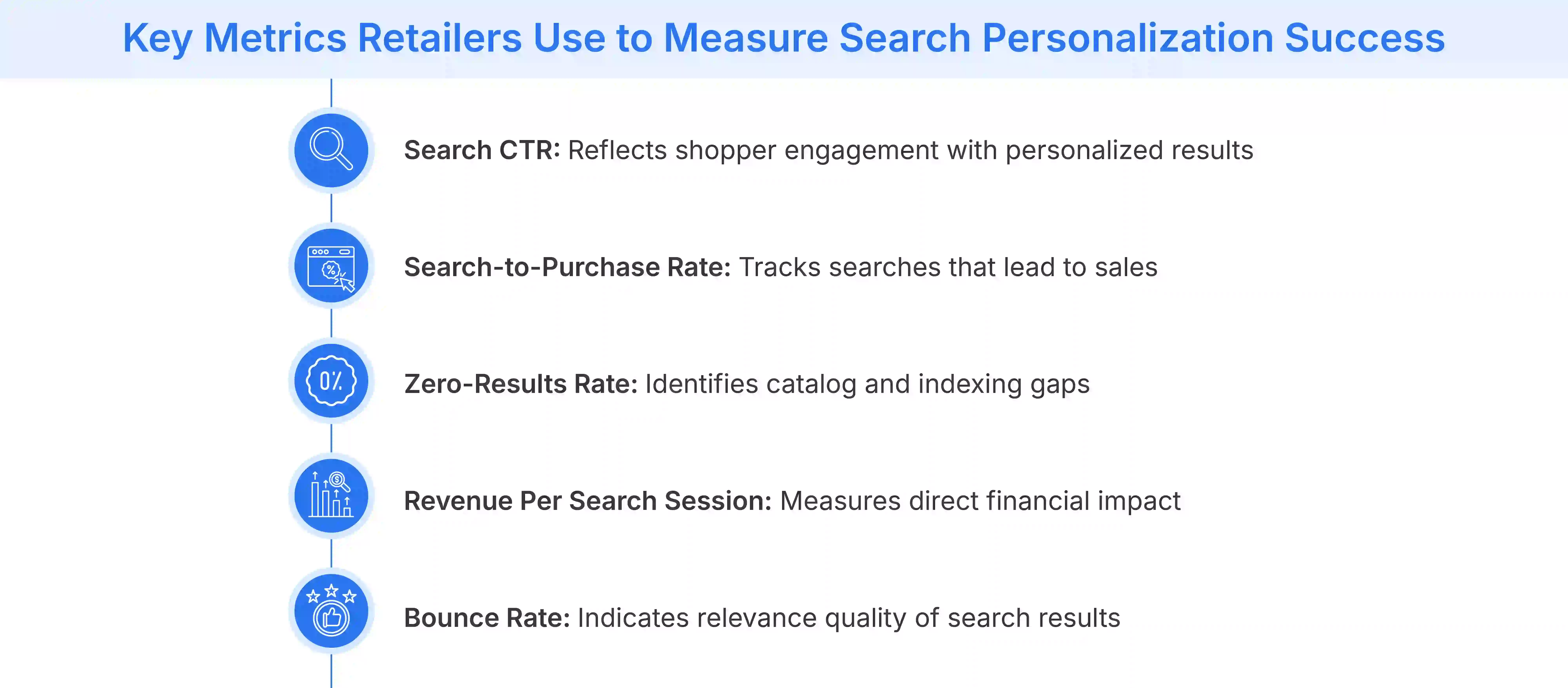
Retailers measure the impact of search personalization using specific metrics that reflect user engagement, product discovery quality, and direct revenue performance across the ecommerce platform.
- Search Click-Through Rate (CTR): Search click-through rate measures how often shoppers engage with results shown after a search query. A rising CTR signals that personalized results are better aligned with each shopper's intent and preferences, directly reflecting improvements in search experience and result quality.
- Search-to-Purchase Conversion Rate: The search-to-purchase conversion rate tracks how many searches lead to a completed sale on the platform. This metric provides a direct measure of how well personalized results match shopper intent and drive actual sales across ecommerce sites with varying catalog sizes.
- Zero-Results Rate: Zero-results rate monitors searches that return no matching products, signaling gaps in catalog coverage or search algorithm accuracy. Reducing this metric is critical for preventing information overload on result pages and maintaining a consistently positive user experience across all search queries.
- Revenue per Search Session: Revenue per search session measures the average revenue attributed to each session where a shopper uses the search bar. Growth in this metric reflects the direct financial impact of improving personalized search results and their influence on individual users' purchasing behavior.
How Flipkart Commerce Cloud Powers Smarter Search Personalization?
Delivering relevant search results at scale requires more than keyword matching. Flipkart Commerce Cloud (FCC) gives retailers the tools to build a personalized search experience that adapts to each shopper and surfaces the right products at the right moment across every session.
FCC Smart Search uses real-time behavioral signals, AI-driven re-ranking, and semantic understanding to close the gap between what shoppers type and what they want. It delivers continuous adaptation based on live session data and prior search history, making every subsequent search more accurate for each individual shopper on your platform.
Beyond search, FCC's Personalization Engine transforms customer signals into product recommendations and dynamic storefront experiences, ensuring every stage of the shopping journey feels tailored.
Book a demo today to see how FCC's integrated discovery tools improve conversion rates and power a better personalized shopping experience for your ecommerce business.

FAQ
For first-time visitors with no behavioral history, the system uses contextual signals such as current location and device type to shape initial results. As the visitor interacts with the site, the personalization engine begins to build an individual user profile in real time, progressively improving the search experience.
Search personalization adapts the results shown when a shopper actively uses the search bar to find specific products. Product recommendations appear on pages such as the homepage or product detail pages without requiring the shopper to initiate a search, making the two complementary rather than interchangeable.
Smaller retailers can benefit by starting with simpler models such as behavioral re-ranking. Cloud-based platforms make deployment accessible without large infrastructure investments, and even basic personalization produces measurable improvements in conversion rates and customer satisfaction.
Search personalization primarily affects on-site search and has limited direct impact on external platforms such as Google Search. However, the improved user engagement and lower bounce rates that personalization drives can support overall search rankings and site authority as secondary outcomes over time.
Retailers manage data privacy by collecting only the necessary user data, implementing opt-in consent flows, and complying with regional regulations such as GDPR. Anonymizing behavioral signals and providing shoppers with clear data control options are widely recognized as best practices for responsible, compliant personalization at scale.