
October 19, 2026
What Are Seasonal Promotions? Types, Benefits, and Retail Strategies
Seasonal promotions are limited-time offers retailers run around holidays, shopping seasons, or recurring events to encourage purchases. These campaigns may use discounts, product bundles, gifts with purchase, or loyalty rewards to respond to seasonal demand and support specific sales goals.
Drishti, Manager - Digital Marketing

Table of Contents
- What Are Seasonal Promotions?
- How Do Seasonal Promotions Work?
- What Is the Difference Between Seasonal Promotions and Seasonal Marketing?
- What Are the Different Types of Seasonal Promotions?
- What Are the Benefits of Seasonal Promotions for Retailers?
- What Are Some Examples of Seasonal Promotions?
- What Are the Challenges of Seasonal Promotions?
- How Can Retailers Plan Effective Seasonal Promotions?
- Conclusion
What Are Seasonal Promotions? Types, Benefits, and Retail Strategies
Shopping patterns change around holidays, back-to-school season, and seasonal transitions. For retailers, these periods create opportunities to attract shoppers and sell relevant products, but poorly planned offers can reduce profit margins or create inventory problems. Seasonal promotions therefore require careful decisions about timing, customer demand, and promotional incentives. This article covers how they work, the different formats retailers use, real retail examples, and the benefits and challenges of planning them.
What Are Seasonal Promotions?
Seasonal promotions are limited-time offers or incentives that retailers introduce around specific holidays, shopping seasons, or recurring changes in customer demand. These promotions encourage purchases during relevant shopping periods and may apply to selected products or categories. Unlike ongoing, year-round offers, seasonal promotions are tied to particular occasions, such as Black Friday or the back-to-school season.
How Do Seasonal Promotions Work?
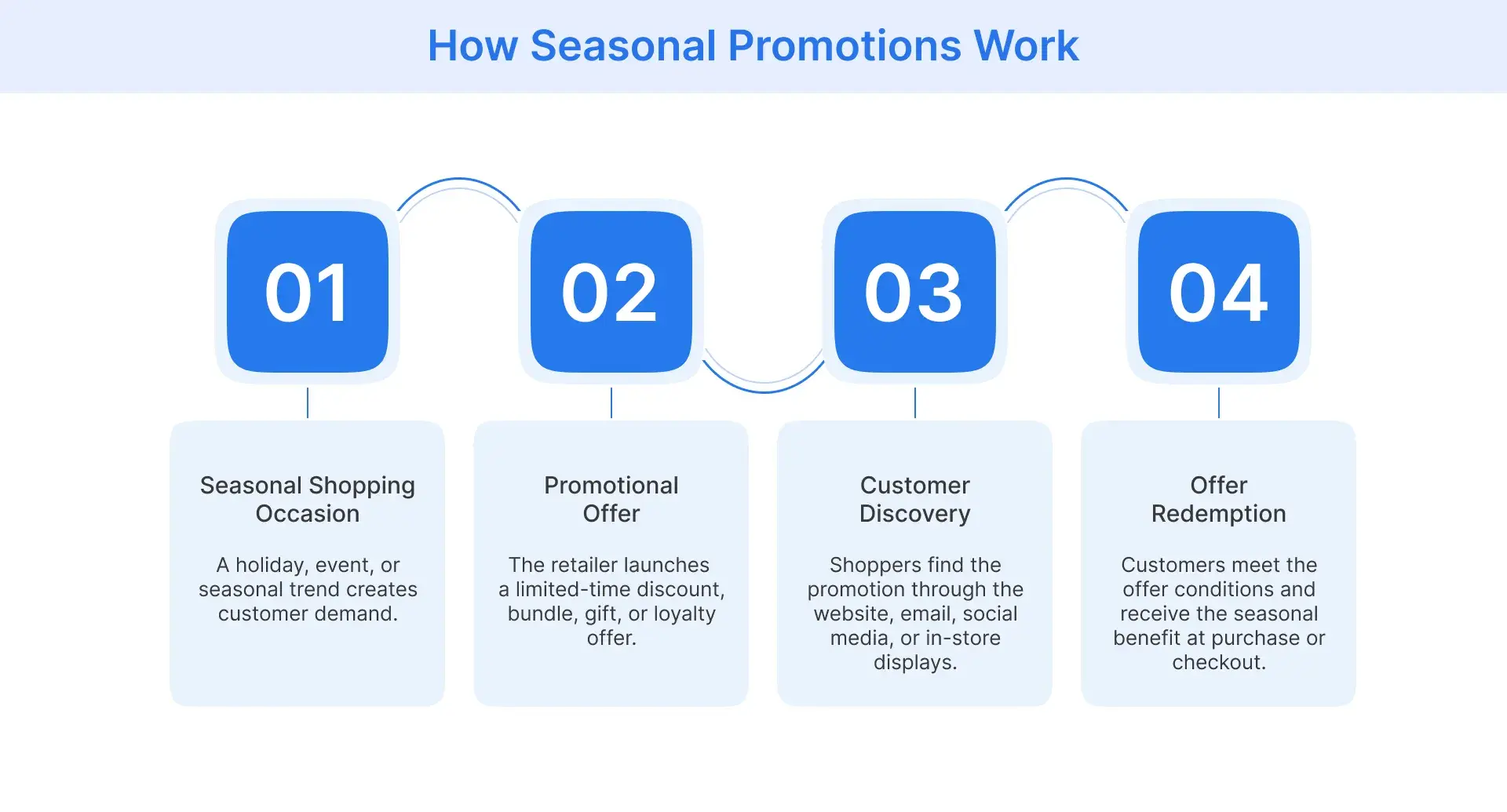
Seasonal promotions work by offering customers discounts or other incentives during specific shopping periods, such as holidays or seasonal sales. Retailers determine which products qualify, how long the offer will run, and any conditions customers must meet to redeem it.
Shoppers encounter these promotions through ecommerce websites, email campaigns, social media, or in-store displays. Depending on the offer, they may receive a discount at checkout, qualify for a free gift, or access a special deal by meeting certain purchase requirements.
By aligning these offers with seasonal shopping demand, retailers can encourage customers to purchase while the promotion is available.
What Is the Difference Between Seasonal Promotions and Seasonal Marketing?
Seasonal marketing is the broader strategy of aligning marketing activities with holidays, shopping seasons, and changes in customer demand. Seasonal promotions are specific, time-limited offers that retailers use during these periods to encourage purchases.
While seasonal marketing can involve advertising, product recommendations, and themed campaigns, seasonal promotions focus on incentives such as discounts, bundles, or gifts with purchase.
|
Seasonal Promotions vs. Seasonal Marketing |
||
|---|---|---|
|
Aspect |
Seasonal Marketing |
Seasonal Promotions |
|
Scope |
Covers broader marketing activities tied to seasonal events and trends. |
Focuses on specific offers available during seasonal periods. |
|
Objective |
Build awareness and attract interest in seasonal products. |
Encourage purchases through time-sensitive incentives. |
|
Typical activities |
Seasonal advertising, themed content, and product recommendations. |
Limited-time discounts, product bundles, and gifts with purchase. |
|
Retail example |
A retailer launches a back-to-school campaign highlighting school essentials. |
The retailer offers 15% off selected school supplies during a back-to-school sale. |
Seasonal promotions can form part of a broader seasonal marketing strategy, but not every seasonal marketing campaign requires a promotional offer.
What Are the Different Types of Seasonal Promotions?
Retailers use different types of seasonal promotions to attract shoppers, encourage purchases, and respond to changes in demand. Common formats include discounts, product bundles, gifts with purchase, cashback offers, and loyalty rewards.
- Limited-time discounts: Retailers reduce prices on selected products for a defined period, often around major shopping events. For example, Walmart's October 2025 holiday deals event offered savings of up to 50% across categories such as toys, electronics, fashion, and home products.
- Buy-one-get-one (BOGO) offers: Customers receive a free or discounted second item when purchasing an eligible product. During its October 2025 Target Circle Week, Target offered buy-one-get-one 50% off selected groceries, including cereal, granola, coffee, and trail mix.
- Seasonal product bundles: Retailers group complementary products into a single offer, sometimes at a lower combined price. For example, a retailer could offer a back-to-school bundle containing notebooks, pens, and other classroom essentials to encourage purchases of related items.
- Gifts with purchase: Customers receive an additional item or reward after meeting specific purchase conditions. During Target Circle Week in October 2024, Target offered a $10 gift card to shoppers who spent $40 on eligible beauty and health products.
- Cashback offers: Retailers return part of an eligible purchase amount as cash, account credit, or another specified reward. For example, an electronics retailer could offer cashback on selected appliances during a holiday sale to encourage higher-value purchases.
- Exclusive loyalty offers: Retailers provide special discounts, early access, or other benefits to eligible loyalty members. For its October 2025 holiday deals event, Walmart gave Walmart+ members five hours of early access before the offers opened to all shoppers.
Retailers can select or combine these promotional formats based on their seasonal sales objectives, product assortment, and customer preferences.
What Are the Benefits of Seasonal Promotions for Retailers?
Seasonal promotions can help retailers attract customers, increase sales during key shopping periods, and make better use of seasonal demand.
- Increase seasonal sales: Discounts and special offers can encourage purchases during peak shopping periods, such as Black Friday and the holiday season. They may also help retailers generate sales during otherwise quiet periods.
- Attract new customers: Seasonal campaigns give retailers opportunities to reach shoppers who may not have purchased from them before. Relevant offers can encourage price-conscious customers to try a product or visit a store.
- Encourage repeat purchases: Exclusive deals and loyalty rewards can give existing customers additional reasons to return. Retailers can use these incentives to strengthen customer engagement and support customer loyalty.
- Improve inventory turnover: Promotions can help retailers sell seasonal products before demand declines. For example, end-of-season discounts can reduce excess inventory and free up space for new products.
- Support product discovery: Seasonal offers can draw attention to selected products or categories. Retailers can use these campaigns to introduce new products or encourage shoppers to consider related items.
What Are Some Examples of Seasonal Promotions?
Seasonal promotions take different forms depending on the shopping occasion, products in demand, and retailer's sales objectives. The following examples show how retailers use seasonal events to create relevant offers.
- Black Friday electronics deals: During Black Friday 2025, Target offered savings of up to $200 on selected Apple products and $100 on PlayStation 5 consoles. These offers were designed to attract shoppers looking for electronics during one of the year's busiest shopping periods.
- Back-to-school promotions: In July 2026, Target ran a weeklong back-to-school savings event with discounts including 30% off school uniform polos and dresses and 20% off selected backpacks and lunch items. The offers helped position relevant products around the period when families prepare for a new school year.
- Summer shopping events: Walmart's July 2025 Walmart Deals event featured six days of savings across electronics, home products, toys, and back-to-school essentials. The event illustrates how retailers can use a seasonal sales period to promote multiple categories rather than focusing on a single product type.
- End-of-season fashion clearance: A clothing retailer might discount winter jackets and sweaters as the season ends to sell remaining stock and make room for spring collections. Unlike peak-season promotions, these offers primarily focus on moving products before seasonal demand declines.
- Holiday loyalty promotions: In December 2025, Target offered Target Circle members 10% off eligible Target GiftCards over a two-day period. The promotion combined a holiday shopping incentive with an exclusive benefit for loyalty members.
These examples show that seasonal promotions are not limited to major discount events. Retailers can also use them to respond to seasonal product demand, manage inventory, and reward existing customers.
What Are the Challenges of Seasonal Promotions?
Seasonal promotions can help retailers increase sales, but they also introduce challenges related to pricing, inventory, and customer expectations. Understanding these risks is important when evaluating the potential impact of a promotional campaign.
- Reduced profit margins: Discounts can increase sales volume while lowering the profit earned on each product. If promotional costs are too high, retailers may generate more orders without achieving higher overall profits.
- Inaccurate demand forecasting: Predicting customer demand during seasonal events can be difficult, particularly when shopping patterns change from year to year. Overestimating demand can leave retailers with unsold products, while underestimating it can result in missed sales opportunities.
- Inventory shortages and excess stock: Popular promotional products may sell out before a campaign ends, disappointing customers and limiting sales. Conversely, retailers may be left with excess seasonal inventory if products do not sell as expected.
- Fulfillment and delivery pressure: A surge in orders during peak shopping periods can strain warehouse operations, shipping capacity, and customer service teams. Delayed deliveries or order errors can affect the customer experience, even when the promotional offer is attractive.
- Poor promotional timing: Launching a campaign too early or too late can reduce its relevance to shoppers. Retailers also face competition from other seasonal offers, making it harder to attract attention during major shopping events.
- Customers waiting for discounts: Frequent seasonal deals can encourage some customers to postpone purchases until the next sale. Over time, this can make it harder for retailers to maintain full-price sales outside promotional periods.
How Can Retailers Plan Effective Seasonal Promotions?
Successful seasonal promotions require retailers to balance customer demand, promotional incentives, inventory availability, and profitability. The following steps can help retailers plan and manage campaigns around key shopping periods.
-
Identify relevant seasonal opportunities. Build a promotional calendar around holidays, shopping events, and seasonal trends that matter to your target audience. Consider when customers typically begin shopping so campaigns launch while demand is relevant.
-
Set clear campaign goals. Decide what the promotion should achieve, whether that is increasing sales revenue, attracting new customers, encouraging repeat purchases, or clearing seasonal inventory. These goals will guide product selection, promotional offers, and performance measurement.
-
Analyze past performance and customer demand. Review previous seasonal sales, customer purchasing patterns, and inventory data to estimate demand. Consider how changing shopping trends might affect which products customers want and how much stock the campaign will require.
-
Select products and structure profitable offers. Choose products that match the occasion and decide whether discounts, bundles, cashback, or loyalty rewards are appropriate. Calculate promotional costs, including discounts and any additional fulfillment expenses, to understand how each offer could affect profit margins.
-
Coordinate inventory and sales channels. Confirm that eligible products are available across participating stores and ecommerce channels. Align stock allocation, fulfillment capacity, and promotional messaging so customers can access advertised offers without unnecessary delays or confusion.
-
Communicate the promotion clearly. Use relevant channels, such as email marketing, social media, website banners, and in-store displays, to reach shoppers. Make the promotion dates, eligible products, redemption requirements, and exclusions easy to understand.
-
Monitor results and make adjustments. Track metrics such as conversion rate, average order value, sales lift, inventory sell-through, and profitability. Compare results with campaign goals and relevant past performance to identify which offers are working and where adjustments may be needed.
After the campaign, retailers can use these findings to improve demand forecasts, promotional timing, and offer selection for future seasonal events.
Conclusion
Seasonal promotions help retailers respond to changing shopping demand, attract customers, and move relevant products during key sales periods. Their success depends on more than offering discounts. Retailers also need to consider timing, inventory availability, promotional costs, and customer expectations.
To make seasonal promotions more effective, retailers should:
- Choose offers that match seasonal demand and business goals.
- Coordinate inventory, fulfillment, and promotional messaging before launching.
- Measure campaign performance using sales, conversion rates, average order value, and profitability.
Managing multiple seasonal campaigns can become complex, particularly across different products and customer segments. Flipkart Commerce Cloud's Promotion Management software helps retailers manage promotional campaigns through a centralized platform, configure rule-based offers, and target specific customer groups.
Book a demo to see how FCC can help your team configure seasonal offers, define eligibility rules, and manage promotional campaigns across customer segments.

FAQ
Examples of seasonal products include summer swimwear, winter coats, holiday decorations, and outdoor activities gear. These themed products experience predictable spikes in consumer demand during specific times of the year, driven by changing weather patterns, cultural events, or major recurring annual events like Valentine’s Day and Cyber Monday.
A seasonal campaign or promotion typically lasts two to six weeks, making it a limited time offer. Running campaign initiatives within this optimal timeframe creates a strong sense of urgency, captures peak shopping demand, and prevents customer fatigue before transitioning inventory back to year-round baseline merchandise.
Retailers should start planning seasonal promotions three to six months in advance, as careful planning ensures smooth execution. Early preparation provides a prime opportunity to secure inventory, design marketing efforts, coordinate logistics, and leverage platforms like Flipkart Commerce Cloud to align promotional schedules with demand forecasting.
Seasonal promotions are suitable for virtually every retail business, including any ecommerce business. Even brands selling year-round essentials can boost sales, drive brand awareness, and reach target customers by bundling everyday items into themed products, offering free shipping, or launching tailored holiday promotions for key calendar events.
The difference between seasonal promotions and clearance sales lies in their core business objectives. Seasonal promotions aim to boost sales around high-demand events using curated or limited edition items, while clearance sales focus on discounting remaining stock to clear warehouse space for new merchandise in upcoming seasons.