March 16, 2026
MACH Architecture in Ecommerce: How It Works and Why It Matters
MACH architecture represents a modern approach to building enterprise software using independent components. This framework gives retailers the agility to scale operations and adapt to changing customer demands rapidly.
Drishti, Manager - Digital Marketing

Table of Contents
- What Is MACH Architecture?
- What Are the Core Principles of MACH Architecture?
- How Does MACH Architecture Work in Ecommerce?
- How Does MACH Differ from Monolithic Architecture?
- What Are the Benefits of MACH Architecture for Retailers?
- How Are MACH Architecture and Composable Commerce Related?
- What Are the Challenges of Switching to MACH?
- Is MACH Architecture Suitable for Small Businesses?
- Conclusion
MACH Architecture in Ecommerce: How It Works and Why It Matters
Retailers increasingly need commerce systems that can evolve without requiring a complete platform rebuild whenever business needs, channels, or customer expectations change. MACH architecture provides a modular approach by combining independently deployable services, APIs, cloud infrastructure, and decoupled front-end experiences. This article explains how MACH architecture works, its core principles, benefits and challenges, and its role in modern ecommerce.
What Is MACH Architecture?
MACH architecture is a modular approach to software design built around four technical characteristics: microservices-based, API-first, cloud-native SaaS, and headless. Together, these characteristics define MACH technology and allow retailers to connect, update, scale, or replace individual commerce capabilities without rebuilding the entire platform.
What Are the Core Principles of MACH Architecture?
MACH architecture principles are built around four technical characteristics that determine how services are developed, connected, deployed, and presented to users.
- Microservices-based: Commerce functionality is divided into smaller, independently deployable microservices. Retailers can update or replace a capability such as checkout, catalog, or inventory without rebuilding the entire platform.
- API-first: In an API-first design, APIs are the primary way different services and applications communicate. This allows commerce services, front ends, and third-party tools to exchange data and functionality through defined interfaces.
- Cloud-native SaaS: MACH solutions use cloud-native infrastructure and software-as-a-service delivery. This supports independent scaling, continuous updates, and access to computing resources as demand changes.
- Headless: A headless commerce model separates the customer-facing experience from back-end commerce functionality. Retailers can update storefronts and other digital experiences without requiring corresponding changes to core commerce services.
How Does MACH Architecture Work in Ecommerce?
MACH architecture works by separating core commerce capabilities into independent services that communicate through APIs and can be managed, updated, or scaled separately. Instead of relying on one tightly connected system, retailers can combine different services for functions such as product catalog, search, checkout, inventory, and pricing.
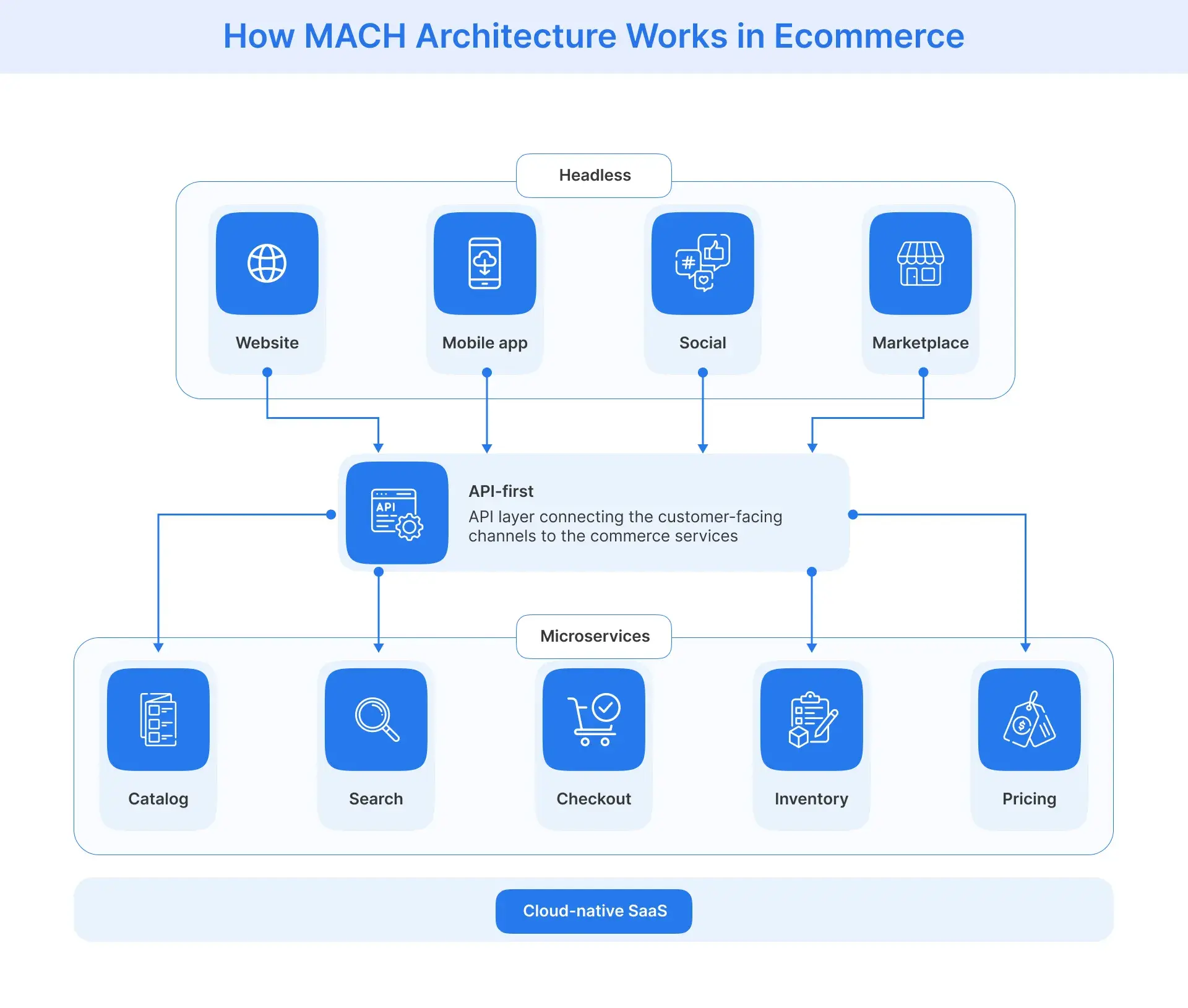
In a MACH-based commerce environment:
- Microservices manage specific capabilities independently, such as checkout, catalog management, or inventory.
- APIs connect these services and allow them to exchange data with front-end experiences and other systems.
- Cloud-native infrastructure allows individual services to scale and be deployed independently as traffic or operational requirements change.
- Headless architecture separates the presentation layer from back-end commerce services, allowing retailers to deliver customer experiences across websites, apps, and other digital touchpoints.
Together, these elements create a modular commerce environment where retailers can add, update, or replace individual capabilities without rebuilding the entire platform.
How Does MACH Differ from Monolithic Architecture?
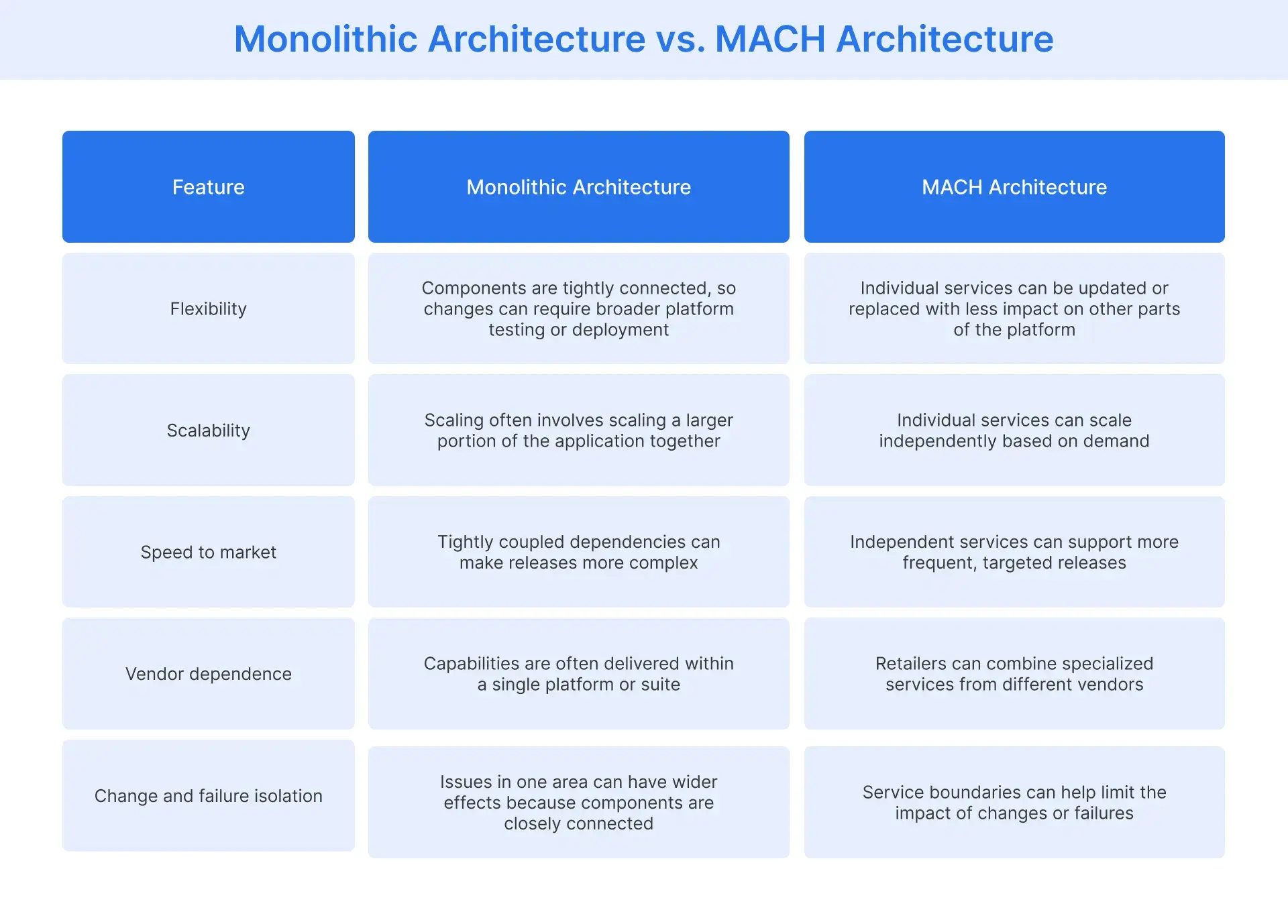
Monolithic architecture combines multiple application functions within a single, tightly connected system, so changes to one area can require broader testing and deployment across the platform. MACH architecture takes a modular approach, with independent services that communicate through APIs and can be developed, deployed, or scaled separately.
For retailers, this means individual commerce capabilities can be updated or replaced without requiring changes across the entire commerce platform.
What Are the Benefits of MACH Architecture for Retailers?
MACH architecture can give retailers greater flexibility in how they build, scale, and update their commerce technology. Because capabilities are separated into independent services, teams can make changes to specific parts of the platform without rebuilding the entire system.
- Faster releases: Software development teams can release new features or update individual services without waiting for a full platform-wide deployment.
- Greater technology flexibility: Retailers can select best-of-breed tools for different commerce functions rather than relying entirely on a single vendor suite.
- Independent scaling: Individual services can scale according to demand, helping retailers allocate resources where they are needed.
- Reduced change risk: Updates or failures can be more isolated to individual services instead of affecting the whole commerce platform.
- Faster experimentation: Teams can test and introduce new capabilities in specific areas without making changes across the entire system.
How Are MACH Architecture and Composable Commerce Related?
MACH architecture and composable commerce are closely related, but they are not the same concept. MACH describes the technical characteristics of a modular software architecture, while composable commerce is an approach to building a commerce platform by selecting and combining independent capabilities.
MACH principles can support composable commerce by making it easier for retailers to connect modular components and services from different vendors through APIs, manage them independently, and replace individual capabilities as business needs change.
For example, a retailer could combine separate solutions for search, checkout, product information, pricing, and inventory rather than relying on one all-in-one commerce suite. MACH provides an architectural approach that can help those components work together within a flexible commerce stack.

What Are the Challenges of Switching to MACH?
Moving to MACH architecture can give retailers more flexibility, but the transition can also introduce technical and operational complexity. The main challenges usually involve integration, cost, skills, and coordination across multiple services and vendors.
- Integration complexity: Connecting multiple services, APIs, and data sources can require significant planning and testing to ensure they work reliably together.
- Higher implementation effort: Retailers may need to invest in integration work, migration, vendor onboarding, and changes to existing systems before realizing the benefits of a MACH environment.
- Technical expertise: Managing distributed services and APIs often requires teams with experience in modern cloud architecture, integration, and DevOps practices.
- Vendor coordination: Using multiple independent solutions can increase the need for clear ownership, governance, and coordination across technology providers.
- Data management and consistency: Retailers need processes that keep customer, product, inventory, and order data synchronized across connected services.
Is MACH Architecture Suitable for Small Businesses?
MACH architecture can work for smaller businesses, but it is not always the most practical choice. The right fit depends on factors such as technical resources, integration needs, growth plans, and how much flexibility the business actually requires.
Small retailers with relatively simple commerce operations may prefer an all-in-one platform because it can be easier to implement and manage with limited technical resources. By contrast, businesses with more complex requirements, multiple channels, or a need to combine specialized commerce services may benefit more from a modular architecture.
For growing businesses, a phased approach can also make MACH more manageable. Instead of replacing the entire commerce stack at once, teams can introduce modular services gradually as specific needs arise.
Conclusion
MACH architecture gives retailers a modular way to build and evolve commerce systems by combining microservices, APIs, cloud-native SaaS, and headless experiences. Rather than depending on one tightly coupled platform, businesses can manage individual capabilities independently and adapt their technology stack as business requirements and customer needs change.
- MACH separates commerce capabilities into independently managed services.
- API-first connectivity allows different systems and services to work together.
- Headless architecture gives retailers more flexibility across customer-facing experiences.
- A MACH approach can support composable commerce, but it also requires careful planning around integration, skills, and governance.
Flipkart Commerce Cloud supports composable commerce through modular, API-driven solutions that can integrate with existing technology stacks. FCC’s Digital Commerce solutions are designed to help retailers build flexible commerce experiences without requiring every capability to come from a single system.
Book a demo to see how FCC can help you modernize specific commerce capabilities while working with your existing technology stack.

FAQ
Migration timelines vary based on the complexity of the existing platform, the number of services being replaced, integration requirements, and the migration approach. A phased migration can allow teams to replace individual components gradually rather than moving the entire platform at once.
The MACH Alliance is a global not-for-profit consortium that promotes open, best-of-breed enterprise technology ecosystems. It certifies vendors who meet MACH architecture standards and educates businesses on transitioning from legacy infrastructure to modern composable technology.
MACH architecture can support secure commerce systems, but security depends on how services, APIs, identity controls, and vendor integrations are configured and managed. Independent services can help limit the scope of some failures, while cloud platforms can provide security and compliance capabilities that organizations can incorporate into their implementation.
Headless architecture refers specifically to decoupling the front-end from the back-end, whereas MACH architecture is a broader four-part framework. MACH includes headless as one principle alongside Microservices, API-first and Cloud-native. Headless alone does not deliver the full scalability and modularity that complete MACH adoption provides.
MACH architecture can significantly improve website performance by allowing individual services to scale independently based on real-time demand. Cloud-native infrastructure ensures on-demand resource allocation during peak traffic, while the headless front-end enables teams to optimize the user experience and page speed independently from back-end processes.