October 23, 2026
Brick-and-Click Stores in Modern Retail
A brick-and-click store is a retail business that operates both a physical storefront and an online sales channel, allowing customers to shop through either. This model helps retailers reach customers across physical and digital touchpoints while managing inventory, orders, and fulfillment across both channels. Services such as in-store pickup and cross-channel returns may also be offered.
Drishti, Manager - Digital Marketing

Table of Contents
- What Is a Brick-and-Click Store?
- How Does a Brick-and-Click Store Work?
- What Is the Difference Between Brick-and-Click and Brick-and-Mortar Retail?
- What Are the Benefits of Brick-and-Click Stores for Retailers?
- What Are the Challenges of Running a Brick-and-Click Store?
- What Are Some Examples of Brick-and-Click Stores?
- What Should Retailers Consider Before Adopting a Brick-and-Click Model?
- Conclusion
Brick-and-Click Stores in Modern Retail
Many retailers now sell through both physical stores and ecommerce websites to serve customers with different shopping preferences. Some shoppers prefer to examine products in person, while others value the convenience of browsing and ordering online.
For retailers, maintaining both sales channels can create opportunities to reach more customers, but it also brings operational considerations involving inventory, order processing, fulfillment, and customer service. This article explains how brick-and-click stores work, how they differ from traditional brick-and-mortar retail, their benefits and challenges, and what retailers should consider before adopting the model.
What Is a Brick-and-Click Store?
A brick-and-click store is a retail business that operates both a physical storefront and an online sales channel, allowing customers to purchase products in-store or through an ecommerce website. This business model combines traditional retail with online shopping, giving customers different ways to browse and buy products.
However, operating both channels does not necessarily mean they are fully integrated. A brick-and-click retailer may manage inventory, orders, and customer service separately for each channel. In contrast, omnichannel retail emphasizes coordinating these operations to provide a more connected shopping experience.
How Does a Brick-and-Click Store Work?
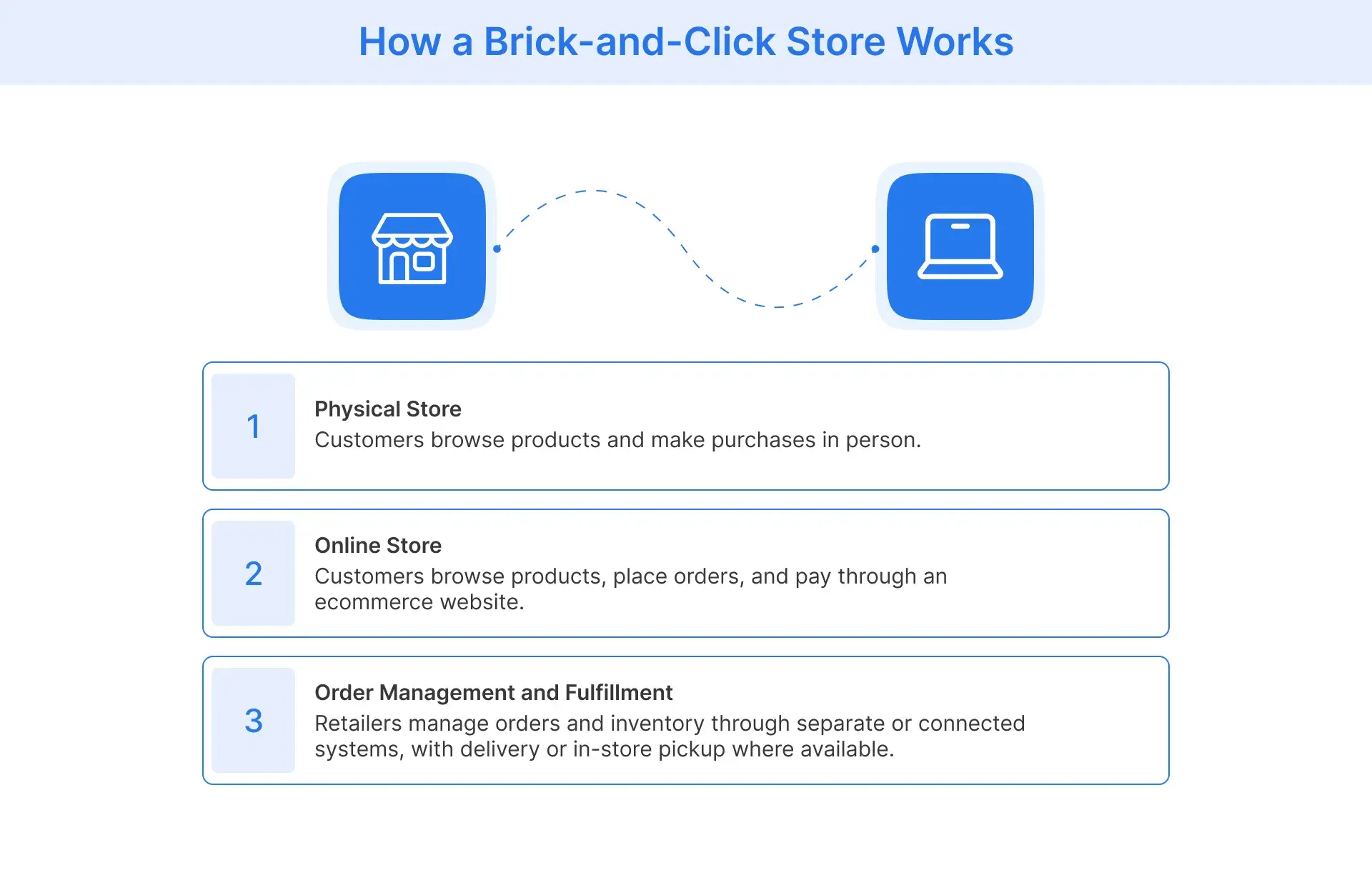
A brick-and-click store works by allowing retailers to sell products through both physical retail locations and an ecommerce website. Customers can visit a store to examine and purchase products in person or browse available items, place orders, and make payments online.
Each sales channel requires processes for managing inventory, payments, orders, and fulfillment. In-store purchases are typically processed through a point-of-sale (POS) system, while online orders are handled through the ecommerce website. Retailers may manage these operations separately or use connected systems to coordinate inventory levels, order information, and fulfillment across both channels.
For example, a customer might visit an electronics store to examine a laptop before purchasing it through the retailer’s website for home delivery. Some brick-and-click retailers also offer buy online, pick up in store (BOPIS), allowing customers to collect online purchases at a physical location. Cross-channel returns may also be available, depending on the retailer’s policies and operational capabilities.
The services offered depend on how the retailer manages its physical and online operations. Simply operating both channels does not mean customers can automatically move between them for pickup, returns, or other services.
What Is the Difference Between Brick-and-Click and Brick-and-Mortar Retail?
The main difference between brick-and-click and traditional brick-and-mortar retail is the availability of an online sales channel. Brick-and-mortar retail involves selling products through physical stores, while the brick-and-click model combines physical locations with an online store where customers can also make purchases.
|
Brick-and-Click vs. Brick-and-Mortar Retail |
||
|---|---|---|
|
Criteria |
Brick-and-Mortar Retail |
Brick-and-Click Retail |
|
Sales channels |
Operates through physical retail locations. |
Combines physical stores with an online sales channel. |
|
Customer access |
Customers generally visit store locations during operating hours to shop. |
Customers can shop in-store or browse and purchase products online. |
|
Purchasing options |
Purchases are primarily completed at physical stores. |
Customers can purchase in-store or online, with additional fulfillment options where supported. |
|
Operational requirements |
Requires physical premises, store staffing, inventory management, and point-of-sale systems. |
Requires physical store operations alongside ecommerce infrastructure, online order processing, and fulfillment capabilities. |
Brick-and-click businesses are also brick-and-mortar retailers because they maintain physical stores. What distinguishes them from physical-store-only businesses is their additional online sales channel. The level of coordination between the two channels varies depending on the retailer’s systems and operations.
What Are the Benefits of Brick-and-Click Stores for Retailers?
Brick-and-click stores offer retailers opportunities to expand their market reach, provide flexible shopping options, and generate sales through both physical and online channels. By maintaining a retail presence across these channels, businesses can serve customers with different purchasing preferences.
The key benefits include:
- Wider market reach: An ecommerce website allows retailers to serve customers beyond their physical store locations. This can help businesses reach a wider audience, including shoppers who cannot conveniently visit a store.
- Greater shopping flexibility: Customers can choose between visiting a physical store and purchasing products online. Depending on the retailer’s capabilities, additional services such as home delivery and in-store pickup can provide more convenient purchasing and fulfillment options.
- More opportunities for product discovery and sales: Physical stores allow customers to examine products in person, while online stores enable shoppers to browse available products remotely. Maintaining both channels creates additional opportunities for customers to discover products and complete purchases through their preferred shopping methods.
- Better use of existing store resources: Retailers with coordinated operations may use physical locations to support online order fulfillment, in-store pickup, or returns. This can help businesses make greater use of their existing retail space, inventory, and staff while supporting customers across different sales channels.
These advantages depend on how effectively retailers manage their physical and online operations. Maintaining both channels can create additional opportunities, but it does not automatically guarantee higher sales or customer satisfaction.
What Are the Challenges of Running a Brick-and-Click Store?
Running a brick-and-click store requires retailers to manage physical and online operations, which can create additional costs and operational complexity. Without effective coordination, businesses may experience inventory discrepancies, order processing delays, and inconsistent customer experiences across sales channels.
Common challenges include:
- Inventory inconsistencies: Managing stock across physical stores and ecommerce websites can be difficult when inventory systems are disconnected. Delayed updates may cause products to appear available online after they have sold out in-store, leading to canceled orders and customer dissatisfaction.
- Order management complexity: Processing purchases from multiple sales channels requires retailers to track orders, payments, cancellations, and fulfillment accurately. Separate point-of-sale (POS) and ecommerce systems can make it harder to maintain consistent order information and prevent processing errors.
- Higher fulfillment costs: Handling online orders introduces additional expenses for packaging, shipping, delivery, and returns. Retailers offering in-store pickup may also need dedicated processes for preparing orders and coordinating collections without disrupting store operations.
- Technology and integration requirements: Operating physical and online stores requires systems for ecommerce transactions, inventory management, and order processing. Integrating these systems can involve additional costs and technical expertise, while disconnected platforms may limit visibility across operations.
- Staffing and customer service demands: Retail employees may need to balance in-store assistance with online order preparation, pickup requests, and customer inquiries. Without sufficient staffing and clear responsibilities, these competing tasks can cause delays and affect service quality.
- Returns and information consistency: Managing returns across physical and online channels requires clear policies and reliable processes for refunds and inventory updates. Differences in product descriptions, availability, or pricing between channels can also create confusion, particularly when customers encounter conflicting information.
Addressing these challenges requires retailers to assess their operational capacity, establish clear processes, and determine where coordination between physical and online systems is necessary.
What Are Some Examples of Brick-and-Click Stores?
Several established retailers use the brick-and-click business model to serve customers through physical stores and ecommerce websites. Examples include Walmart, IKEA, and Best Buy, which offer different ways to purchase and receive products.
-
Walmart: Walmart operates physical retail stores alongside its ecommerce website, where customers can purchase groceries, household essentials, and other products. Shoppers can buy items in-store or place orders online for home delivery or pickup at participating locations. This allows customers to choose purchasing and fulfillment options based on their preferences.
-
IKEA: IKEA combines physical furniture stores with online shopping. Customers can visit stores to examine furniture and home furnishings before purchasing or order products through its website for delivery. In supported locations, IKEA also offers Click & Collect, allowing shoppers to place orders online and collect them at designated pickup points.
-
Best Buy: Best Buy sells electronics and appliances through physical stores and its ecommerce website. Customers can examine products in-store, purchase items directly, or order online for delivery. Its store pickup service also allows shoppers to collect eligible online purchases at participating retail locations.
These examples illustrate how brick-and-click retailers can combine physical and online sales while offering different purchasing and fulfillment options. The availability of services such as in-store pickup and home delivery depends on each retailer’s operations and location.
What Should Retailers Consider Before Adopting a Brick-and-Click Model?
Before adopting a brick-and-click model, retailers should evaluate whether operating physical and online stores aligns with customer demand, available resources, and business objectives. The decision requires assessing both the commercial opportunities and the operational requirements of managing two sales channels.
Key considerations include:
- Customer shopping preferences: Assess whether customers prefer purchasing in-store, online, or through both channels. Customer surveys, purchase histories, and website analytics can help retailers identify demand for additional shopping options.
- Product suitability: Consider whether products can be effectively presented, sold, and fulfilled online. Items that require demonstrations, special handling, or complex delivery arrangements may need additional information or services to support online purchases.
- Store locations and market reach: Evaluate whether existing physical locations can serve customers effectively and whether online sales could reach areas beyond the current store network. Consider the costs of serving customers in locations without nearby stores.
- Operating costs and ecommerce infrastructure: Estimate the expenses of developing and maintaining an ecommerce website, processing payments, marketing online products, and managing delivery services. Retailers should also assess whether their existing technology can support online transactions and business growth.
- Inventory visibility and order management: Determine how stock availability and orders will be tracked across physical and online channels. Retailers should assess whether their current systems can provide accurate inventory information and support order processing without creating unnecessary manual work.
- Fulfillment and returns capabilities: Evaluate whether existing warehouses, stores, or delivery partners can handle online orders. Consider shipping costs, delivery coverage, packaging requirements, and whether services such as in-store pickup or cross-channel returns are operationally practical.
- Staffing and customer service: Assess whether employees have the capacity and training to manage online orders alongside in-store responsibilities. Establish clear processes for handling customer inquiries, delivery issues, refunds, and returns across both channels.
Retailers should weigh these considerations against expected customer demand and available resources before expanding their operations. Starting with a manageable product assortment or limited online service area can also help businesses evaluate the model before committing to a wider rollout.
Conclusion
Brick-and-click stores allow retailers to serve customers through both physical locations and ecommerce websites, providing greater flexibility in how they shop. However, successfully operating both channels requires careful planning and effective management of inventory, orders, and fulfillment.
Before adopting a brick-and-click model, retailers should:
- Assess customer preferences and demand for physical and online shopping.
- Evaluate inventory visibility, order management, and fulfillment capabilities across both channels.
- Consider technology costs, staffing requirements, and available operational resources.
Flipkart Commerce Cloud helps retailers manage inventory across multiple sales channels using its Inventory Management System to maintain real-time stock visibility, synchronize inventory data, and support fulfillment planning.
Book a demo to explore how FCC can help your business manage inventory across physical and online sales channels.

FAQ
Brick-and-mortar retail involves selling through physical storefronts, typically using a point-of-sale (POS) system. Ecommerce allows customers to browse and purchase products through online retail platforms. Unlike physical shopping, online purchases can be made remotely, with orders delivered or collected depending on the retailer’s available fulfillment options.
Yes, brick-and-click and clicks-and-mortar refer to essentially the same retail business model. Both describe businesses operating physical storefronts alongside online sales channels. Combining offline sales channels with an online presence allows retailers to serve different shopping habits and customer expectations, although the channels are not necessarily fully integrated.
Yes, small businesses can adopt a brick-and-click model by adding an online shop to their existing physical retail operations. This may expand their overall reach and customer base, but the costs and complexity depend on their ecommerce platform, inventory processes, staffing, and fulfillment arrangements.
No, brick-and-click stores do not need to offer in-store pickup. The model only requires physical and online sales channels. Where practical, pickup can combine the convenience of online shopping with collection at a physical store, potentially reducing delivery costs for eligible orders and providing customers with another fulfillment option.
Yes, brick-and-click retailers can charge different prices online and in-store where permitted by applicable laws and policies. Price differences may reflect channel-specific promotions or operating costs. Retailers should clearly communicate prices and any conditions before purchase to manage customer expectations and avoid confusion.
Yes, brick-and-click retailers can charge different prices online and in-store where permitted by applicable laws and policies. Price differences may reflect channel-specific promotions or operating costs. Retailers should clearly communicate prices and any conditions before purchase to manage customer expectations and avoid confusion.