
September 30, 2026
Multi-Channel Fulfillment Across the Modern Ecommerce Landscape
Multi-channel fulfillment is the process of fulfilling orders placed across multiple sales channels, such as ecommerce websites, online marketplaces, social commerce platforms, and other selling channels.
Drishti, Manager - Digital Marketing

Table of Contents
- What Is Multi-Channel Fulfillment?
- How Does Multi-Channel Fulfillment Work?
- What Are the Benefits of Multi-Channel Fulfillment?
- What Are the Challenges of Multi-Channel Fulfillment?
- What Is the Difference Between Multi-Channel and Omnichannel Fulfillment?
- What Are Examples of Multi-Channel Fulfillment?
- How Can Retailers Improve Multi-Channel Fulfillment?
- Conclusion
Multi-Channel Fulfillment Across the Modern Ecommerce Landscape
Retailers today sell through more than one channel. Customers may place orders through a brand’s ecommerce website, online marketplaces, social commerce platforms, and other digital storefronts, creating more opportunities for businesses to reach and serve customers.
However, managing orders across several sales channels also creates operational complexity. Retailers need to coordinate inventory, order processing, shipping, and delivery while ensuring customers receive a reliable experience regardless of where they make a purchase.
Multi-channel fulfillment helps retailers manage this process across different selling channels. In this article, we discuss how multi-channel fulfillment works, its benefits and challenges, examples, and how retailers can improve their fulfillment strategy.
What Is Multi-Channel Fulfillment?
Multi-channel fulfillment is the process of fulfilling customer orders placed across multiple sales channels. These channels can include a retailer’s ecommerce website, online marketplaces, social commerce platforms, and other digital storefronts.
With this approach, orders from different channels can be fulfilled using shared inventory and fulfillment resources, even when the channels themselves operate independently. This ecommerce fulfillment approach allows retailers to manage order fulfillment across several selling channels without maintaining a completely separate fulfillment process for each one.
How Does Multi-Channel Fulfillment Work?
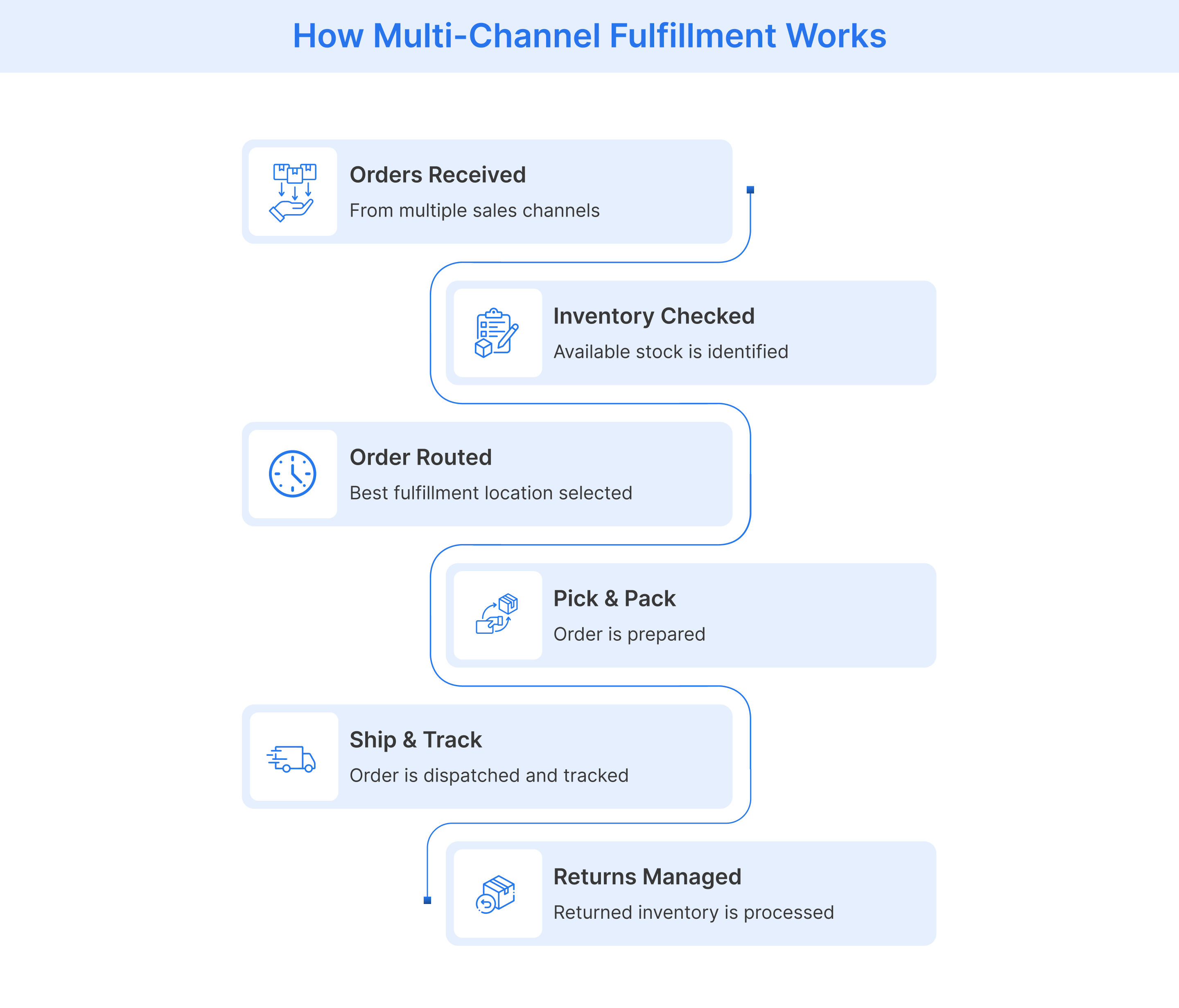
Multi-channel fulfillment begins when orders from different sales channels enter a retailer’s fulfillment system. Once an order is received, available inventory is identified and allocated to the order before it moves through the fulfillment process.
The order is then processed, picked, packed, and shipped from the appropriate fulfillment center or location. Tracking information is shared as the order moves toward delivery, while returns are managed through the retailer’s established processes.
Integrations between sales channels, inventory management, and order management systems help coordinate these activities. This gives retailers better visibility into order data and inventory while supporting more reliable delivery across channels.
What Are the Benefits of Multi-Channel Fulfillment?
Multi-channel fulfillment allows retailers to support orders from several sales channels without maintaining a separate fulfillment operation for each one. Key benefits include:
- Greater sales-channel flexibility: Retailers can sell through multiple storefronts while coordinating fulfillment across them.
- Better use of inventory: Shared inventory can be allocated across channels, helping retailers make more efficient use of available stock.
- Streamlined order processing: A coordinated fulfillment workflow can reduce the complexity of managing orders from different channels.
- Faster fulfillment opportunities: Orders can be routed to appropriate fulfillment centers or locations to support fast shipping and delivery.
- Support for business growth: Retailers can add sales channels and handle increasing order volumes without building separate fulfillment processes for each channel.
By consolidating fulfillment activities, retailers can reduce operational complexity and use their internal resources more efficiently as the business scales, supporting more sustainable growth.
What Are the Challenges of Multi-Channel Fulfillment?
As retailers expand across more sales channels, coordinating fulfillment can become increasingly complex. Some of the main challenges include:
- Inventory visibility: Retailers need accurate inventory information across channels to avoid overselling, stockouts, or incorrect availability.
- Order synchronization: Orders from different channels must be captured and processed accurately to prevent delays or fulfillment errors.
- SKU management: Maintaining consistent SKU data across multiple storefronts and systems can become difficult as product assortments grow.
- Channel-specific requirements: Different sales channels may have their own shipping, packaging, delivery, returns, and customer service requirements.
- Fulfillment costs: Managing orders across several channels can increase shipping costs and other fulfillment costs, particularly when processes are inefficient, putting pressure on profit margins.
- Returns management: Retailers need clear processes for handling returns from different channels while keeping inventory records accurate.
- Shipping expectations: Customers may expect faster delivery, shorter shipping times, and different shipping options across sales channels, which can make fulfillment planning more complex.
- Consistent customer experience: Retailers need to maintain reliable service across channels because fulfillment performance can directly affect customer satisfaction.
Fragmented systems can make these challenges harder to manage, resulting in inaccurate inventory information, routing difficulties, delayed orders, and higher operational costs.
What Is the Difference Between Multi-Channel and Omnichannel Fulfillment?
Multi-channel and omnichannel fulfillment both support orders across multiple sales channels, but they differ in how closely those channels and fulfillment operations are connected.
With multi-channel fulfillment, retailers fulfill orders from several sales channels, but each channel may continue to operate independently. Omnichannel fulfillment involves greater integration, connecting channels, inventory, order information, and fulfillment processes to provide a more coordinated customer experience.
The key difference is therefore the level of integration across the retailer’s operations.
|
Multi-Channel vs. Omnichannel Fulfillment |
||
|---|---|---|
|
Factor |
Multi-Channel Fulfillment |
Omnichannel Fulfillment |
|
Channel structure |
Multiple channels may operate independently |
Channels are closely connected |
|
Inventory visibility |
Inventory may be managed separately across channels |
Inventory is more integrated across channels |
|
Order management |
Orders may follow channel-specific workflows |
Order information is coordinated across channels |
|
Customer experience |
Experience may vary by channel |
Experience is designed to be more consistent across channels |
|
Fulfillment coordination |
Fulfillment supports several channels |
Fulfillment is coordinated across the broader channel network |
What Are Examples of Multi-Channel Fulfillment?
Multi-channel fulfillment can take different forms depending on where customers place orders and how a retailer manages its inventory and fulfillment operations. Common examples include:
- Shared inventory across a website and marketplace: A retailer may sell products through its ecommerce website and an online marketplace while fulfilling orders from the same inventory. Orders from both sales channels are processed and shipped through a shared fulfillment operation.
- Using a 3PL across multiple storefronts: A retailer can work with a third-party fulfillment provider to store inventory and fulfill orders coming from several online storefronts. The fulfillment partner receives the order information, picks and packs the products, and manages shipping to the customer.
- Using a fulfillment network for direct and marketplace sales: An ecommerce business may use a fulfillment network to manage inventory and fulfill both direct-to-consumer and marketplace orders from suitable fulfillment locations or distribution centers.
In each case, the retailer is able to serve customers across different sales channels while using shared fulfillment resources rather than creating a separate operation for every storefront.
How Can Retailers Improve Multi-Channel Fulfillment?
Improving multi-channel fulfillment requires retailers to connect their sales channels with inventory, order management, warehouse, and fulfillment systems. Custom integrations can help connect these systems where direct connections are not already available.
- Maintain accurate inventory visibility: Keep inventory information updated across channels so retailers have full visibility into what stock is available and where it is located.
- Standardize SKU data: Use consistent product and SKU information across systems to reduce errors when inventory and orders move between channels.
- Automate order routing: Route orders to the appropriate fulfillment location based on factors such as inventory availability, delivery requirements, and shipping costs.
- Manage channel requirements: Account for the different packaging, shipping, returns, and service requirements of each sales channel.
- Streamline shipping and returns: Establish clear processes for shipping orders and managing returns across different channels.
- Monitor fulfillment performance: Track fulfillment costs, shipping times, order accuracy, and other performance indicators to identify areas for improvement.
As order volumes and sales channels increase, especially during peak season, connected systems and scalable fulfillment processes can help retailers maintain reliable delivery without adding unnecessary operational complexity.
Conclusion
Multi-channel fulfillment helps retailers manage orders across multiple sales channels without creating separate fulfillment operations for each one. Its effectiveness depends on accurate inventory visibility, connected systems, efficient fulfillment processes, and the ability to meet customer expectations as order volumes and sales channels grow.
Flipkart Commerce Cloud supports these operations with its Order Management System, which helps retailers centralize order management, automate fulfillment workflows, and gain real-time inventory visibility across fulfillment locations. Retailers can also connect the OMS with warehouse, shipping, and other systems to coordinate fulfillment as their operations scale.
FAQ
Amazon Multi-Channel Fulfillment (MCF) is a third-party logistics service that allows ecommerce brands to store inventory in Amazon warehouses to fulfill orders from non-Amazon channels. Merchants leverage this system to pick, pack, and ship products sold on their brand's website, social storefronts, or other digital marketplaces.
The fulfillment fees for Amazon Multi-Channel Fulfillment orders depend on item size, weight, shipping speed, and overall order volume. Merchants pay standardized rates covering pick, pack, and delivery fulfillment services, plus monthly storage fees, allowing retailers to maintain predictable operational costs across their off-Amazon sales channels.
You can track an Amazon Multi-Channel Fulfillment order by checking shipment updates inside Amazon Seller Central or through your integrated e-commerce platform. Amazon generates a shareable tracking link for each order, allowing merchants to provide end customers with real time visibility into delivery milestones and carrier progress.
The packaging used for Amazon MCF orders typically consists of plain, unbranded boxes and blank packing tape to prevent consumer confusion. While standard Amazon FBA orders ship in Amazon-branded boxes, multi-channel shipments default to neutral packaging to protect your independent brand identity on non-Amazon sales channels.
Amazon MCF differs from FBA primarily by the sales channel origin and packaging style. While Fulfillment by Amazon (FBA) processes orders placed directly on Amazon's marketplace using branded boxes, MCF operates as a broader fulfillment solution, handling orders generated across external storefronts using a single inventory pool.
Yes, multi-channel fulfillment can be used without Amazon by partnering with independent third-party logistics providers or retail technology platforms. Advanced enterprise software like Flipkart Commerce Cloud helps enterprise brands optimize inventory distribution, streamline order routing, and manage global supply chain operations across diverse marketplaces completely independent of Amazon.
Many e-commerce platforms support multi-channel fulfillment solutions via easy integration plugins. Leading technology providers like Flipkart Commerce Cloud connect digital storefronts with global order management platforms, helping online retailers automatically sync stock levels and manage multi-channel fulfillment across diverse sales channels.