
September 30, 2026
What Is Time-Based Pricing and How Does It Work?
Time-based pricing is a pricing strategy in which prices vary according to when a purchase or consumption occurs or, in some cases, how long a product or service is used
Drishti, Manager - Digital Marketing

Table of Contents
- What Is Time-Based Pricing?
- What Are the Different Types of Time-Based Pricing?
- What Are the Benefits of Time-Based Pricing for Retailers?
- What Are the Risks of Time-Based Pricing?
- What Are Examples of Time-Based Pricing?
- What Is the Difference Between Time-Based Pricing and Dynamic Pricing?
- When Should Retailers Use Time-Based Pricing?
- Conclusion
What Is Time-Based Pricing and How Does It Work?
The value of a pricing opportunity can change depending on when customers make a purchase. Seasonal demand, holidays, events, and periods of high demand or lower activity can create different purchasing conditions throughout the year.
For retailers, these predictable shifts in customer demand create opportunities to use timing as part of their pricing strategy. Planned price changes can help businesses respond to changing market conditions while supporting broader pricing and inventory objectives.
Time-based pricing provides a structured way to account for these changes. In this article, we discuss what time-based pricing means, how it works, its different types, benefits and risks, examples, and when retailers should use it.
What Is Time-Based Pricing?
Time-based pricing is a pricing strategy in which the price of a product or service is determined partly or entirely by time. This can mean charging different rates based on how long a product, service, or resource is used or adjusting the price according to when a purchase or consumption occurs.
How Does Time-Based Pricing Work?
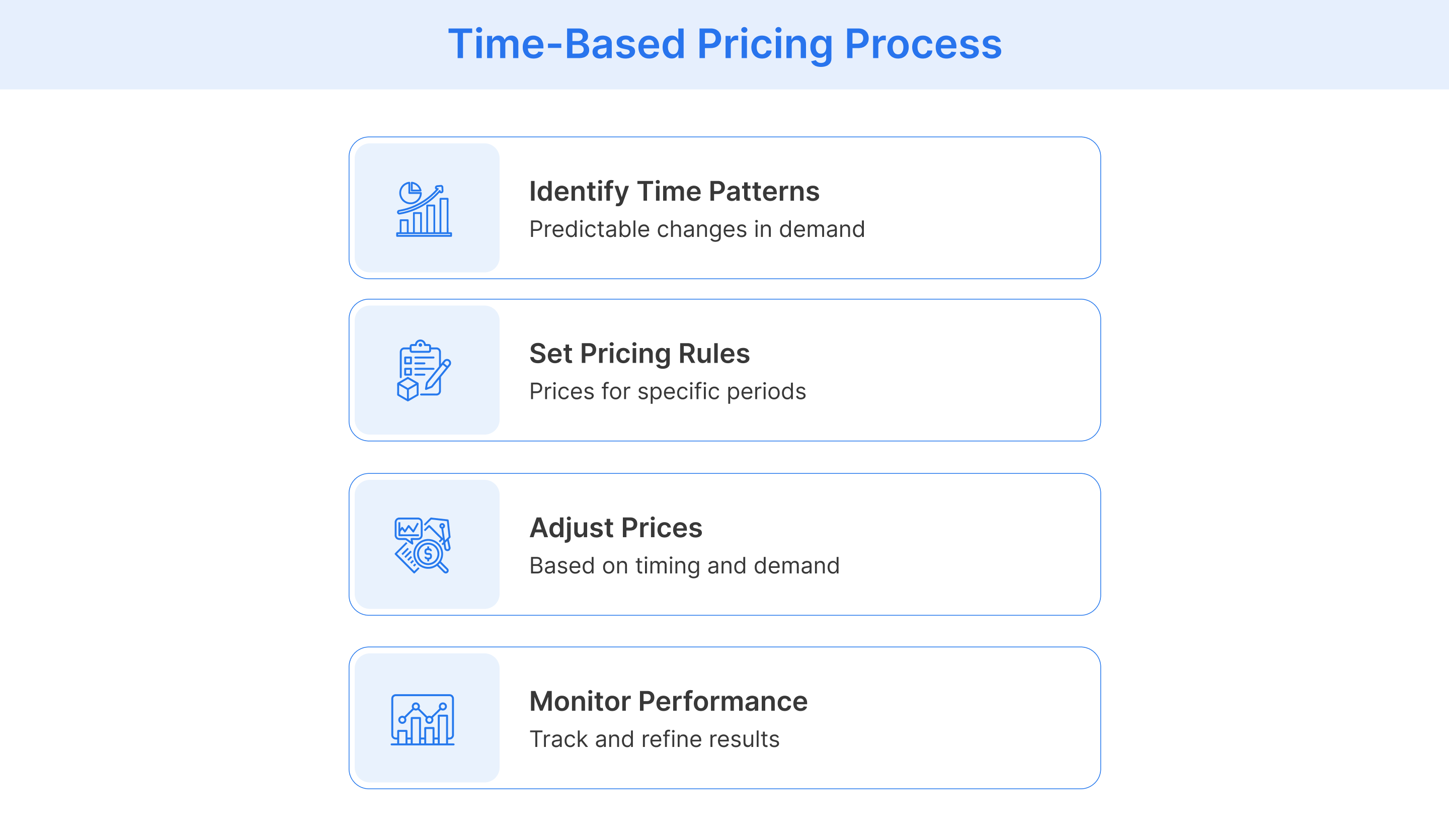
In retail, time-based pricing works by identifying predictable periods when customer demand or purchasing conditions change and establishing pricing rules for those periods. These periods may be based on seasonality, time of day, day of the week, holidays, events, or other recurring changes in purchasing activity.
Retailers may charge higher prices during periods of stronger demand or lower prices during slower periods to encourage purchases and move inventory. This allows them to use timing as a pricing variable while supporting broader revenue and inventory objectives.
What Are the Different Types of Time-Based Pricing?
Time-based pricing can take different forms depending on the time variable a retailer or business uses to determine prices. Common types include:
- Peak and off-peak pricing: Prices are higher during periods of high demand and lower during quieter periods to encourage purchases when customer traffic is lower.
- Seasonal pricing: Prices change according to seasonal demand, such as holiday periods or other times of the year when demand predictably rises or falls.
- Time-of-day pricing: Different rates apply at different times of the day, such as during peak hours or slower periods.
- Day-based pricing: Prices vary depending on the day, such as different prices on weekdays and weekends.
- Event or holiday-based pricing: Prices are adjusted for a particular time or event when purchasing activity is expected to change.
- Duration-based pricing: The price is based on how long a product, service, or resource is used, such as an hourly rate.
What Are the Benefits of Time-Based Pricing for Retailers?
Time-based pricing gives retailers greater flexibility to respond to predictable changes in demand. By adjusting prices for specific periods, retailers can align their pricing decisions more closely with customer purchasing patterns.
- Increase revenue during high-demand periods: Retailers can charge higher prices when demand is stronger, helping them capture more revenue when customers are more willing to purchase.
- Encourage purchases during slower periods: Lower prices can attract customer traffic when demand is weaker, helping retailers generate sales that might otherwise be lost.
- Support inventory movement: Timely price adjustments can help retailers move inventory during slower periods or before products lose relevance.
- Improve pricing responsiveness: Retailers can create pricing rules around recurring demand patterns, allowing them to respond consistently rather than making individual price changes each time.
For retailers managing large product assortments, automation tools can make these pricing rules easier to apply at scale while reducing the amount of manual work required.
What Are the Risks of Time-Based Pricing?
While time-based pricing gives retailers more flexibility, frequent or poorly explained price changes can negatively affect how customers perceive a brand. Some of the main risks include:
- Customer frustration: Customers may become frustrated if they discover that the same product was available at a different price shortly before or after their purchase.
- Reduced trust: Price changes that appear unpredictable or unfair can make customers question a retailer’s pricing practices, potentially affecting customer satisfaction and future purchase decisions.
- Margin pressure: Lowering prices too often during slower periods can reduce profit margins, particularly when discounts are deeper or more frequent than necessary.
- Competitive pressure: Retailers may feel compelled to adjust prices in response to competitors, even when those changes do not align with their own demand patterns or pricing objectives.
To reduce these risks, retailers need clear and consistent pricing rules. Customers do not necessarily expect prices to remain unchanged, but the differences should make sense within the purchasing context rather than appear arbitrary.
What Are Examples of Time-Based Pricing?
Time-based pricing appears in several retail situations where demand changes predictably according to a particular period. Common examples include:
- Seasonal pricing: Retailers may adjust prices as demand changes across seasons. For example, seasonal clothing may sell at higher prices when demand is strongest before being discounted toward the end of the season.
- Holiday or event pricing: Prices may change around holidays, festivals, or major events when retailers expect purchasing activity to increase or decrease.
- Peak and off-peak pricing: Retailers can charge different rates during busier and quieter periods. For example, businesses may offer lower prices during off-peak periods to encourage additional purchases.
- Day or period-based pricing: Prices can vary according to the day of the week or another defined period, particularly when retailers have predictable patterns in customer traffic.
Time-based pricing is also used outside retail. Airlines and businesses in the hospitality industry, for example, commonly vary prices according to travel dates, seasons, and periods of stronger or weaker demand.
What Is the Difference Between Time-Based Pricing and Dynamic Pricing?
Time-based pricing differs from other pricing strategies mainly in the factor used to determine when or why a price changes. While time-based pricing relies on timing, other approaches may prioritize demand, competitor prices, customer perception, or product costs.
Time-Based Pricing vs. Dynamic Pricing
Time-based pricing uses time as the primary variable for adjusting prices, such as a particular season, day, or peak period. Dynamic pricing, on the other hand, can consider multiple variables, including demand, inventory levels, competitor prices, customer behavior, and market conditions, with prices potentially changing in real time.
Time can therefore be one input in a dynamic pricing strategy, but the two approaches are not interchangeable.
Competitive Pricing vs. Time-Based Pricing
Competitive pricing sets prices primarily in relation to what competitors charge for similar products or services. Time-based pricing instead adjusts prices according to when a purchase occurs or how long a product or service is used.
For example, a retailer using a competitive pricing strategy may lower a product’s price after identifying a lower competitor price, while a time-based approach may lower it during a predictable off-peak period.
Value-Based Pricing vs. Time-Based Pricing
Value-based pricing focuses on how much value customers perceive in a product and what they are willing to pay for it. Time-based pricing bases the adjustment on timing rather than perceived customer value.
A retailer using value-based pricing may charge more for a product customers perceive as highly valuable, whereas time-based pricing may change the price of that same product across different periods.
Time-Based Pricing vs. Cost-Plus Pricing
Cost-plus pricing calculates the selling price by adding a predetermined markup to the cost of producing or acquiring a product. Time-based pricing does not use product cost as its primary pricing variable and instead changes prices according to time.
As a result, cost-plus pricing can provide a relatively consistent method for determining a base price, while time-based pricing allows retailers to respond to predictable changes across different periods.
|
Time-Based Pricing vs Other Pricing Strategies |
||
|---|---|---|
|
Pricing strategy |
Primary pricing basis |
Typical trigger for price change |
|
Time-based pricing |
Time or duration |
Season, day, hour, event, or usage period |
|
Dynamic pricing |
Multiple real-time variables |
Demand, inventory, competitors, market conditions |
|
Competitive pricing |
Competitor prices |
Changes in competitor pricing |
|
Value-based pricing |
Perceived customer value |
Changes in willingness to pay or perceived value |
|
Cost-plus pricing |
Product cost + markup |
Changes in cost or required margin |
When Should Retailers Use Time-Based Pricing?
Time-based pricing works best when retailers can identify predictable changes in demand or purchasing behavior across specific periods. It may be particularly useful when:
- Demand changes seasonally: Retailers can adjust prices when demand for certain products predictably rises or falls during different seasons.
- There are recurring peak and off-peak periods: Businesses with consistent periods of stronger and weaker demand can use different prices to respond to these patterns.
- Holidays or events affect demand: Retailers can plan price changes around periods when specific holidays, events, or occasions are likely to influence purchasing activity.
- Inventory needs to move within a timeframe: Time-based pricing can help retailers encourage purchases when seasonal or time-sensitive inventory needs to be sold before demand declines.
Before using this pricing approach, retailers should consider customer expectations, profit margins, demand patterns, inventory levels, and price elasticity. They should also ensure they can manage price changes consistently without creating unnecessary confusion for customers.
Conclusion
Time-based pricing gives retailers a way to use predictable changes in timing and demand as part of their pricing strategy. When applied carefully, it can support revenue and inventory objectives, but retailers also need to consider customer expectations and how frequent price changes may affect price perception and the overall customer experience.
Flipkart Commerce Cloud helps retailers make more informed pricing decisions using pricing intelligence, demand signals, and changing market conditions. These capabilities can help retailers respond to market trends while making pricing decisions that align with broader business objectives.
Book a demo to learn how FCC can help you make more responsive pricing decisions.

FAQ
Time-based pricing is one of several flexible pricing models where product rates fluctuate based on the purchase time. Merchants adjust price points during peak hours, seasons, or days to capture surging demand, maximize overall revenue management, and manage product inventory or operational capacity efficiently across sales channels.
The most common example of time-based pricing in services is a theater offering off-peak matinee discounts, while in retail, it applies to peak holiday rate adjustments. Setting the price of a service lower during slow hours incentivizes customer purchases, while higher peak pricing captures maximum revenue during busy shopping windows.
Time-based pricing makes sense in the retail industry when consumer demand fluctuates predictably across specific hours or seasons. Retailers managing seasonal merchandise or limited stock benefit significantly, as timed discounts support a broader retail markdown strategy, clearing aging inventory while maintaining strong profit margins during peak hours.
The crucial distinction between time-based pricing and a fully automated dynamic pricing approach lies in the triggering mechanism. Time-based schedules change strictly according to predetermined calendar or clock intervals, whereas dynamic models rely on algorithmic tracking of real-time competitor prices, live inventory shifts, and immediate market demand.
When implementing time-based pricing, retailers must evaluate customer price sensitivity, historical demand trends, brand perception, and external factors like competitor moves. Solutions like Flipkart Commerce Cloud enable brands to analyze complex market data, helping merchants set strategic price intervals that protect profit margins without frustrating buyers.
Retailers can use time-based pricing in online retail by automating flash sales or introducing scheduled off-peak discounts. These timed adjustments create customer urgency, increase sales volume during quiet hours, and serve as a convenient way for e-commerce businesses to optimize inventory velocity throughout the operating year.