
September 29, 2026
What Is Cross-Functional Collaboration and How Does It Work?
Cross-functional collaboration is the process of bringing people from different departments or areas of expertise together to work toward a shared goal.
Drishti, Manager - Digital Marketing

Table of Contents
- What Is Cross-Functional Collaboration?
- How Does Cross-Functional Collaboration Work?
- Why Is Cross-Functional Collaboration Important in Digital Commerce?
- What Are the Challenges of Cross-Functional Collaboration?
- What Are Examples of Cross-Functional Collaboration in Retail?
- How Can Retailers Improve Cross-Functional Collaboration?
- How Can Cross-Functional Collaboration Be Measured?
- Conclusion
What Is Cross-Functional Collaboration and How Does It Work?
Digital commerce relies on different departments working toward connected business and customer goals. Marketing, merchandising, technology, operations, customer service, and data teams may have different areas of expertise, but the decisions they make often affect the same customer experience.
When individual teams work in isolation, information can become fragmented, priorities may conflict, and decisions can take longer to execute. This can make it harder for retailers to respond to market changes, solve complex problems, and deliver consistent experiences across the customer journey.
Cross-functional collaboration helps bring these different functions together around shared objectives. For retailers, it provides a way to connect expertise, information, and decision-making across the organization so teams can work toward better outcomes.
What Is Cross-Functional Collaboration?
Cross-functional collaboration is the process of bringing people from different departments, functions, or areas of expertise together to work toward a common goal. Instead of each team working independently, employees combine their knowledge, skill sets, and perspectives to achieve a shared objective.
This collaboration can happen continuously between teams or be organized around a specific project, initiative, or business problem. For example, sales and marketing teams may regularly exchange customer insights, while a new product launch may bring together marketing, technology, operations, and customer service teams for a defined period.
Whether ongoing or project-based, cross-functional collaboration allows different teams to contribute their expertise while working toward the same outcome.
How Does Cross-Functional Collaboration Work?
Cross-functional collaboration works by bringing the expertise, information, and responsibilities of different teams together around a shared goal. Each team contributes its knowledge while remaining aligned on what needs to be achieved.
Effective collaboration depends on clear responsibilities, open communication, information sharing, and agreed decision-making processes. Teams also need accountability so that everyone understands their role and can coordinate their work without unnecessary delays or confusion.
Why Is Cross-Functional Collaboration Important in Digital Commerce?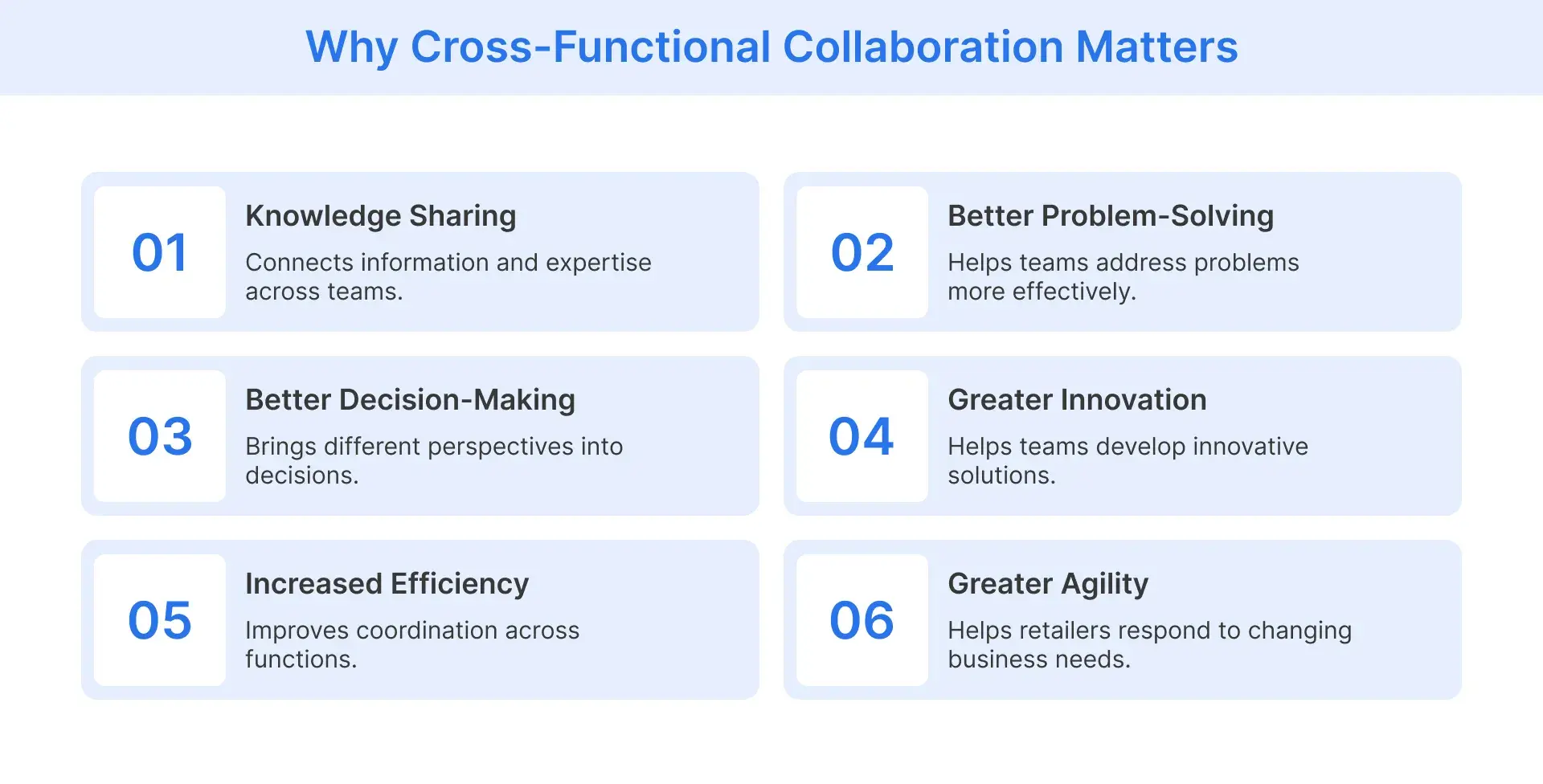
Digital commerce involves multiple functions that influence the same customer and operational experience. Marketing campaigns can affect demand, merchandising decisions can influence inventory needs, and technology and fulfillment teams can shape how smoothly customers complete and receive their orders. Cross-functional collaboration helps retailers coordinate these decisions instead of allowing each function to operate in isolation.
It also encourages knowledge sharing and brings diverse perspectives into decision-making. This can help teams solve problems more effectively, identify opportunities earlier, develop innovative solutions, and respond more efficiently to changing business needs.
For retailers, this coordination can lead to better decision-making, stronger communication, greater efficiency, and more consistent execution across digital commerce operations.
What Are the Challenges of Cross-Functional Collaboration?
Cross-functional collaboration can become difficult when teams have different priorities, working practices, or expectations. Common challenges include:
- Poor communication: Inconsistent communication can create information gaps and make it harder for teams to coordinate their work.
- Conflicting priorities: Different teams may focus on their own targets, making it difficult to agree on shared goals or timelines.
- Unclear ownership: When roles and responsibilities are not clearly defined, decisions can be delayed or important tasks may be overlooked.
- Departmental silos: Limited information sharing between functions can prevent teams from seeing how their decisions affect other areas of the business.
- Lack of trust: Teams may be less willing to share information or rely on one another when trust has not been established.
- Resource constraints: Competing demands for time, people, or budgets can make collaboration harder to maintain.
- Resistance to change: Teams accustomed to established processes may find it difficult to adopt new collaborative ways of working.
Clear goals, responsibilities, and decision-making authority can help reduce these challenges and make conflict resolution easier when different functions contribute to the same initiative.
What Are Examples of Cross-Functional Collaboration in Retail?
Cross-functional collaboration in retail often happens when decisions made by one team directly affect the work of another. Common examples include:
- Marketing and merchandising: These teams can coordinate promotions to align campaign messaging, product selection, pricing, and availability before a campaign goes live.
- Ecommerce and inventory: Ecommerce teams can share expected demand with inventory teams to help prepare product availability for promotions, seasonal peaks, or changes in customer demand.
- Technology, fulfillment, and customer service: These teams can work together to improve the post-purchase experience by addressing issues with order processing, delivery, tracking, or customer support.
In each case, different teams contribute their expertise and information toward a shared commercial or customer objective rather than making decisions independently.
How Can Retailers Improve Cross-Functional Collaboration?
Retailers can improve cross-functional collaboration by creating the right processes and environment for teams to work together effectively. Practical approaches include:
- Establish shared goals: Give participating teams a clear understanding of the outcome they are collectively working toward.
- Define roles and responsibilities: Clarify ownership so teams know who is responsible for specific tasks and decisions.
- Create clear communication channels: Establish consistent ways for teams to exchange information, discuss progress, and resolve issues.
- Improve information sharing: Use shared systems and collaboration tools to give teams access to the information they need and reduce departmental silos.
- Build trust and transparency: Encourage transparent communication so teams can raise concerns, share perspectives, and address problems openly.
- Streamline workflows: Collaborative workflows and automation can reduce unnecessary handoffs and make coordination between functions more efficient.
- Support a collaborative culture: Leadership should reinforce cooperation across functions rather than allowing individual teams to focus only on departmental priorities.
These practices can make collaboration efforts more consistent and help teams coordinate effectively as business priorities change.
How Can Cross-Functional Collaboration Be Measured?
Cross-functional collaboration should be measured by whether teams are achieving the intended business outcome, not simply by how often they communicate. Retailers can assess its effectiveness using measures such as:
- Project completion: Whether cross-functional initiatives are completed successfully and on schedule.
- Productivity: Whether collaboration helps teams complete work more efficiently.
- Shared goal achievement: Whether participating teams are meeting the objectives they agreed to pursue together.
- Execution time: Whether coordination across functions reduces delays and improves the speed of execution.
- Team feedback: Whether employees believe communication, responsibilities, and decision-making are working effectively across teams.
The most useful measures will depend on the initiative, but they should ultimately show whether cross-functional work is improving execution and contributing to the agreed business outcome.
Conclusion
Cross-functional collaboration helps retailers connect expertise, information, and decision-making across departments instead of allowing individual functions to operate in isolation. With shared goals, clear responsibilities, effective communication, and the right collaboration systems, teams can coordinate digital commerce initiatives more efficiently.
Connected technology can further support this coordination by giving teams a stronger foundation for working across functions.
Flipkart Commerce Cloud enables retailers to build more connected digital commerce operations, helping teams align their efforts around shared business and customer goals. Book a demo to learn how FCC can help your teams work more effectively across connected digital commerce operations.

FAQ
Five key benefits of cross-functional collaboration include faster problem-solving, enhanced innovation, higher employee engagement, aligned business goals, and reduced operational silos. Bringing diverse teams together allows organizations to pool different perspectives, generate creative solutions, streamline internal workflows, and deliver customer-centric outcomes far more efficiently than isolated departments can achieve alone.
An example of cross-functional collaboration occurs when marketing, product development, and customer support align to launch a new feature. By sharing real-time insights, marketing matches messaging with true consumer needs, while developers refine functionality based directly on user feedback, ensuring the product team delivers maximum value
Businesses can strengthen cross-functional collaboration by setting a shared vision, building transparent communication channels, and deploying specialized project management software. Utilizing unified e-commerce intelligence platforms like Flipkart Commerce Cloud FCC provides a shared data hub, helping various departments align strategies, track progress, and avoid duplicate work.
Another way to say cross-functional collaboration is interdepartmental teamwork, multidisciplinary cooperation, or cross-disciplinary alignment. These alternative terms all describe how modern organizations unite specialists from different backgrounds to pool expertise, break down operational boundaries, and solve complex business problems through collective effort.
The difference between cross-functional collaboration and standard teamwork lies in scope and structural diversity. Traditional team collaboration involves a single functional team working on daily routine tasks, whereas cross-functional initiatives connect a group of people across larger teams to solve complex, company-wide challenges together.
Cross-functional collaboration is important in digital commerce because driving successful digital transformation requires complete alignment across marketing, supply chain, and IT. Uniting these functions ensures promotion schedules match inventory levels and platform capabilities, eliminating operational friction and driving continuous improvement in overall customer experience.