
October 22, 2026
Pay What You Want Pricing and Customer Choice in Retail
Pay what you want (PWYW) pricing is a pricing model that allows customers to choose how much they pay for a product or service instead of accepting a fixed price. Retailers may introduce suggested prices or minimum payments to guide customer decisions and manage financial risks.
Drishti, Manager - Digital Marketing

Table of Contents
- What Is Pay What You Want Pricing?
- How Does Pay What You Want Pricing Work?
- When Does Pay What You Want Pricing Work Best?
- What Are Some Examples of Pay What You Want Pricing?
- What Is the Difference Between Pay What You Want and Fixed Pricing?
- What Is the Difference Between PWYW and Cost Anchor Pricing?
- What Is the Difference Between PWYW and Competition-Based Pricing?
- What Is the Difference Between PWYW and Value-Based Pricing?
- What Influences How Much Customers Pay Under PWYW Pricing?
- What Are the Benefits of Pay What You Want Pricing for Retailers?
- What Are the Challenges of Pay What You Want Pricing?
- How Can Retailers Implement Pay What You Want Pricing?
- Conclusion
Pay What You Want Pricing and Customer Choice in Retail
Retailers typically set product prices by considering costs, customer demand, and business objectives. However, some pricing strategies give shoppers greater influence over what they pay, raising questions about customer perceptions of value and business profitability. Pay what you want pricing introduces a different approach to these decisions. This article explores how the model works, when retailers might use it, what influences customer payments, and the benefits and risks involved.
What Is Pay What You Want Pricing?
Pay what you want (PWYW) pricing is a participative pricing model that allows customers to decide how much they pay for a product or service instead of accepting a fixed price set by the retailer.
Under an unrestricted PWYW model, customers can choose to pay any amount, including nothing. Other arrangements require a minimum payment or provide a suggested price to guide customers’ decisions.
How Does Pay What You Want Pricing Work?
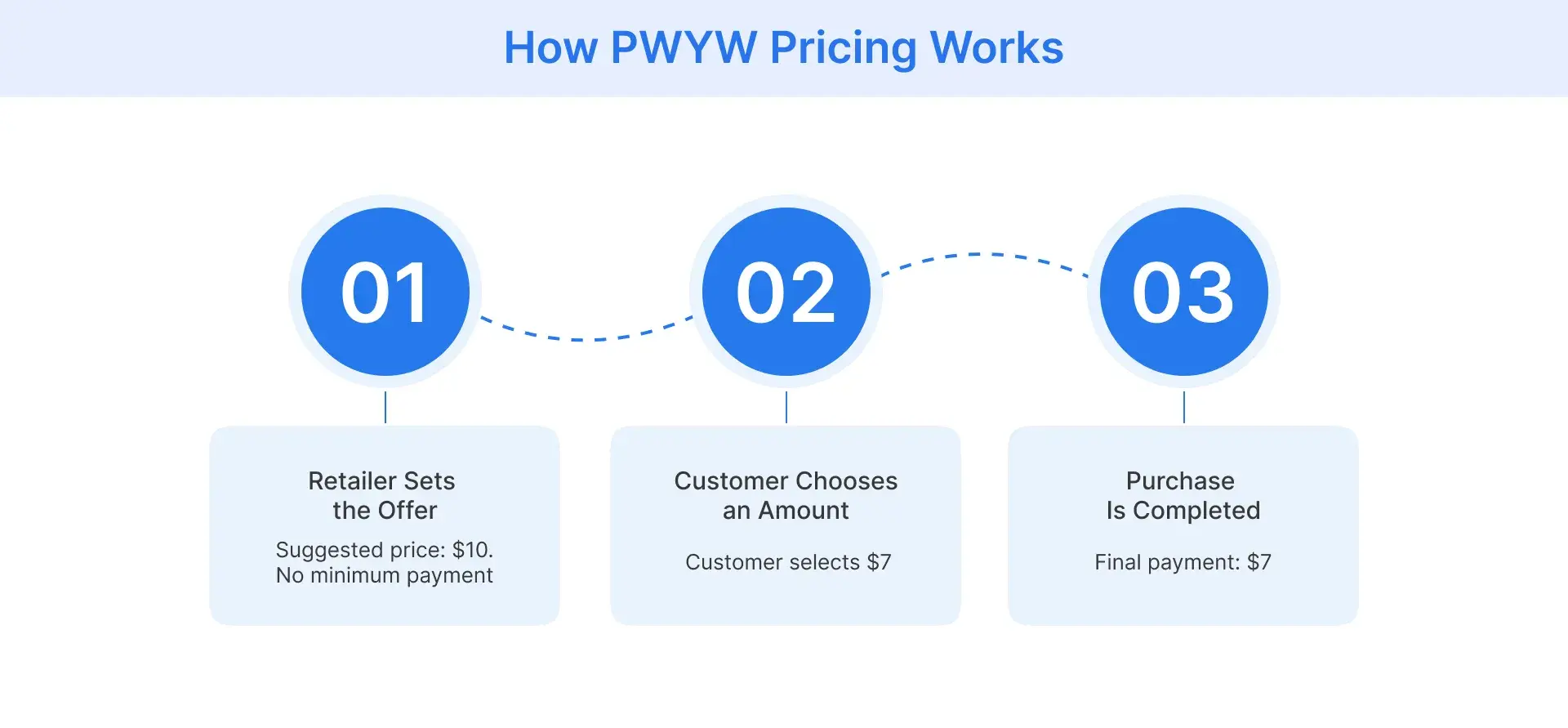
Pay what you want pricing works by allowing customers to enter the amount they wish to pay for an eligible product or service. Retailers communicate any payment conditions, such as a suggested price or minimum amount, before customers complete their purchase.
The payment process depends on the rules of the offer. Under an unrestricted PWYW model, customers can choose any amount, including zero. A minimum-price arrangement requires customers to pay at least a specified amount, while a suggested price provides a reference point without making that amount compulsory.
For example, a retailer might offer a product with a suggested price of $10 but no minimum payment. If a customer chooses to pay $7, the transaction is completed at $7. The selected amount becomes the purchase price, provided it meets any conditions established by the retailer.
When Does Pay What You Want Pricing Work Best?
Pay what you want pricing may work best when customers recognize the value of an offering and retailers can accommodate variations in payment amounts without putting their costs at risk. Its suitability depends on the product, customer relationships, and business objectives.
The following conditions can make PWYW pricing more suitable:
- Low marginal costs: Products or services with a low additional cost per customer give businesses greater flexibility to accept different payment amounts. Digital products, for example, may cost relatively little to distribute to each additional buyer after development.
- Established customer relationships: Customers who trust a retailer or feel connected to its business may be more willing to make payments they consider fair. However, an existing customer relationship does not guarantee higher payments.
- Strong perceived value: PWYW may be more suitable when customers can recognize the quality or usefulness of a product or service. Clear information about what they receive can help shoppers assess how much they are willing to pay.
- Short-term promotional experiments: Retailers can use PWYW for selected products, customer events, or limited-time campaigns to explore how shoppers respond to flexible pricing without changing their entire pricing strategy.
PWYW pricing may be less suitable for expensive physical products, items with narrow profit margins, or businesses that depend on predictable revenue from each sale. Retailers need to consider whether customer-selected payments can adequately cover their costs before using the model.
What Are Some Examples of Pay What You Want Pricing?
Pay what you want pricing has been used for digital products, entertainment, and community-focused services. These examples show how businesses can give customers pricing flexibility for different purposes.
Real-world examples
- Humble Bundle: Humble Bundle has used PWYW pricing for collections of video games and other digital content. Customers choose how much to contribute, while minimum payment tiers may determine which items they receive. The approach combines flexible pricing with charitable contributions.
- Radiohead’s In Rainbows album: In 2007, the band Radiohead allowed fans to choose how much they would pay for a digital download of its album In Rainbows. The experiment gave listeners control over the album’s price and allowed the band to distribute its music directly to fans.
- Panera Cares: Panera Bread operated nonprofit community cafés where customers could pay the suggested amount for a meal, contribute more, or pay less according to their circumstances. The initiative aimed to make food accessible while encouraging community support. However, the remaining cafés closed by 2019, illustrating the difficulty of sustaining this approach.
Illustrative retail scenarios
The following are hypothetical examples of how retailers could apply PWYW pricing:
- Limited-time product promotion: A retailer could allow customers to choose their payment amount for selected low-cost products during a short campaign. The objective would be to encourage product trials and understand customers’ willingness to pay.
- Customer-priced workshop: A home improvement retailer could offer a product demonstration workshop with a suggested attendance price. Participants would choose how much to pay, allowing the retailer to introduce its products and assess customer interest.
These examples demonstrate different applications of customer-selected pricing, but their suitability depends on operating costs, customer expectations, and the purpose of the offer.
What Is the Difference Between Pay What You Want and Fixed Pricing?
The main difference between pay what you want pricing and fixed pricing is who determines the final purchase price. With fixed pricing, retailers set the amount customers must pay. Under PWYW pricing, customers choose their payment amount, subject to any minimum price established by the retailer.
|
Pay What You Want Pricing vs. Fixed Pricing |
||
|---|---|---|
|
Aspect |
Pay What You Want Pricing |
Fixed Pricing |
|
Price determination |
Customers choose how much to pay, within any stated conditions. |
Retailers establish the selling price. |
|
Pricing flexibility |
Customers can select different payment amounts for the same offering. |
Customers pay the listed price unless the retailer changes it or offers a discount. |
|
Revenue predictability |
Payments may vary between customers, making revenue per sale less predictable. |
The selling price is known for each transaction, although total sales depend on demand. |
|
Implications for retailers |
Requires retailers to assess customer-selected payments against product costs and pricing objectives. |
Gives retailers greater control over selling prices and supports more consistent margin planning. |
What Is the Difference Between PWYW and Cost Anchor Pricing?
The main difference between PWYW and cost anchor pricing is the starting point for determining the selling price. Under PWYW pricing, customers choose their own price, subject to any minimum payment. Cost-anchored pricing uses the retailer’s product costs as the basis for setting a price, typically by adding a markup.
For example, if a product costs $6 to source and the retailer adds a $3 markup, the selling price becomes $9. Under PWYW, customers could choose to pay $7, $9, or another amount, depending on the offer’s conditions.
Cost-anchored pricing gives retailers greater control over how prices relate to their expenses, while PWYW allows customer decisions to determine the final transaction amount.
What Is the Difference Between PWYW and Competition-Based Pricing?
The difference between PWYW and competition-based pricing is how the selling price is determined. Under PWYW, customers choose their own price, subject to any minimum payment. Competition-based pricing allows retailers to set prices by considering what competitors charge for similar products.
For example, if competing retailers sell a product for $20, a business using competition-based pricing might set its price at $19 to remain competitive. Under PWYW, customers could choose to pay $15, $20, or another amount, depending on the offer’s conditions.
Competition-based pricing helps retailers position their products within competitive markets, while PWYW places greater emphasis on customers’ willingness to pay.
What Is the Difference Between PWYW and Value-Based Pricing?
Value-based pricing involves retailers setting prices according to how much customers are likely to value a product or service. PWYW pricing takes a different approach by allowing customers to choose how much they actually pay, subject to any minimum payment requirements.
For example, a retailer might price a product at $40 based on its quality, features, and perceived value to customers. Under a PWYW model, shoppers could choose to pay $25, $40, or a higher price, depending on their willingness to pay and the conditions of the offer.
Both pricing strategies consider customer perceptions of value, but value-based pricing leaves the final pricing decision with the retailer, while PWYW gives customers greater control over the purchase price.
What Influences How Much Customers Pay Under PWYW Pricing?
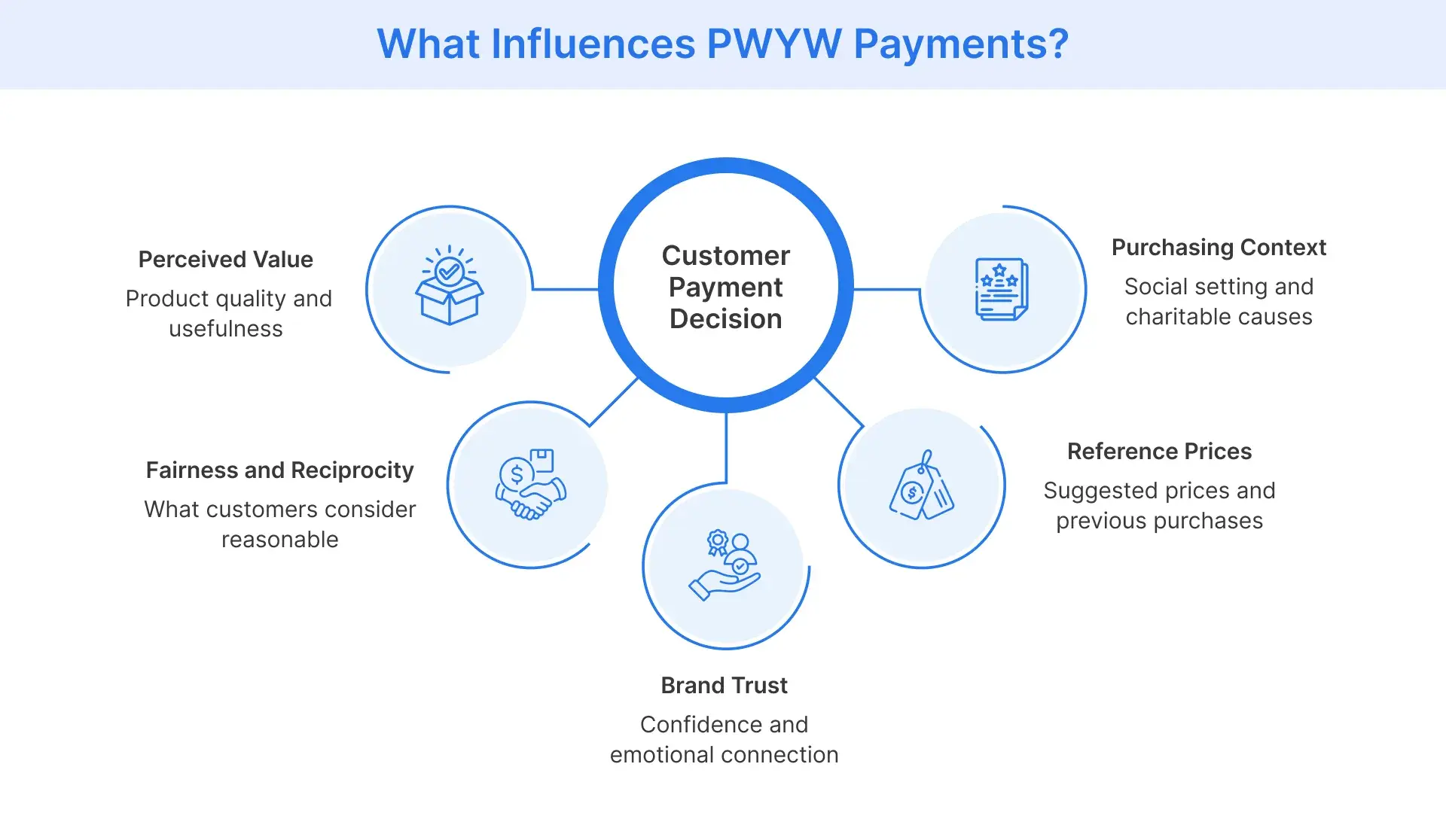
Customers do not always choose the same payment amount under a PWYW model, even when purchasing identical products. Their decisions can depend on how they value the offering, their relationship with the retailer, and the circumstances surrounding the purchase.
Several factors can influence the PWYW price a customer chooses:
- Perceived value and willingness to pay: Customers consider a product’s quality, usefulness, and what they believe it is worth. Their budget and price sensitivity can also affect the amount they are comfortable paying.
- Fairness and reciprocity: Some customers consider what would be fair compensation for the retailer. Others may pay more because they appreciate the service received or want to acknowledge the seller’s effort.
- Brand trust and emotional connection: Customers who trust a brand or feel personally connected to its purpose may be willing to support it through their payments. This does not mean an established customer base will consistently pay higher prices.
- Reference prices: Customers may compare the offer with prices they have previously paid or seen elsewhere. A suggested price can also provide a reference point when deciding what amount is reasonable.
- Purchasing context: Payment decisions can differ depending on whether customers pay privately or in front of others, whether a charitable cause is involved, and how the offer is presented.
These factors can influence customers in different ways. A shopper who values a product highly may still choose a small payment, while another may contribute more to support the retailer or a cause. PWYW pricing therefore does not guarantee that customers will pay an amount that reflects the product’s cost or perceived value.
What Are the Benefits of Pay What You Want Pricing for Retailers?
Pay what you want pricing can give retailers opportunities to encourage customer participation and better understand purchasing behavior. While its effectiveness depends on the product and pricing conditions, several potential benefits make it worth considering for selected offers.
-
Encourages product trials: Giving customers control over their payment amount can reduce the hesitation associated with trying an unfamiliar product. This may help retailers introduce new offerings without requiring shoppers to commit to a fixed price.
-
Reaches price-sensitive customers: Flexible pricing can lower purchasing barriers for customers who might otherwise find a product too expensive. It allows shoppers to choose an amount that better reflects their budget, subject to any minimum payment requirements.
-
Builds customer goodwill: Allowing customers to decide what they pay can demonstrate trust and create a more participative shopping experience. When customers perceive the arrangement as fair, it may strengthen their relationship with the retailer.
-
Provides pricing insights: Customer-selected payments can offer information about willingness to pay and perceived product value. By reviewing average payment amounts and payment patterns, retailers can gather insights that inform future pricing decisions.
These benefits are not guaranteed. Retailers should evaluate how customers respond to the offer and whether the resulting payments support their commercial objectives.
What Are the Challenges of Pay What You Want Pricing?
Pay what you want pricing gives customers greater control over their payments, but it also introduces financial and operational uncertainty for retailers. Without careful planning, customer-selected prices may not generate enough revenue to support the business.
The main challenges include:
- Underpayment and reduced profit margins: Customers may choose small amounts that fall below a product’s cost, leaving retailers with little or no margin on individual sales. This is particularly concerning for physical products with substantial production or sourcing costs.
- Unpredictable revenue: Because customers can pay different amounts for the same offering, retailers may struggle to forecast revenue accurately. Even when an offer attracts buyers, the total amount collected can vary considerably.
- Cost recovery: Inventory purchases, packaging, staffing, and other operational expenses remain payable regardless of what customers contribute. A PWYW pricing model may become difficult to sustain if average payments consistently fall short of these costs.
- Customer hesitation: Some shoppers may feel uncertain about what constitutes a fair payment, particularly when no suggested price is provided. This uncertainty can make the purchasing decision less straightforward.
- Changing price expectations: Repeated PWYW offers may influence what customers expect to pay for a product. Retailers could face resistance when returning to fixed prices if shoppers become accustomed to choosing lower amounts.
These challenges make it important for retailers to assess their costs, pricing conditions, and customers’ payment behavior before adopting PWYW on a wider scale.
How Can Retailers Implement Pay What You Want Pricing?
Retailers can introduce pay what you want pricing through a limited campaign before considering wider adoption. A structured approach helps businesses establish payment conditions, manage financial exposure, and understand how customers respond.
-
Select suitable products and define your objectives. Start with products or services that can accommodate flexible payments, such as low-cost items or customer workshops. Determine whether the goal is to encourage product trials, assess willingness to pay, or gather insights for future pricing decisions.
-
Calculate costs and assess financial limits. Review product sourcing, packaging, fulfillment, transaction fees, and other relevant expenses. Establish how much payment variation the business can accommodate without putting its financial objectives at risk.
-
Establish clear payment conditions. Decide whether customers can pay any amount, must meet a minimum price, or will see a suggested price. Make sure the chosen PWYW model reflects the campaign’s objectives and cost considerations.
-
Communicate the offer clearly. Explain which products qualify, how customers select their payment amount, and whether any restrictions apply. Customers should understand the pricing conditions before completing their purchase.
-
Test the campaign on a limited scale. Run the offer for a defined period or selected product range. Monitor customer participation and payment behavior before deciding whether the approach is suitable for broader use.
-
Measure performance and refine the approach. Review the average purchase price, distribution of payments, conversion rate, total revenue, and contribution margin. Compare the results with relevant fixed-price performance to assess whether the campaign supports the retailer’s objectives.
Retailers can use these findings to adjust payment conditions, repeat a successful experiment, or return to conventional pricing where PWYW does not deliver sustainable results.
Conclusion
Pay what you want pricing gives customers greater control over what they pay, but retailers must balance that flexibility with costs and profitability.
Before adopting PWYW, retailers should:
- Choose suitable products: Focus on offerings that can accommodate flexible payments.
- Understand customer behavior: Consider perceived value and willingness to pay.
- Measure performance: Track average payments, revenue, and profit margins.
Flipkart Commerce Cloud helps retailers make informed pricing decisions by providing insights into customer demand and pricing performance.
Its Price Optimization software supports pricing simulations, demand-elasticity analysis, and performance monitoring, helping retailers evaluate pricing opportunities against their business objectives.

FAQ
The difference between pay what you want and freemium pricing centers on transaction structure. Under a participative pricing mechanism like pay what you want pricing, buyers select a chosen purchase price for the full product, whereas freemium offers free access to basic features while charging a fixed standard price for upgrades.
While a PWYW pricing strategy attracts new customers and accelerates market penetration, it is rarely a sustainable core business model due to fluctuating profit margins. However, structured temporary campaigns allow brands to test buyer elasticity without compromising overall cost recovery.
No, pay what you want is not identical to pay what you can, though both offer flexible pricing. Pay what you want focuses on perceived value and buyer discretion, whereas pay what you can is a social responsibility framework used primarily by non-profits to support individuals with lower average income levels.
Yes, e-commerce stores on digital platforms can offer pay what you want pricing for digital downloads or promotional bundles. Sellers use specialized checkout widgets to let buyers enter custom amounts above transaction thresholds, expanding their active consumer base while controlling payment costs.