
November 26, 2026
Hedonic Pricing: Understanding Price Differences Between Products
edonic pricing is an analytical method used to estimate how individual characteristics contribute to a product’s market price. By examining observed prices and product attributes, often through regression analysis, businesses can better understand price differences between products and assess the value associated with specific features.
Drishti, Manager - Digital Marketing

Table of Contents
- What Is Hedonic Pricing?
- How Does Hedonic Pricing Work?
- What Are Some Examples of Hedonic Pricing?
- How Can Retailers Apply Hedonic Pricing?
- What Are the Benefits of Hedonic Pricing?
- What Are the Limitations of Hedonic Pricing?
- Conclusion
Hedonic Pricing: Understanding Price Differences Between Products
Products that serve similar purposes can sell at different prices because of differences in their features, materials, quality, or brand. For retailers, understanding how these characteristics relate to market prices can help explain price differences between comparable products and support more informed pricing decisions.
This article discusses how hedonic pricing works, its applications across different product categories, and how retailers can use its findings. It also examines the benefits and limitations of the method.
What Is Hedonic Pricing?
Hedonic pricing is a method used to estimate how individual product characteristics contribute to a product's market price. It examines the relationship between observed prices and specific attributes, such as size, quality, materials, or brand, to understand why comparable products sell at different prices.
In economics, the term hedonic refers to the value associated with individual characteristics of a product rather than the product as a whole. Hedonic pricing uses this principle to estimate the implicit price of each attribute. Unlike premium pricing, which involves charging higher prices based on perceived value or positioning, hedonic pricing analyzes how product characteristics are associated with actual market prices.
How Does Hedonic Pricing Work?
Hedonic pricing works by analyzing the relationship between a product’s market price and its individual characteristics. It typically uses regression analysis to estimate how much each attribute contributes to observed price differences while accounting for other measurable characteristics.
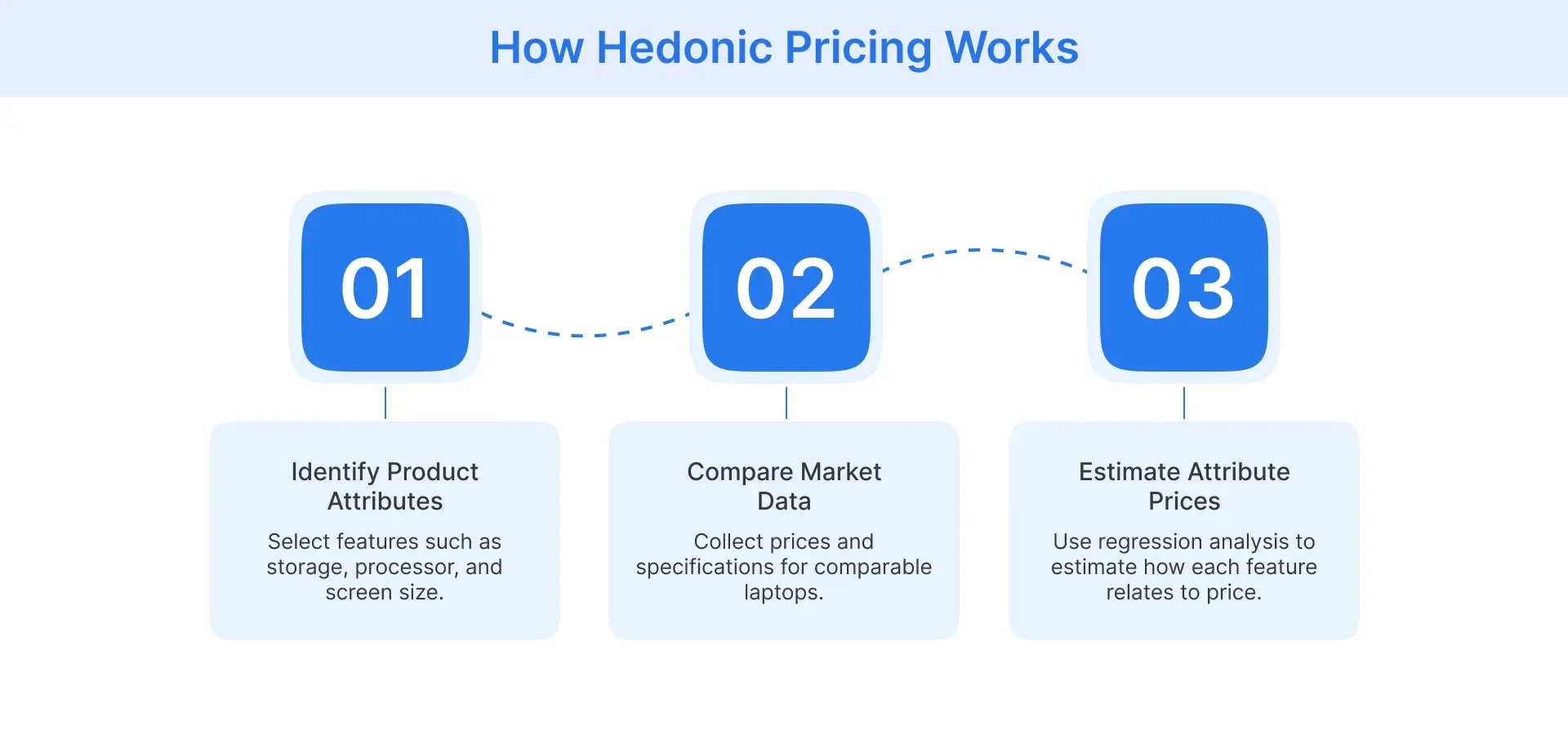
The process generally involves three steps:
- Identify relevant characteristics: Select measurable attributes that may influence prices, such as size, materials, product specifications, or brand.
- Compare market data: Collect prices and attribute information for comparable products to identify differences across the market.
- Estimate implicit prices: Use statistical analysis to estimate the price associated with each characteristic while accounting for the other attributes included in the model.
For example, a retailer could analyze the prices of similar laptops with different storage capacities, processors, and screen sizes. A hedonic pricing model could estimate how much additional storage is associated with a higher market price, after accounting for differences in other specifications.
These estimates help explain observed price differences, but they do not automatically determine what a retailer should charge.
What Are Some Examples of Hedonic Pricing?
Hedonic pricing can be applied to products with measurable characteristics that influence their market prices. Common examples include real estate, consumer electronics, and apparel.
Real estate
Two houses in the same neighborhood may have different prices because of their size, number of bedrooms, age, or condition. Hedonic analysis can estimate how much each characteristic is associated with the selling price while accounting for other property features.
Consumer electronics
Smartphones with similar core functions may sell at different prices depending on storage capacity, camera specifications, processing power, or brand. By comparing models, a hedonic pricing analysis can estimate the price differences associated with these attributes.
Apparel
Two jackets may differ in price because of their fabric, construction quality, design, or brand. Hedonic analysis can help estimate how these characteristics relate to market prices across comparable products.
These examples illustrate how hedonic pricing can be applied. Actual estimates require market data and statistical analysis rather than assumptions about the value of individual features.
How Can Retailers Apply Hedonic Pricing?
Retailers can use hedonic pricing to evaluate how individual product features relate to prices across comparable products. By analyzing characteristics such as materials, technical specifications, and brand, they can identify which attributes are associated with higher or lower market prices.
These findings can support several retail decisions:
- Product comparisons: Assess whether price differences between similar products can be explained by their features rather than comparing prices alone.
- Assortment decisions: Identify characteristics associated with higher market prices when evaluating which product variations to stock or introduce.
- Pricing evaluations: Compare a product’s current price with prices estimated from its characteristics to identify potential pricing gaps that warrant further investigation.
Hedonic analysis provides evidence for these decisions, but it does not establish the optimal selling price. Retailers must also consider costs, customer demand, competition, and profit margins before making pricing changes.
What Are the Benefits of Hedonic Pricing?
Hedonic pricing helps businesses evaluate price differences more accurately by accounting for the characteristics that distinguish comparable products. Its key benefits include:
- Understanding attribute-related price differences: Businesses can estimate how individual characteristics, such as size, materials, or specifications, are associated with variations in market prices.
- Comparing products with different features: The method allows businesses to assess price differences between products that are similar but not identical, rather than relying on direct price comparisons alone.
- Accounting for quality differences: Hedonic analysis can help distinguish price variations associated with measurable quality characteristics from differences that remain unexplained by the model.
- Understanding market price patterns: By examining data across comparable products, businesses can identify consistent relationships between product characteristics and observed prices.
These insights support more informed product and pricing analysis, although they do not guarantee increased sales or profitability.
What Are the Limitations of Hedonic Pricing?
Hedonic pricing relies on market data and statistical models, which means the reliability of its findings depends on the information available and how the analysis is conducted. Its main limitations include:
- Incomplete market data: Missing or inaccurate product specifications, transaction prices, or other relevant information can affect the reliability of estimated price relationships.
- Omitted characteristics: If a model excludes important attributes that influence prices, it may incorrectly attribute their effects to the characteristics included in the analysis.
- Correlated attributes: Product features often occur together. For example, premium materials may be associated with stronger brand positioning, making it difficult to estimate the separate contribution of each characteristic.
- Statistical complexity: Developing a reliable hedonic pricing model requires expertise in regression analysis, variable selection, and interpreting statistical results.
Another important limitation is that observed market prices do not necessarily reveal how much customers are willing to pay for a particular feature. Similarly, an estimated relationship between an attribute and its price does not guarantee that changing a product’s price will produce a predictable sales response.
Retailers should therefore interpret hedonic pricing findings within their market context, considering external factors such as competition, changing market conditions, and customer preferences before applying them to pricing decisions.
Conclusion
Hedonic pricing helps retailers understand how product characteristics influence market prices, providing useful insights for product comparisons and pricing decisions. However, reliable analysis depends on accurate data and an understanding of market conditions.
For retailers, three points are worth keeping in mind:
- Product attributes: Features, quality, and specifications help explain price differences.
- Retail applications: Hedonic analysis supports product comparisons and pricing evaluations.
- Limitations: Estimated price relationships do not automatically determine optimal selling prices.
Flipkart Commerce Cloud (FCC) supports informed pricing decisions through its Pricing Optimizer, helping retailers evaluate pricing opportunities based on demand and business objectives.
Book a demo to see how FCC can help your business make pricing decisions that align with market demand and commercial goals.

FAQ
An early influential application of hedonic pricing came from economist Andrew Court in 1939, when he used statistical analysis to examine how automobile characteristics related to prices. Economist Sherwin Rosen later developed a formal theoretical framework in 1974, helping establish the foundation for modern hedonic models used in product analysis and real estate valuation.
The hedonic price function is generally expressed as:
P = f(X1, X2, ..., Xn)
Here, P represents the market price (dependent variable), while X1 through Xn represent product characteristics (independent variables). Hedonic regression analysis estimates how these characteristics relate to observed prices, including the implicit price associated with a marginal change in a particular characteristic.
The hedonic pricing method estimates how individual product characteristics relate to observed market prices using statistical analysis. Value-based pricing, on the other hand, sets prices primarily according to customers’ perceived value and willingness to pay. One examines existing price relationships, while the other guides pricing decisions based on customer perceptions.
Yes, retailers can use hedonic pricing to estimate a reference price for new products by comparing their combination of characteristics with those of existing products. However, this estimate does not automatically determine the best launch price. Retailers must also consider production costs, customer demand, competition, and business objectives.