
May 9, 2026
Leader Pricing Strategy
Leader pricing strategy is a retail pricing approach where specific products are sold at very low prices or at a loss to attract customers and drive store traffic. The goal is to generate revenue from additional purchases rather than from the discounted item itself. Retailers across grocery, electronics and ecommerce categories use loss leader pricing to grow their customer base and increase basket size.
Drishti, Manager - Digital Marketing

Table of Contents
- What Is Leader Pricing Strategy?
- How Does Leader Pricing Strategy Work?
- What Are Real-World Examples of Leader Pricing?
- What Are the Different Types of Leader Pricing Strategies?
- What Are the Advantages and Disadvantages of Leader Pricing?
- What Is the Difference Between Leader Pricing and Competitive Pricing?
- Optimize Pricing Strategies with Flipkart Commerce Cloud
Leader Pricing Strategy
Leader pricing strategy gives retailers a structured way to generate store traffic by discounting a small selection of high-demand products strategically. Large companies and small businesses alike use this pricing approach to draw shoppers away from competitor stores.
The leader pricing strategies used by major retailers in the United States, Britain and Ireland show how widely this approach applies across market contexts. From food staples and printers to gaming consoles, the model continues to shape retail pricing decisions globally.
- Leader pricing strategy attracts new customers by offering popular products at prices significantly below normal levels.
- Retailers use loss leader pricing to increase foot traffic and expose shoppers to full-margin merchandise.
- The pricing approach works across both physical retail and ecommerce platforms targeting price-sensitive shoppers.
- A close eye on basket data helps retailers confirm that leader pricing generates net positive revenue overall.
What is Leader Pricing Strategy?
Leader pricing strategy is an approach where retailers sell selected products at very low prices or at a net loss to attract customers into their stores or onto their platforms. The discounted items are chosen for their appeal to a broad customer base rather than for their individual profit margins.
Also known as loss-leader pricing, this strategy uses heavily discounted popular products to drive store traffic and increase sales across the rest of the catalog. The loss on the leader item is treated as a marketing cost rather than a pricing error.
The goal of a leader pricing strategy is not to profit from the discounted item itself, but to generate revenue from other products customers purchase during the same visit or session. Done well, the combined margin from those additional purchases exceeds the loss on the leader product.
How Does Leader Pricing Strategy Work?
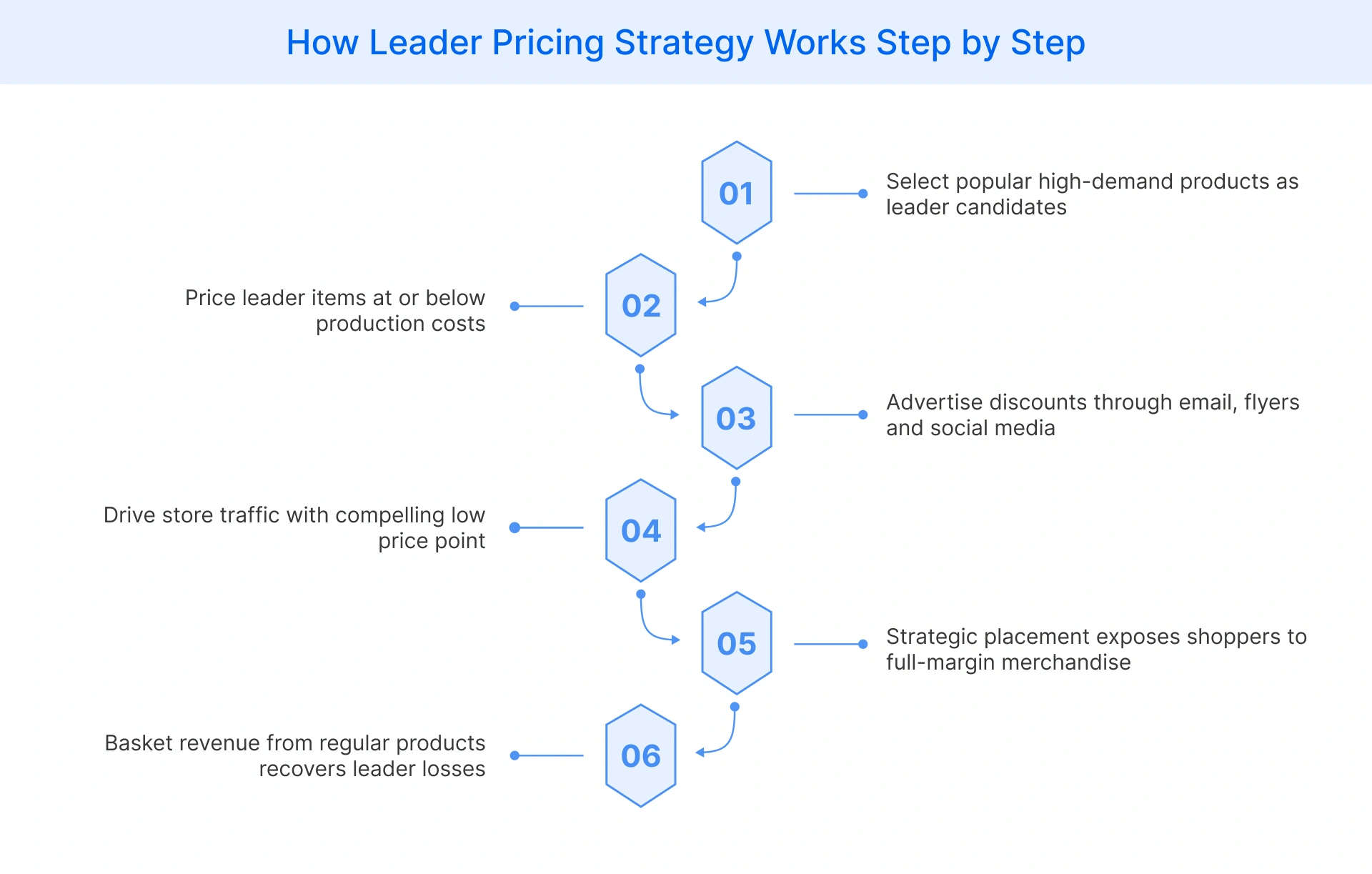
Leader pricing strategy follows a deliberate sequence that converts attention to discounted products into broader, profitable customer purchasing behavior.
- Step 1 - Product Selection: Retailers identify popular products that customers purchase frequently, such as food staples, seasonal items or high-demand electronics, as suitable leader candidates.
- Step 2 - Price Setting: These products are priced at production costs or below to create compelling value that attracts immediate customer attention at the point of decision.
- Step 3 - Promotion: The discounted items are advertised through flyers, email campaigns and social media to maximize awareness and drive shoppers toward the store or platform.
- Step 4 - Traffic Generation: Customers visit the store specifically to buy the low-priced leader item, bringing them into contact with regular-priced merchandise throughout the shopping journey.
- Step 5 - Strategic Placement: Product placement encourages customers to browse and purchase additional higher-margin items during their visit, increasing the average basket value per transaction.
- Step 6 - Profit Recovery: The combined profit from regular-priced purchases exceeds the loss on the leader-priced products, restoring and improving overall profitability across the visit.
What Are Real-World Examples of Leader Pricing?
Here are some real-world examples showcasing leader pricing strategy in action:
- Amazon and Kindle: Amazon sells Kindle devices at cost or below cost to lock customers into buying profitable digital books, audiobooks and media content repeatedly. The hardware carries a smaller profit margin, while the recurring content sales generate the high-margin revenue that justifies the pricing approach.
- Gillette Razors: Gillette prices razors very low or gives them away to new customers, knowing those customers will repeatedly purchase expensive replacement blade cartridges over time. This razor-and-blades model is an extremely popular leader pricing strategy.
- Gaming Consoles: Gaming console manufacturers such as those behind the PlayStation and Xbox sell hardware at a loss and profit from high-margin video games, accessories, and online subscriptions. At Christmas and during major sales events, these manufacturers further deepen discounts to accelerate growth of their customer base before recovering margins through content sales.
- Costco Rotisserie Chicken: Costco sells rotisserie chickens for $4.99, absorbing losses of $30 to $40 million annually to drive overall store traffic and support membership renewals across its warehouse locations. The British Motor Corporation and BMC used comparable pricing logic for the Ford Anglia-era basic model to grow market share in Britain by offering entry-level vehicles at below cost.
What Are the Different Types of Leader Pricing Strategies?
Leader pricing strategy takes several forms depending on the retail context, product category and specific business objectives a retailer is pursuing.
- Introductory Leader Pricing: New products are priced very low during launch to build market share and customer awareness, then gradually increase over time. This approach helps retailers and brands accelerate adoption without relying solely on traditional marketing strategies to generate initial trial.
- Seasonal Clearance Leader Pricing: Retailers discount seasonal inventory at cost or below to clear space for new merchandise with higher profit margins in the next cycle. This type reduces operational costs associated with storing slow-moving stock while recovering partial revenue from products that would otherwise be written down.
- Frequent Purchase Leader Pricing: Essential items purchased regularly, such as groceries or household goods, are priced as permanent loss leaders to build customer loyalty and repeat visits. Supermarkets in the United States and Ireland regularly apply this approach to food staples to anchor weekly shopper behavior around their stores.
- Promotional Event Leader Pricing: Black Friday and holiday sales events use temporary deep discounts to drive massive traffic and introduce new customers to the retailer's broader catalog. These time-limited leader pricing strategies create urgency, accelerating purchase decisions and generating significant short-term sales volumes across multiple categories.
- Free Sample Leader Pricing: Products are given away free to trigger the reciprocity principle, where customers feel a social obligation to make additional purchases from the retailer. This approach is common in cosmetics, food retail, and software, where a starting price of zero significantly lowers the barrier to initial engagement.
- Razor and Blade Model: Core products are sold at low prices while consumable replacements or accessories generate recurring profitable revenue that sustains the business model long-term. Printers sold below cost with high-margin ink cartridges represent one of the most recognized examples of this leader pricing strategy variant in retail.
What Are the Advantages and Disadvantages of Leader Pricing?
Here are the benefits and challenges that leader pricing strategy presents for retailers:
Advantages of Leader Pricing Strategy
- Increased Store Traffic: Low prices on popular products draw shoppers who might otherwise visit competitor stores, increasing the total volume of customers engaging with the full catalog. Higher foot traffic creates more opportunities to convert browsers into buyers across higher-margin product categories throughout the store or platform.
- Customer Acquisition: Attractive leader pricing deals bring new customers into contact with the retailer's broader product range. Many of these shoppers convert into repeat buyers once they experience the store's service, range and convenience beyond the initial loss leader product.
- Inventory Clearance: Leader pricing moves excess or seasonal inventory that would otherwise incur ongoing storage and operational costs but does not generate revenue. Clearing slow-moving stock also frees up shelf space and working capital for new products with stronger profit margins and better sales velocity.
- Brand Awareness: Deep discounts generate word-of-mouth and social media attention, increasing brand visibility without proportional advertising spend. Major retailers that execute leader pricing well attract earned media coverage, particularly during large promotional events, amplifying reach beyond their existing customer base.
Disadvantages of Leader Pricing Strategy
- Cherry Picking Risk: Some customers purchase only the loss leader products without buying any additional profitable items, which compounds losses without delivering the intended basket uplift. Retailers must use placement and promotional mechanics carefully to minimize the proportion of cherry-picking shoppers in their customer traffic.
- Margin Erosion: Frequent use of leader pricing can train customers to wait for sales events before purchasing, gradually reducing the profit margins the retailer earns on standard transactions. Over time, this behavior shift makes it harder to sustain healthy profitability without constant promotional activity across the catalog.
- Brand Perception Damage: Constant discounting may signal low quality to shoppers or devalue the premium brand positioning a retailer or manufacturer has invested in building. Small businesses and premium brands face a higher risk of this perception damage than large companies with established reputations for value across a broad customer base.
- Competitive Price Wars: Competitors may match or undercut the leader's prices, triggering destructive price competition that reduces profitability across the entire product category or market. Without a sustainable cost advantage, retailers drawn into these price wars face shrinking margins and growing pressure on their overall business model.
What Is the Difference Between Leader Pricing and Competitive Pricing?
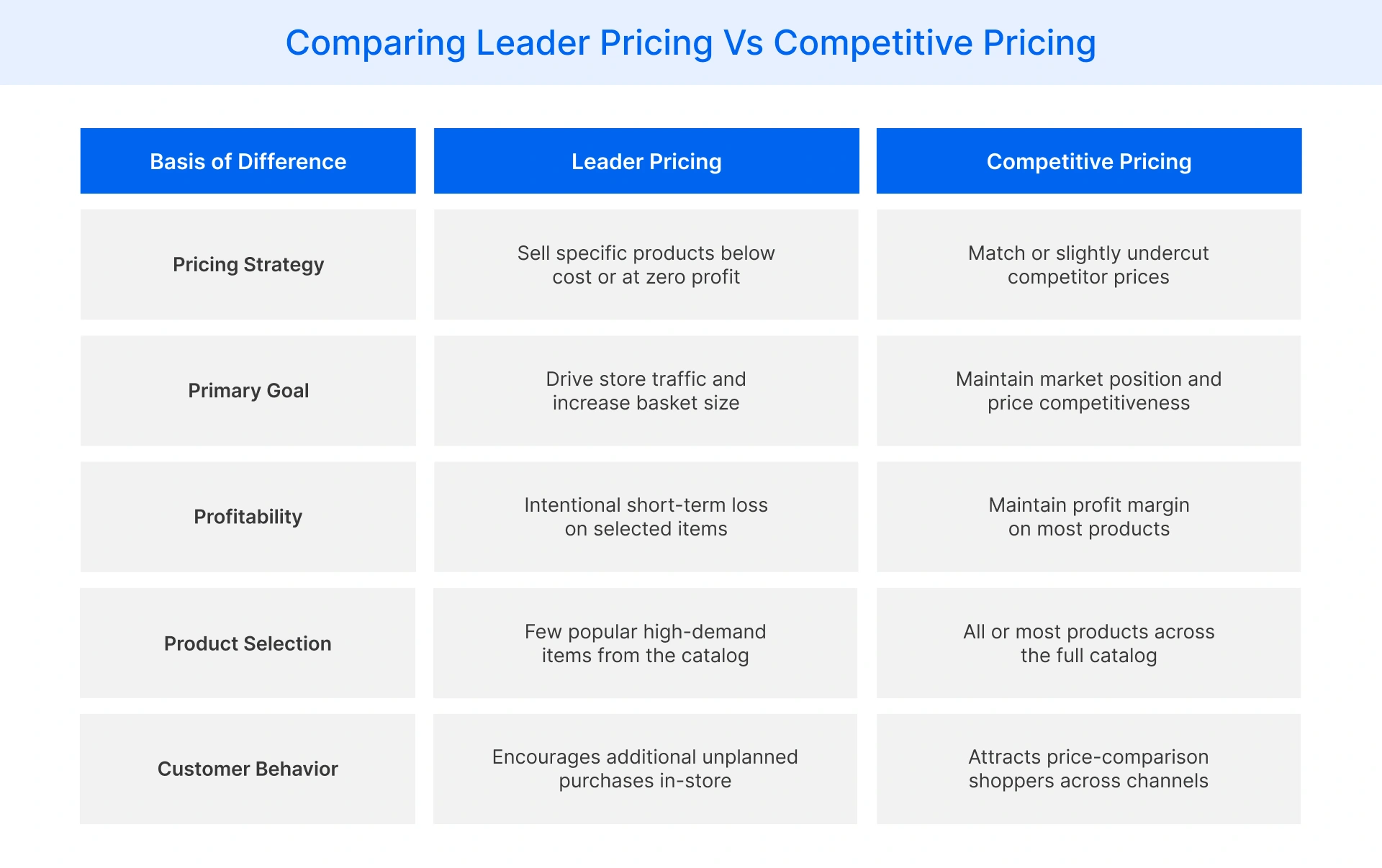
Leader pricing strategy intentionally prices specific products below cost to generate traffic and basket uplift across the broader catalog. Competitive pricing, by contrast, aims to match or slightly undercut rival prices across most products while maintaining acceptable profit margins throughout. Leader pricing accepts a planned loss on selected items, whereas competitive pricing seeks to remain profitable on every product it sells.
Optimize Pricing Strategies with Flipkart Commerce Cloud
Executing an effective leader pricing strategy requires technology that monitors competitor prices in real time, calculates optimal discount levels and measures promotional performance accurately. Manual pricing decisions cannot respond quickly enough to the market changes that determine whether leader pricing generates a net positive return.
The Pricing Solution from Flipkart Commerce Cloud provides ML-powered dynamic pricing capabilities to help retailers build and execute profitable leader-pricing strategies at scale. The algorithms analyze demand elasticity and competitor pricing to recommend which products are the strongest candidates for loss-leader designation across categories.
Our Dynamic Pricing Software enables retailers to automate promotional pricing while maintaining guardrails that protect overall profitability across the catalog. Retailers can set specific loss limits for leader items while FCC's Price Optimization Software adjusts prices on complementary products to maximize basket value and recover margin on every transaction.
Book a demo to see how FCC optimizes leader pricing at scale.
FAQ
Costco selling rotisserie chickens at $4.99 while absorbing tens of millions in annual losses is a well-known example of a leader-pricing strategy. The low price drives store visits and membership renewals, generating revenue from higher-margin purchases made during the same trip. Amazon pricing Kindle devices at or below cost to sell profitable digital content follows the same logic.
Cost leadership means achieving lower production costs than competitors to sustain profitability at competitive price points. Price leadership describes a situation in which one retailer or brand sets the market price that competitors tend to follow. Leader pricing strategy is a specific short-term tactic used within a broader price leadership or competitive pricing approach.
Leader pricing means selling selected popular products at very low prices or at a loss to attract customers and increase overall store revenue. The discounted item acts as the entry point while profit is recovered from additional purchases made during the same visit. It is widely used in grocery, electronics and ecommerce retail categories.
The opposite of price leadership is price following, where a retailer adjusts its prices in response to what market leaders or dominant competitors have already set. Price followers lack the market share or cost structure to influence category pricing independently. Small businesses and newer market entrants most commonly adopt a price-following approach rather than setting their own leader pricing.
The main disadvantages include cherry-picking customers who purchase only the discounted items without buying profitable products alongside them. Repeated use of loss leader pricing can erode profit margins by conditioning shoppers to expect permanent discounts rather than paying standard prices.