
September 30, 2026
Partial Shipments and the Flexibility of Split Order Fulfillment
A partial shipment occurs when a single customer order is fulfilled through two or more separate shipments instead of being shipped all at once.
Drishti, Manager - Digital Marketing

Table of Contents
- What Is a Partial Shipment?
- What Is an Example of Partial Shipment?
- Why Do Retailers Use Partial Shipments?
- What Are the Benefits of Partial Shipments?
- What Are the Challenges of Partial Shipments?
- What Is the Difference Between Partial Shipment and Partial Fulfillment?
- What Is the Difference Between Partial Shipment and Partial Truckload Shipping?
- How Can Retailers Manage Partial Shipments Effectively?
- Conclusion
Partial Shipments and the Flexibility of Split Order Fulfillment
Online orders do not always need to wait until every item is available before order fulfillment can begin. Retailers may have some products ready to ship while others are temporarily unavailable or stored elsewhere.
Inventory may also be spread across different warehouses, while delivery times, product requirements, or an urgent customer need can affect how an order is fulfilled. In these situations, shipping available items separately can help retailers avoid delaying the entire order and maintain a better customer experience.
Partial shipment provides retailers with this flexibility. In this article, we discuss how partial shipments work, why retailers use them, their benefits and challenges, and how they can be managed effectively.
What Is a Partial Shipment?
A partial shipment occurs when the fulfillment of a single order is divided across two or more separate shipments instead of being shipped all at once. Different items of the order may be dispatched at different times or from different fulfillment locations depending on inventory availability and delivery requirements.
The term is sometimes used alongside phrases such as split shipment, partial shipping, or partial delivery. In each case, part of the order is shipped first while the remaining items are delivered separately later.
How Does Partial Shipment Work?
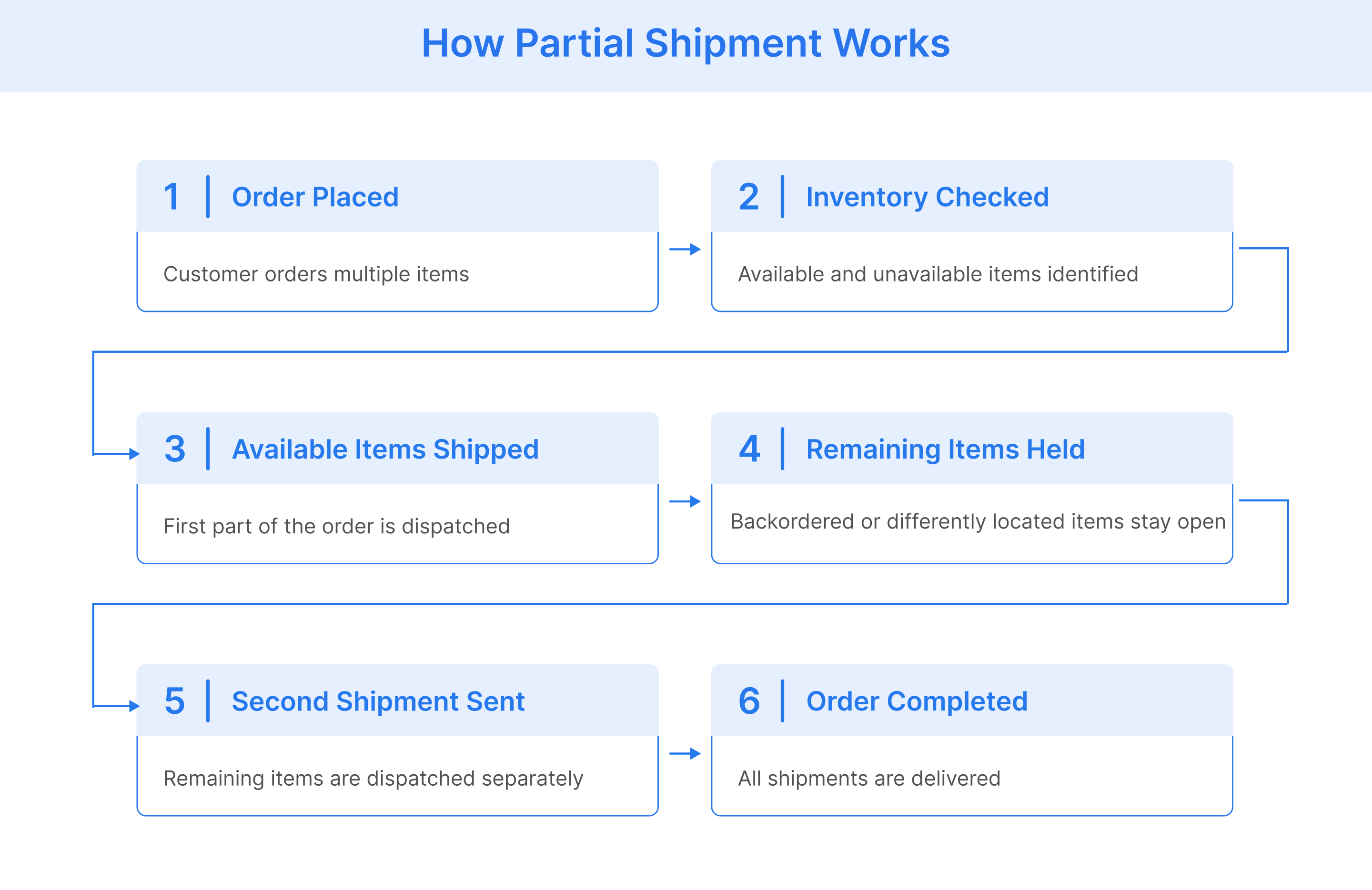
Partial shipment begins by identifying which items in the original order are available for fulfillment. Those items can be picked, packed, and dispatched while unavailable items or products stored at another location remain open within the same order.
Each shipment may have its own tracking information, delivery updates, and shipping status. The original order remains partially fulfilled until the remaining items are shipped or otherwise resolved.
What Is an Example of Partial Shipment?
A customer may place a single order containing several items, but not every item is available at the same fulfillment location. For example, two items may be ready to ship immediately while another item is backordered or stored at a different warehouse.
The available items can be sent first as one of the smaller shipments, while the remaining item is shipped separately once it becomes available. The customer receives separate tracking information and delivery updates for each shipment, but all shipments remain connected to the original order.
Why Do Retailers Use Partial Shipments?
Retailers use partial shipments when sending available items immediately is more practical than delaying the entire order. This can happen for several reasons:
- Backordered or out-of-stock items: Available products can be shipped first while unavailable items remain open until stock becomes available.
- Inventory in different warehouses: Items stored across separate fulfillment locations may need to be dispatched independently.
- Urgent customer needs: Priority items can be shipped first when a customer has an urgent need.
- Different delivery addresses: Parts of the same order may need to be sent to separate destinations.
- Product delays: Delayed items can be shipped later without holding back the rest of the order.
- Items that cannot be packed together: Product size, handling requirements, or packaging restrictions may require separate shipments.
- Partial shipments can be planned in advance or triggered by fulfillment conditions after the order is placed, giving retailers more flexibility in how they complete the order.
- What Are the Benefits of Partial Shipments?
- Partial shipments allow retailers to send available items without making customers wait for the entire order to be ready. This can improve flexibility across the fulfillment process while reducing unnecessary delays.
- Faster access to available items: Customers can receive products that are already in stock instead of waiting for delayed or unavailable items.
- Reduced delivery delays: Shipping part of the order first can shorten waiting times for priority products.
- Greater fulfillment flexibility: Retailers can respond more effectively to differences in inventory availability, delivery requirements, and fulfillment locations.
- Better use of inventory: Available stock can move from different locations rather than remaining held until every item in the order is ready.
- Improved customer satisfaction: Receiving available items sooner can create a better customer experience, particularly when the remaining items are clearly communicated.
Partial shipments can also support inventory management by allowing retailers to move available stock without waiting for every item in the order to become available.
What Are the Challenges of Partial Shipments?
Partial shipments can create additional operational complexity because a single customer order must be managed as multiple physical shipments. Some of the main challenges include:
- Higher shipping and packaging costs: Sending multiple packages for one order can increase shipping costs and require additional packaging materials.
- More tracking and documentation: Each shipment may need its own tracking information, delivery updates, and supporting documentation.
- Separate customer notifications: Retailers need to communicate clearly when each part of the order is shipped and when customers should expect delivery.
- Billing complexity: Dividing an order into multiple shipments can make billing and payment records more difficult to coordinate, particularly when partial invoices are generated for separate shipments.
- Returns management: Returns may need to be handled separately depending on which shipment contained the returned item.
- Greater risk of fulfillment errors: Managing several shipments creates more opportunities for incorrect items, missed updates, or delivery problems.
- Environmental impact: Additional packaging and separate deliveries can increase the environmental impact of fulfilling a single order.
Clear communication is especially important with partial shipments. If customers are not told that the remaining items will arrive separately, receiving only part of an expected order can create confusion and negatively affect the customer experience.
What Is the Difference Between Partial Shipment and Partial Fulfillment?
Partial shipment and partial fulfillment are closely related, but they describe different parts of the fulfillment process.
Partial fulfillment refers to the status of an order when only some of the items have been fulfilled. Partial shipment, on the other hand, refers to the physical shipment of those available items while the remaining items are sent later.
The terms may sometimes be used interchangeably, but the main difference is that partial fulfillment describes the order status, while partial shipment describes the shipping activity.
|
Partial Shipment vs. Partial Fulfillment |
||
|---|---|---|
|
Factor |
Partial Shipment |
Partial Fulfillment |
|
Meaning |
Part of an order is physically shipped separately |
Only part of an order has been fulfilled |
|
Main focus |
Shipment and delivery activity |
Order fulfillment status |
|
Example |
Two items ship today while one ships later |
Two of three items in an order are marked fulfilled |
What Is the Difference Between Partial Shipment and Partial Truckload Shipping?
Partial shipment and partial truckload shipping may sound similar, but they refer to different logistics processes.
In ecommerce, a partial shipment occurs when different items from a single customer order are sent in separate deliveries. Partial truckload shipping, on the other hand, is a freight shipping method used when a shipment does not require an entire trailer but still takes up more truck space than a typical smaller freight load.
Partial truckload, or PTL, shipments are concerned with the transportation of freight rather than the fulfillment of individual ecommerce orders. With PTL freight, factors such as the volume of the load and the amount of truck space required can influence how the freight is moved. While PTL may be compared with LTL transport in freight logistics, both are distinct from partial shipment, which focuses on sending different parts of a customer order separately.
How Can Retailers Manage Partial Shipments Effectively?
Managing partial shipments effectively requires retailers to coordinate inventory, fulfillment, tracking, communication, and order status across the whole process.
Some useful practices include:
- Maintain accurate inventory and order information: Update inventory and order records as each portion of the order is fulfilled so teams have a clear view of what has shipped and what is still outstanding.
- Provide clear tracking and delivery updates: Give customers separate tracking numbers, estimated delivery dates, and a clear delivery window for each shipment.
- Keep teams and systems aligned: Warehouse, logistics operations, customer service, and billing teams should have access to consistent shipment and order information.
- Use order management software: Order management software, ERP systems, or other fulfillment technology can automate shipment tracking, inventory updates, and order-status management.
- Set clear shipping expectations: A clear shipping policy can help customers understand when an order may arrive in separate shipments and how those deliveries will be handled.
- Monitor additional costs: Track the extra shipping and packaging costs created by splitting orders so partial shipment does not unnecessarily increase fulfillment expenses.
The right logistics solutions can also help retailers keep inventory, shipment, and order information coordinated across the fulfillment process.
Conclusion
Partial shipment gives retailers the flexibility to send available items without delaying an entire order. While this can support faster delivery and greater fulfillment flexibility, businesses also need to manage the additional shipping costs, tracking requirements, and operational complexity that come with multiple shipments.
Flipkart Commerce Cloud helps businesses coordinate orders, inventory, and fulfillment across locations while maintaining visibility throughout the order lifecycle. Using its Order Management System, shipment tracking, inventory updates, and fulfillment workflows can be automated, making it easier to manage partial shipments until the entire order is complete.

FAQ
Partially shipped status indicates that a merchant has dispatched only some items from your order while remaining items stay in the warehouse. Retailers split shipments for various reasons, such as items stocking in different locations, ensuring available products reach buyers quickly without waiting for the entire fulfillment process.
Partially delivered means that one or more packages from a multi-item order have arrived at your door while others remain in transit. E-commerce merchants often dispatch packages separately from different fulfillment hubs, leading to separate delivery times across nearby destinations depending on local carrier schedules and route efficiency.
Partial delivery describes the supply chain strategy of delivering customer orders in multiple separate shipments instead of a single package. This approach accelerates order handling, allowing online merchants to deliver in-stock items rapidly while secondary items undergo processing or transfer between regional distribution centers
Partially shipped on SHEIN means that different items of a single order were processed across separate regional warehouses. To prevent delivery delays, SHEIN ships available items first, while remaining clothing or accessories are packaged and dispatched as soon as local inventory becomes ready for final carrier transportation.
In global logistics, a partial shipment means dividing an order into smaller, separate deliveries rather than sending everything together. Transshipment refers to moving cargo between intermediate transport vehicles or transit hubs, helping international logistics providers optimize delivery routes, manage load volumes, and reduce overall freight transportation costs.
The difference between a partial shipment of a single order and a full shipment comes down to dispatch timing. Full shipments deliver all purchased items together in one package, whereas partial shipping sends items individually. Platforms like Flipkart Commerce Cloud FCC provide the right tools to manage these distinct processes.