
May 12, 2026
What is Out-of-Stock Rate?
Out-of-stock rate measures the percentage of products that are unavailable for purchase at a given time. It helps retailers understand how often customers encounter stockouts and identify lost sales opportunities.
Drishti, Manager - Digital Marketing

Table of Contents
- What is Out-of-Stock Rate?
- How is Out-of-Stock Rate Calculated?
- Is a High Stockout Rate Always Bad?
- Why is Out-of-Stock Rate Important for Businesses?
- What Causes High Out-of-Stock Rates?
- How Do Stockouts Impact Businesses?
- How Can You Reduce Out-of-Stock Rate?
- Conclusion
What is Out-of-Stock Rate?
Out-of-stock rate (also known as stockout rate or OOS rate) is a retail metric that measures the percentage of products that are unavailable for purchase at a given time.
It reflects how often customers encounter situations where a product they want is not in stock. This can occur when an item is sold out, unavailable in a specific size or variant, or temporarily missing from inventory.
A high out-of-stock rate indicates frequent stockouts, which can lead to missed sales opportunities and a poor customer experience.
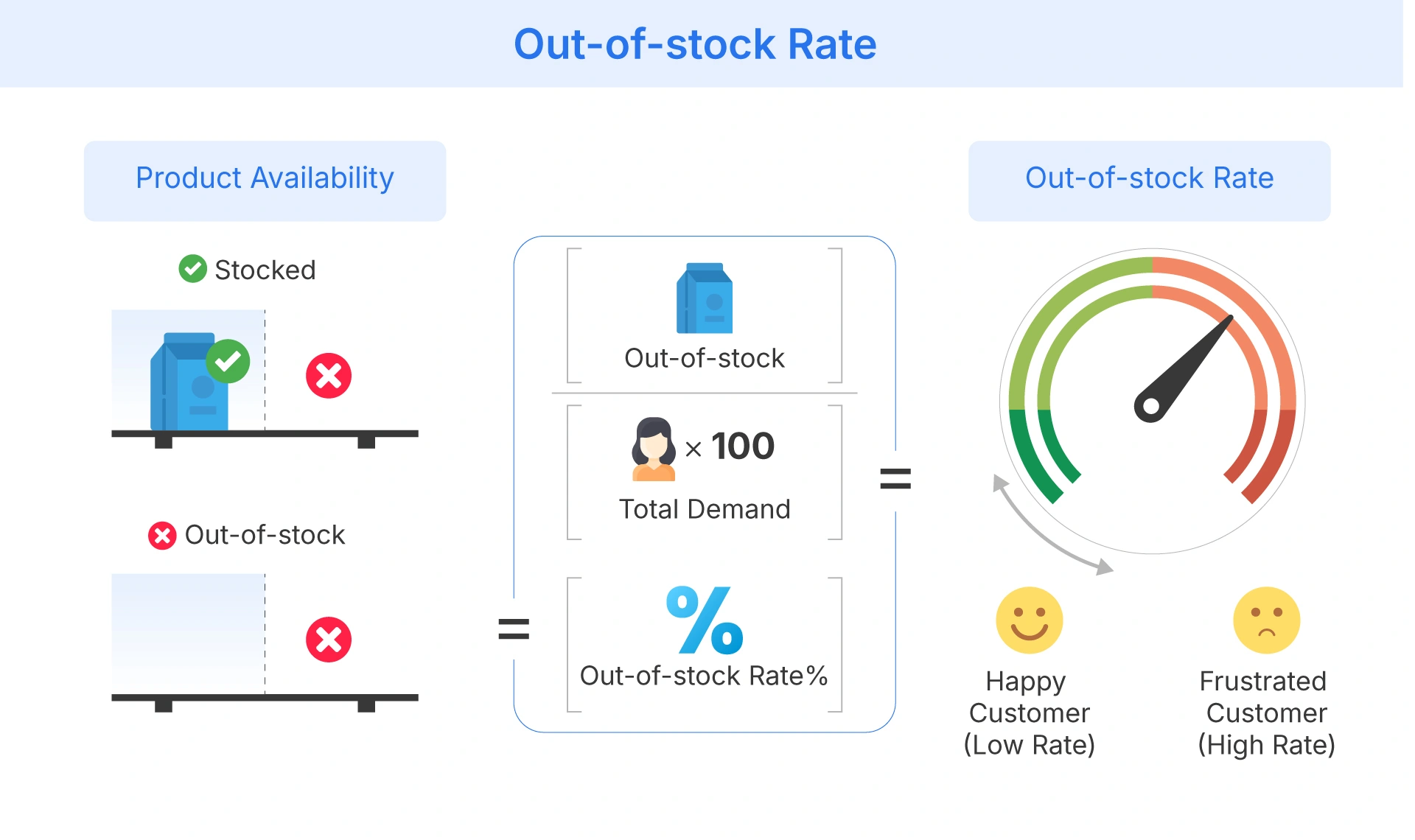
How is Out-of-Stock Rate Calculated?
The out-of-stock rate is calculated using the following formula:
|
OOS Rate = (Number of SKUs Out-of-Stock / Total Number of SKUs) × 100 |
SKU (Stock Keeping Unit): A unique identifier assigned to each product or product variant.
Example:
If your product catalog contains 100 SKUs and 10 are out-of-stock:
OOS Rate = (10 / 100) × 100 = 10%
This means 10% of your inventory is unavailable to customers at that time.
Is a High Stockout Rate Always Bad?
A high stockout rate is not always a negative sign, especially if it indicates strong customer demand, successful marketing campaigns, or limited-edition products selling faster than expected. Examples include products launched during seasonal sales, flash promotions, or viral trends. Conversely, dead stock indicates low stockout and low customer demand.
However, consistently high stockout rates indicate supply chain bottlenecks and lead to lost sales, reduced customer trust, and inaccurate demand forecasting if businesses are unable to replenish stock quickly.
The goal is not to eliminate stockouts, but to maintain a balance between inventory availability, replenishment efficiency, and inventory holding costs.
Why is Out-of-Stock Rate Important for Businesses?
Tracking the out-of-stock rate helps businesses understand how inventory availability impacts sales performance, customer satisfaction, and operational efficiency. Monitoring this metric allows retailers to identify inventory gaps early and improve replenishment planning before stock shortages affect revenue.
- Sales performance: When products are unavailable, customers cannot complete purchases, leading to missed sales opportunities. Frequent stockouts may also push buyers toward competing brands or marketplaces.
- Demand forecasting: Monitoring stockout patterns helps businesses understand actual product demand more accurately. High stockout rates can distort forecasting data because customer demand may appear lower than it actually is when products remain unavailable for extended periods.
- Customer experience and retention: Consistent product availability improves customer satisfaction and trust. On the other hand, repeated stock shortages can reduce brand reliability and increase the likelihood of customer switching.
- Marketing effectiveness: Promotions and advertising campaigns perform better when inventory levels are stable. Running campaigns for products that are unavailable can reduce campaign efficiency and negatively affect conversion rates.
- Operational planning: Tracking stockout rates also helps businesses improve inventory allocation, replenishment timing, and supply chain coordination across channels.
What Causes High Out-of-Stock Rates?
High stockout rates are typically the result of gaps in planning, execution, or supply chain coordination.
Poor Demand Forecasting
Inaccurate demand forecasting can cause businesses to underestimate customer demand, leading to insufficient inventory levels for high-demand products during peak sales periods.
Inventory Mismanagement
Incorrect stock records or delays in updating inventory systems can create mismatches between actual inventory levels and product availability across sales channels.
Supply Chain Disruptions
Delays in procurement, shipping, or supplier operations can interrupt replenishment cycles and prevent businesses from restocking products on time.
High or Unpredictable Demand
Seasonal sales, promotional campaigns, or sudden spikes in customer demand can quickly deplete inventory and increase the risk of temporary stockouts.
Inefficient Replenishment Processes
Slow restocking workflows or operational inefficiencies may delay inventory replenishment and reduce product availability for customers.
How Can You Control Out-of-Stock Rate?
Reducing stockouts requires better visibility, planning, and coordination across operations.
- Improve Demand Forecasting: Use historical data and predictive analytics to anticipate demand more accurately.
- Maintain Real-Time Inventory Visibility: Ensure inventory systems are updated continuously across all sales channels.
- Optimize Replenishment Cycles: Set reorder points and automate restocking to prevent delays.
- Strengthen Supply Chain Coordination: Work closely with suppliers and logistics partners to ensure timely delivery.
- Use Pricing to Manage Demand: Adjust pricing strategically during high-demand periods to control stock depletion.

Conclusion
The out-of-stock rate is a critical metric that directly impacts revenue, customer satisfaction, and operational efficiency. Monitoring and optimizing this metric helps businesses reduce missed sales opportunities, improve forecasting accuracy, and maintain consistent product availability.
Flipkart Commerce Cloud supports inventory management through real-time visibility, intelligent forecasting, and scalable infrastructure, enabling businesses to minimize stockouts and deliver reliable shopping experiences.

FAQ
A good out-of-stock (OOS) rate is generally considered to be under 5%. While the global retail average is notably higher, keeping your OOS rate between 2% and 5% during normal operations means you are successfully balancing lean inventory costs without missing out on significant revenue from unavailable products.
High out-of-stock rates are primarily caused by a mismatch between supply and demand, often stemming from inaccurate sales forecasting or unexpected viral trends. Other major culprits include supply chain bottlenecks, vendor delays, and data inaccuracies where your system thinks you have stock that is actually missing, stolen, or damaged.
They are exact inverses of each other and together total 100% of your inventory catalog. Your in-stock rate is the percentage of your product assortment currently on hand and available for purchase, while the stockout rate represents the percentage of items that are completely depleted and unavailable to buyers at that given time.
Reducing out-of-stocks requires moving from reactive to proactive inventory management. You can achieve this by utilizing AI-driven demand forecasting, tracking your inventory in real-time across all channels, diversifying your supplier base to avoid bottlenecks, and maintaining a mathematically calculated buffer of safety stock.
The average out-of-stock rate across the e-commerce industry typically hovers right around 8%. However, this baseline can easily spike to 10% or higher during heavy promotional periods, flash sales, or holiday seasons when shopper traffic predictably surges and supply chains are stretched thin.