
July 28, 2026
What Is Sales Price Variance (SPV) And How To Calculate It?
Sales price variance (SPV) measures how sales revenue changes when the actual price deviates from the budgeted price, revealing its true impact on performance.
Drishti, Manager - Digital Marketing

Table of Contents
- What is Sales Price Variance (SPV)?
- How Does Sales Price Variance Work in Retail?
- How Do You Calculate Sales Price Variance?
- What is Favorable vs. Unfavorable Sales Price Variance?
- What is the Difference Between Sales Price Variance vs. Sales Volume Variance?
- What Are the Retail Factors That Drive Pricing Deviations?
- What are the Best Practices for Sales Pricing Variance?
- How Can Automated Retail Engines Help Control Portfolio Margins?
What Is Sales Price Variance (SPV) And How To Calculate It?
Sales price variance (SPV) helps businesses measure how pricing decisions affect revenue. Tracking sales price variance allows retailers to separate the impact of price changes from the impact of selling more or fewer units, making it easier to evaluate pricing performance and protect profit margins.
Sales price variance comes from standard costing used since the 20th century to compare planned figures against actual results. Retailers adapted the same logic to pricing: instead of asking whether a factory spent more than budgeted, they ask whether a product sold for more or less than planned.
In this article, you’ll have answers to: What is sales price variance(SPV)? We'll break down the formula, how to read a favorable versus unfavorable result, and how it differs from sales volume variance.
- Sales price variance (SPV) measures the revenue impact of selling at a different price than budgeted, separate from any change in units sold.
- Formula: (Actual Selling Price − Budgeted Standard Price) × Actual Quantity Sold.
- A positive result is favorable (you earned more per unit than planned); a negative result is unfavorable (you earned less).
- Tracked separately from sales volume variance, which measures the impact of selling at a different price than planned.
What is Sales Price Variance?
Sales price variance (SPV) is the difference between the price you actually sold a product for and the price you expected to sell it for, multiplied by how many units you actually sold. It's the dollar amount your revenue moved up or down purely because of pricing, nothing else.
Finance and merchandising teams established a standard price for each stock-keeping unit (SKU) during the budgeting process. Actual selling prices often change because of promotions, competitor pricing, seasonal demand, or market conditions.
Sales price variance measures the revenue impact of those pricing changes while excluding changes caused by sales volume. Separating price variance from sales volume variance helps retailers selling through a B2C Commerce storefront identify whether revenue changes resulted from pricing decisions or changes in unit sales.

How Does Sales Price Variance Work in Retail?
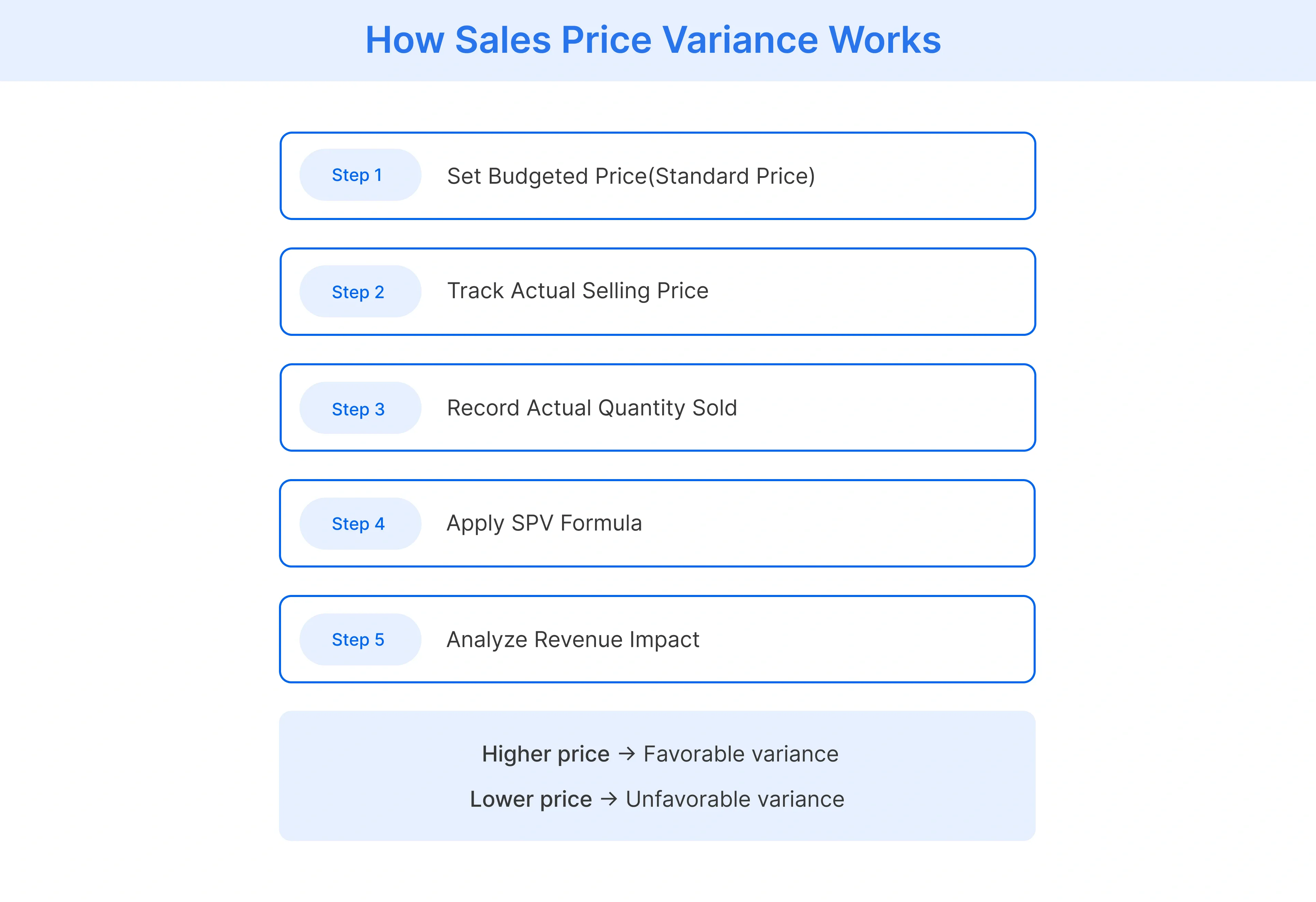
Sales price variance follows three key steps: setting a budgeted selling price, tracking the actual selling price, and measuring the revenue impact of pricing differences.
- Set the budget price: Finance and merchandising teams set a budgeted selling price, often called the standard price, for each SKU, based on margin targets and market conditions.
- Track actual selling price: Promotions, seasonal demand, competitor pricing, and markdowns can increase or reduce actual selling prices during the selling period.
- Measure Price Impact: The sales price variance formula excludes change in sales volume, and shows exactly how much revenue you gained or lost purely because of pricing decisions.
How Do You Calculate Sales Price Variance?
To calculate sales price variance, you need the actual selling price, budgeted selling price, and actual quantity sold.
- Actual Selling Price (ASP): The real, average price you sold the product for during the period, not the price you planned to charge.
- Budgeted Standard Price (BSP): The target price your team set at the start of the sales cycle, based on margin goals and market conditions.
- Actual Quantity Sold (AQS): The total number of units that actually moved during the timeframe you're measuring.
Put together, the sales price variance formula looks like this:
|
Sales Price Variance (SPV)= (Actual Selling Price−Budgeted Standard Price)×Actual Quantity Sold |
The formula uses actual quantity (units) sold to isolate the impact of pricing decisions without including changes in sales volume.
Example of Calculating Sales Price Variance
- Scenario: An online retail brand budgets to sell a premium smart home device at a standard selling price of $100. But when a competitor launches an aggressive promotion, the brand lowers its actual selling price to $90 to stay competitive. Over the period, it sold exactly 2,000 units.
- Calculation: SPV=($90−$100)×2,000=−$20,000
- Result: That works out to a -$20,000 unfavorable price variance. The result shows that lowering the selling price reduced planned revenue by $20,000.
Also read: Everything you need to know about inventory control.
What is Favorable vs. Unfavorable Sales Price Variance?
Sales price variance produces either a favorable or an unfavorable result depending on whether the actual selling price is higher or lower than the budgeted selling price.
Favorable Sales Price Variance (Positive Result)
A favourable sales price variance occurs when your actual selling price comes in higher than your budgeted standard price, meaning you earned more revenue per unit than planned.
-
Analysis & Causes: A positive sales price variance points to strong product demand, lighter-than-expected competition, successful premium upselling, or simply not needing to lean on promotions as heavily.
Unfavorable Sales Price Variance (Negative Result)
An unfavorable sales price variance occurs when your actual selling price is below your budgeted standard price, meaning you earned less per unit than you planned.
-
Analysis & Causes: A negative sales price variance often traces back to aggressive markdown periods, heavy competitor price-matching, or customers proving more price-sensitive than your budget assumed.
Also Read: Purchase Price Variance

What is the Difference Between Sales Price Variance vs. Sales Volume Variance?
Sales price variance and sales volume variance are two financial metrics used to analyze why actual sales revenue differs from budgeted revenue.
Sales price variance measures the impact of selling products at a different price than planned, while sales volume variance measures the impact of selling a different number of units than planned.
|
Metric |
Primary Metric |
Standard Formula |
Question Addressed |
|
Sales Price Variance (SPV) |
Change in Unit Pricing |
(Actual Price − Standard Price) × Actual Units Sold |
Why did we earn a different price per unit than planned? |
|
Sales Volume Variance |
Change in Units Sold |
(Actual Quantity − Budgeted Quantity) × Standard Price |
Did we sell more or fewer units than we budgeted? |
Some retailers also analyze sales mix variance to measure how changes in product mix affect overall sales performance.
Also Read: Customer Value Based Pricing
What are the Retail Factors That Drive Pricing Deviations?
- Competitor Dynamic Pricing Actions: When rivals drop prices on major marketplaces, e-commerce stores are often forced into unplanned discount adjustments just to stay in the running.
- Marketplace Discounting and Markdowns: End-of-season clearances, holiday flash sales, and loyalty promotions all pull your actual selling price below standard targets, even when they're planned campaigns.
- Shifts in Product and Customer Mix: Selling more in bulk, or shifting sales toward lower-tier regional channels, changes your overall average selling price something omnichannel retail brands see constantly as customers move between online, mobile, and in-store touchpoints, and something well-organized catalog management helps you track at the SKU level.
What Are the Best Practices for Sales Pricing Variance?
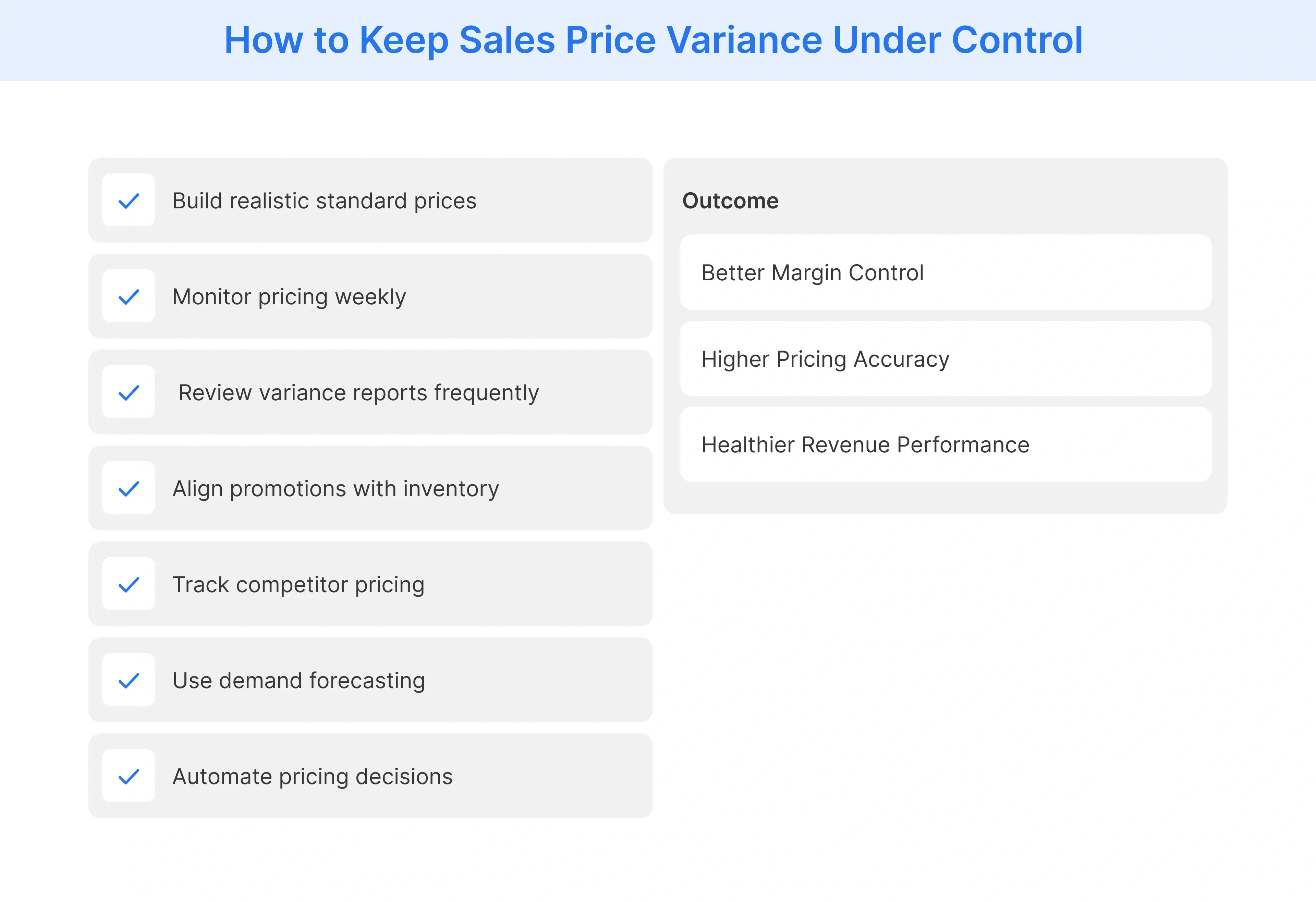
Retailers can reduce sales price variance by improving pricing accuracy, monitoring performance, and aligning pricing with inventory planning.
- Set Realistic Standard Budgets: Build your standard prices around actual market demand, historical sales data, and where competitors are positioned, not inflated sales projections that set you up for an automatic unfavorable price variance.
- Review Pricing Variances Regularly: Audit your sales price variance weekly or monthly instead of waiting until year-end, so you catch margin leaks while there's still time to act.
- Coordinate Pricing and Inventory Planning: Align your front-end discounts directly with your warehouse levels, supported by real-time inventory visibility, so you only mark down stock when you genuinely need to clear it, not as a reflex.
How Flipkart Commerce Cloud Retail Engines Help Control Portfolio Margins?
Running a profitable retail brand comes down to keeping a tight grip on how your actual transactional prices deviate from your corporate financial targets, across every product line and every channel.
Managing sales price variance across thousands of SKUs requires accurate pricing data, demand forecasting, and automated pricing decisions. Flipkart Commerce Cloud helps retailers monitor pricing performance, improve pricing accuracy, and protect margins with ML-powered pricing and demand forecasting solutions.
Book a demo to see how FCC helps retailers reduce pricing variance and improve margin performance.

FAQ
SPV sales price variance measures the revenue impact of selling products at prices that differ from the budgeted selling price. It multiplies that price gap by the actual quantity of units sold, giving a clear read on positive variance or negative variance in isolation.
Sales price variance means the dollar impact on your business performance caused strictly by charging a different price than planned, not by selling more or fewer units. A favorable variance signals higher sales per unit; an unfavorable one signals a lower price eating into profit margin.
You calculate sales price variance by subtracting the budgeted price from the actual selling price, then multiplying the result by the actual quantity of units sold. The sales price variance formula isolates pricing-driven changes in total revenue, separate from sales quantity shifts, so root causes are easy to pinpoint.
Companies use sales variance analysis to break down actual sales results against budgeted targets and identify exactly why business performance moved. By separating price, volume, and mix effects, teams identify pricing, volume, and product mix issues to guide smarter business decisions.
The difference between sales price and sales margin variance is what gets measured: selling price variance looks only at revenue change from price shifts, while sales margin variance factors in actual cost too, showing how pricing decisions affected standard profit and profit margin, not just total revenue.
Common challenges when interpreting sales price variance results include mistaking a favorable variance for genuinely strong performance when it actually came from reduced sales quantity, and overlooking how raw materials cost changes or mixed product lines can distort the numbers without careful risk management.
Yes, specific industries where tracking sales price variance is especially important include retail, e-commerce, manufacturing, and consumer electronics, where prices shift constantly due to competition and demand. Flipkart Commerce Cloud helps brands in these sectors monitor sales performance and financial data in real time to protect margins.