
November 25, 2026
Markdown Optimization in Retail: Balancing Stock Clearance and Margins
Markdown optimization is the process of determining which products to discount, when to reduce prices, and by how much, using sales, inventory, and demand data. Retailers use it to clear slow-moving or end-of-season stock while minimizing unnecessary losses in profit margins.
Drishti, Manager - Digital Marketing

Table of Contents
- What Is Markdown Optimization?
- How Does Markdown Optimization Work?
- What Factors Influence Markdown Optimization Decisions?
- What Are Some Examples of Markdown Optimization in Retail?
- What Are the Benefits of Markdown Optimization for Retailers?
- What Are the Challenges of Markdown Optimization?
- How Can Retailers Implement Markdown Optimization Effectively?
- Conclusion
Markdown Optimization in Retail: Balancing Stock Clearance and Margins
When products sell more slowly than expected, retailers must decide whether to reduce prices or risk holding unsold inventory. This becomes more pressing as seasonal deadlines approach, particularly when remaining stock needs to be cleared before new collections arrive.
However, discounting too early or too heavily can reduce profit margins, while waiting too long may leave retailers with excess inventory that requires even deeper price reductions.
This article discusses how markdown optimization works, the factors that influence markdown decisions, and how retailers can manage stock clearance without unnecessarily sacrificing profitability.
What Is Markdown Optimization?
Markdown optimization is a data-driven approach retailers use to determine when to reduce product prices and by how much. It involves analyzing sales performance, inventory levels, and expected demand to identify price reductions that can help clear excess or aging stock while limiting losses in profit margins.
Unlike temporary promotional discounts, which are often used to encourage purchases during a campaign, markdowns typically address products that are selling slowly or approaching the end of their selling period. Markdown optimization helps retailers make these reductions based on inventory needs rather than applying the same discount across different products.
How Does Markdown Optimization Work?
Markdown optimization works by combining sales history, inventory data, and demand forecasts to determine which products need price reductions and when those reductions should occur. Retailers can use pricing models to estimate how demand may change at different price points and evaluate markdown options against their inventory and margin objectives.
The process generally involves four steps:
- Assess inventory performance: Review sales trends and stock levels to identify products that are selling below expectations or may remain unsold.
- Evaluate markdown options: Use demand forecasts and historical price-response data to estimate how different price reductions could affect sales and remaining inventory.
- Select markdown timing and depth: Determine when to introduce a markdown and how much to reduce the price, considering clearance targets and minimum margin requirements.
- Monitor and adjust: Track sales, inventory movement, and profit margins after implementing markdowns. Use the results to assess whether further price adjustments are necessary.
For example, an apparel retailer could evaluate several discount options for a slow-selling collection before choosing a markdown that balances expected sales with the need to clear stock. Actual performance can then inform subsequent pricing decisions.
What Factors Influence Markdown Optimization Decisions?
The right markdown timing and depth depend on a product’s sales performance, remaining selling period, and financial requirements. Retailers need to assess several factors before deciding whether a price reduction is necessary.
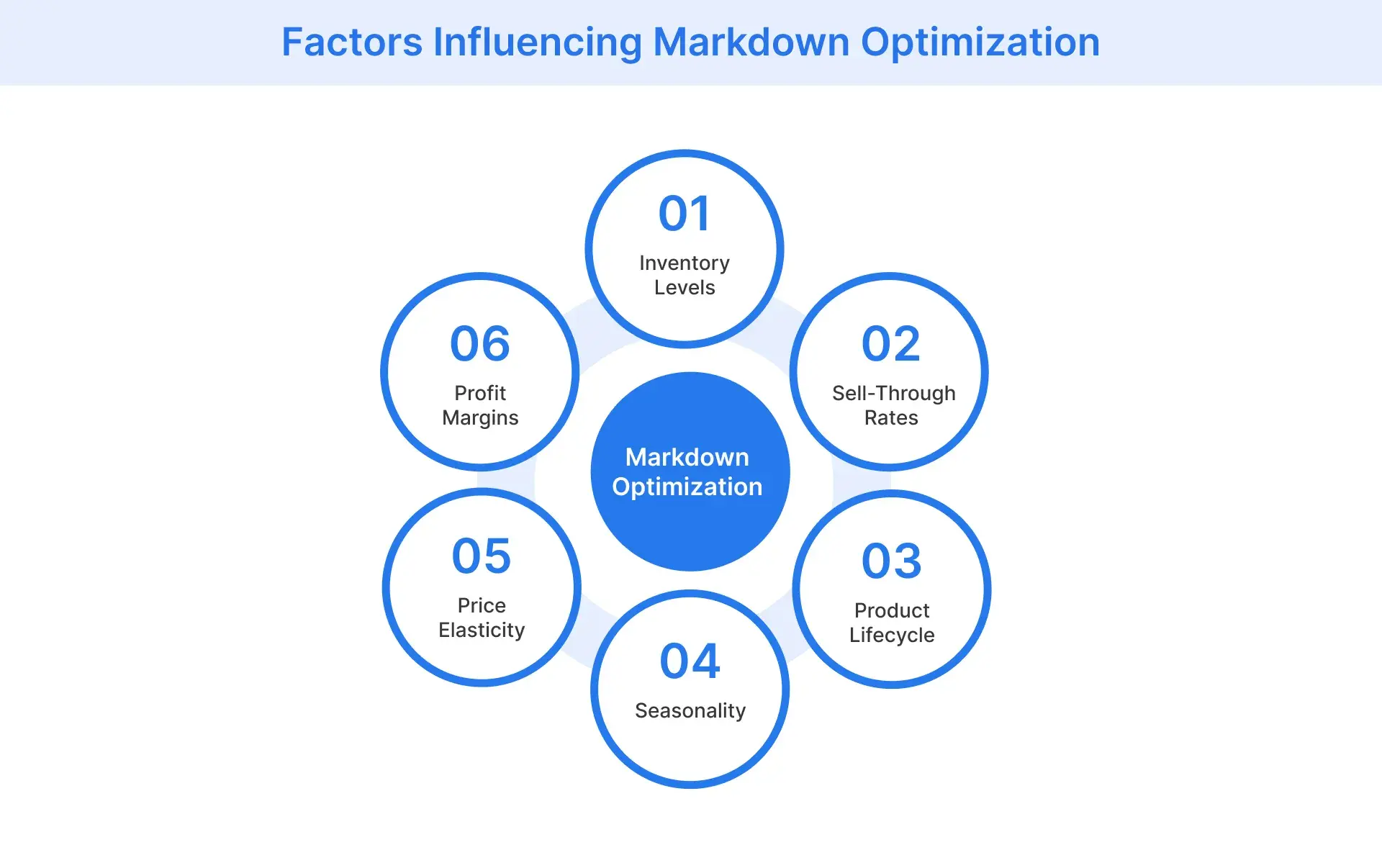
Key factors include:
- Inventory levels: Products with excess inventory relative to expected demand may require earlier or deeper markdowns to reduce the risk of unsold stock.
- Sell-through rates: A low sell-through rate indicates that inventory is moving more slowly than expected. Retailers can use this information to identify products that may need price adjustments.
- Remaining product lifecycle: Products approaching expiration, obsolescence, or the end of their selling period often have less time to generate sales, making timely markdowns more important.
- Seasonality: Demand for seasonal items can decline sharply after peak selling periods. Retailers must consider when customer interest is likely to fall when planning markdowns.
- Price elasticity: Products with more price-sensitive demand may experience a stronger sales response to discounts, while less price-sensitive products may not generate sufficient additional sales to justify a reduction.
- Profit margin requirements: Retailers must consider purchasing costs, gross margins, and minimum acceptable selling prices to avoid markdowns that undermine profitability.
These factors help retailers distinguish products that require faster inventory clearance from those that can continue selling at regular prices. A slow-selling seasonal item nearing the end of its selling period may need a more urgent markdown than a product with steady demand and a longer shelf life.
What Are Some Examples of Markdown Optimization in Retail?
Markdown optimization can help retailers manage different inventory challenges, depending on how quickly products need to sell and how much pricing flexibility remains.
Seasonal apparel
A clothing retailer has unsold winter jackets as the season approaches its end. Rather than applying a large discount immediately, the retailer could introduce targeted markdowns based on remaining stock, sales history, and expected demand. The goal is to clear seasonal inventory before demand declines further while protecting profit margins where possible.
Slow-moving consumer products
An electronics retailer notices that certain headphone models are selling below expectations despite having a longer shelf life. By reviewing sales trends and inventory levels, the retailer could test moderate price reductions on selected models instead of discounting the entire product category. This approach aims to improve sell-through without unnecessary margin losses.
Perishable inventory
A grocery retailer has fresh produce approaching the end of its selling period. Since these products have limited shelf life, the retailer may introduce earlier or progressively deeper markdowns to encourage purchases before the items become unsellable. The objective is to reduce food waste and recover revenue that might otherwise be lost.
These scenarios show why markdown decisions should reflect each product’s selling window, inventory position, and expected customer demand rather than follow a uniform discount schedule.
What Are the Benefits of Markdown Optimization for Retailers?
Markdown optimization helps retailers manage unsold inventory while making more informed decisions about discounting. Its benefits extend beyond stock clearance to inventory efficiency and financial performance.
Key benefits include:
- Improved inventory sell-through: Targeted markdowns can encourage purchases of slow-moving products, helping retailers sell a greater proportion of available stock before the selling period ends.
- Reduced excess inventory: Timely price reductions can help clear surplus products, lowering the risk of obsolete stock and unnecessary storage costs.
- Better inventory turnover: Moving aging products more efficiently allows retailers to replenish inventory with items that better reflect current customer demand.
- Greater margin protection: Rather than applying deep discounts across an entire product category, retailers can make selective reductions that limit unnecessary margin erosion.
- Improved working capital: Converting unsold stock into sales can release capital tied up in inventory, making funds available for other business needs.
- More informed pricing decisions: Retailers can evaluate markdown performance across products, categories, or store locations to identify where pricing adjustments are most effective.
These benefits depend on accurate inventory information, realistic demand estimates, and markdown decisions that reflect the retailer’s financial objectives.
What Are the Challenges of Markdown Optimization?
Markdown optimization can be difficult when retailers lack reliable data or struggle to implement pricing decisions consistently. Even carefully planned markdowns may produce disappointing results if inventory information, demand estimates, or execution are inaccurate.
Common challenges include:
- Inaccurate inventory records: Incorrect stock information can lead retailers to discount products unnecessarily or underestimate how much inventory needs to be cleared.
- Unreliable demand forecasts: Forecasting errors can cause retailers to introduce markdowns too early, too late, or at discount levels that do not reflect actual customer demand.
- Limited price-response data: Without sufficient historical information about how sales respond to price changes, retailers may struggle to estimate the effect of different markdown levels.
- Unpredictable customer behavior: Changes in shopping preferences, competitor offers, or market conditions can make it difficult to anticipate how customers will respond to reduced prices.
- Excessive discounting: Reducing prices more than necessary can erode profit margins, even when markdowns increase sales volume.
- Delayed markdowns: Waiting too long to reduce prices can leave insufficient time to clear remaining inventory, potentially requiring deeper discounts later.
- Inconsistent execution across channels: Differences in markdown prices between physical stores, websites, and other sales channels can create customer confusion and make performance harder to evaluate.
Addressing these challenges requires accurate data, realistic demand estimates, and pricing constraints that protect margins while supporting inventory clearance.
How Can Retailers Implement Markdown Optimization Effectively?
Implementing markdown optimization requires clear business objectives, reliable data, and consistent execution across retail operations. Retailers need to establish pricing guidelines and measure whether markdown decisions deliver the intended results.
The following practices can support effective implementation:
- Set clearance and margin objectives: Define how much inventory needs to be sold within a specific period and establish acceptable profit margin thresholds. These targets help guide markdown decisions without focusing solely on stock clearance.
- Prepare accurate inventory data: Ensure product-level information, including stock quantities, sales history, purchasing costs, and remaining selling periods, is accurate and up to date. Reliable data helps retailers evaluate markdown recommendations.
- Establish pricing rules and review recommendations: Set acceptable discount ranges, minimum selling prices, and approval requirements. Evaluate recommended markdowns against inventory targets, expected sales, and margin constraints before implementing them.
- Test and coordinate markdown execution: Test recommendations on selected products or categories where appropriate. Align pricing and merchandising teams to ensure approved discounts are applied consistently across relevant stores and online channels.
- Measure results and refine decisions: Monitor sell-through rates, remaining inventory, and profit margins against established targets. Use performance findings to adjust subsequent markdowns and improve future clearance planning.
A consistent approach to implementation helps retailers evaluate markdown performance and make adjustments based on actual results rather than relying on assumptions.
Conclusion
Markdown optimization helps retailers clear unsold stock without reducing prices more than necessary. The goal is to make timely discount decisions that support inventory movement while protecting profit margins.
For retailers, three priorities are worth keeping in mind:
- Timing matters: Introduce markdowns while there is still sufficient demand to move remaining stock.
- Discounts should be targeted: Adjust prices according to product performance rather than applying uniform reductions.
- Results should guide decisions: Monitor sell-through and margins to determine whether further adjustments are needed.
Flipkart Commerce Cloud (FCC) supports informed pricing decisions through its Pricing Optimizer, which helps retailers evaluate demand patterns and simulate potential price changes.
Book a demo to see how FCC can help your business make pricing decisions that balance revenue and profitability.

FAQ
When choosing markdown optimization software, retailers should assess demand forecasting accuracy, price elasticity analysis, and compatibility with existing inventory systems. Useful capabilities include product-level markdown recommendations, margin simulations, configurable pricing rules, and reporting that helps teams evaluate whether discounts are meeting clearance targets.
There is no standard margin increase from markdown optimization. Results depend on the product category, inventory levels, demand forecasts, and existing discount practices. By improving markdown timing and depth, retailers may reduce unnecessary price cuts, but actual margin improvements must be measured against prior performance.
Markdown optimization focuses on planning price reductions to clear aging or seasonal inventory while managing profit margins. Dynamic pricing is broader, allowing retailers to raise or lower prices in response to demand, competition, and other market conditions. Markdown optimization can therefore form part of a wider dynamic pricing strategy.
Yes, retailers can tailor markdown optimization by store or sales channel when inventory levels, local demand, and clearance deadlines differ. For example, a product may require a deeper discount in one store than another. However, retailers should coordinate pricing rules to avoid confusing or inconsistent offers.