
September 6, 2026
Yield Pricing and How Retailers Can Use It
Yield pricing is a pricing approach that adjusts prices based on changes in demand, timing, inventory availability, and market conditions. It helps businesses maximize revenue from available or time-sensitive inventory by setting prices according to current demand and revenue opportunities.
Drishti, Manager - Digital Marketing

Table of Contents
- What Is Yield Pricing?
- How Does Yield Pricing Work?
- Why Is Yield Pricing Important for Retailers?
- When Should Retailers Use Yield Pricing?
- What Are Examples of Yield Pricing?
- What Is the Difference Between Yield Pricing and Dynamic Pricing?
- How Can Retailers Implement Yield Pricing?
- Turn Yield Pricing Into Smarter Retail Decisions
Yield Pricing and How Retailers Can Use It
Yield pricing is a pricing approach that helps retailers respond to changing demand, timing, inventory availability, and market conditions. Instead of relying on a fixed price, retailers can adjust prices based on current demand and available inventory to identify the right price for a product at the right time.
This approach becomes particularly useful when demand is shifting and inventory has limited selling opportunities. By using relevant market signals and consumer behavior insights, retailers can make more informed pricing decisions, manage inventory effectively, and work toward stronger revenue outcomes.
This article explains what yield pricing is, how it works, when retailers should use it, how it compares with dynamic pricing, and how businesses can implement it effectively.
What Is Yield Pricing?
Yield pricing is a pricing approach that adjusts prices based on changes in demand, inventory availability, timing, and market conditions. Instead of keeping a product at a fixed price, businesses can use changing demand and other factors to determine the right price at a given time.
The goal is to maximize revenue from limited or time-sensitive inventory by selling the right product to the right customer at the right price and time. For retailers, this can mean adjusting prices as demand rises or falls, particularly for seasonal or high-demand products.
Yield pricing can also use historical data, demand patterns, consumer behavior, and other external factors to support pricing decisions. This allows businesses to respond to shifting demand rather than relying on static prices.
How Does Yield Pricing Work?
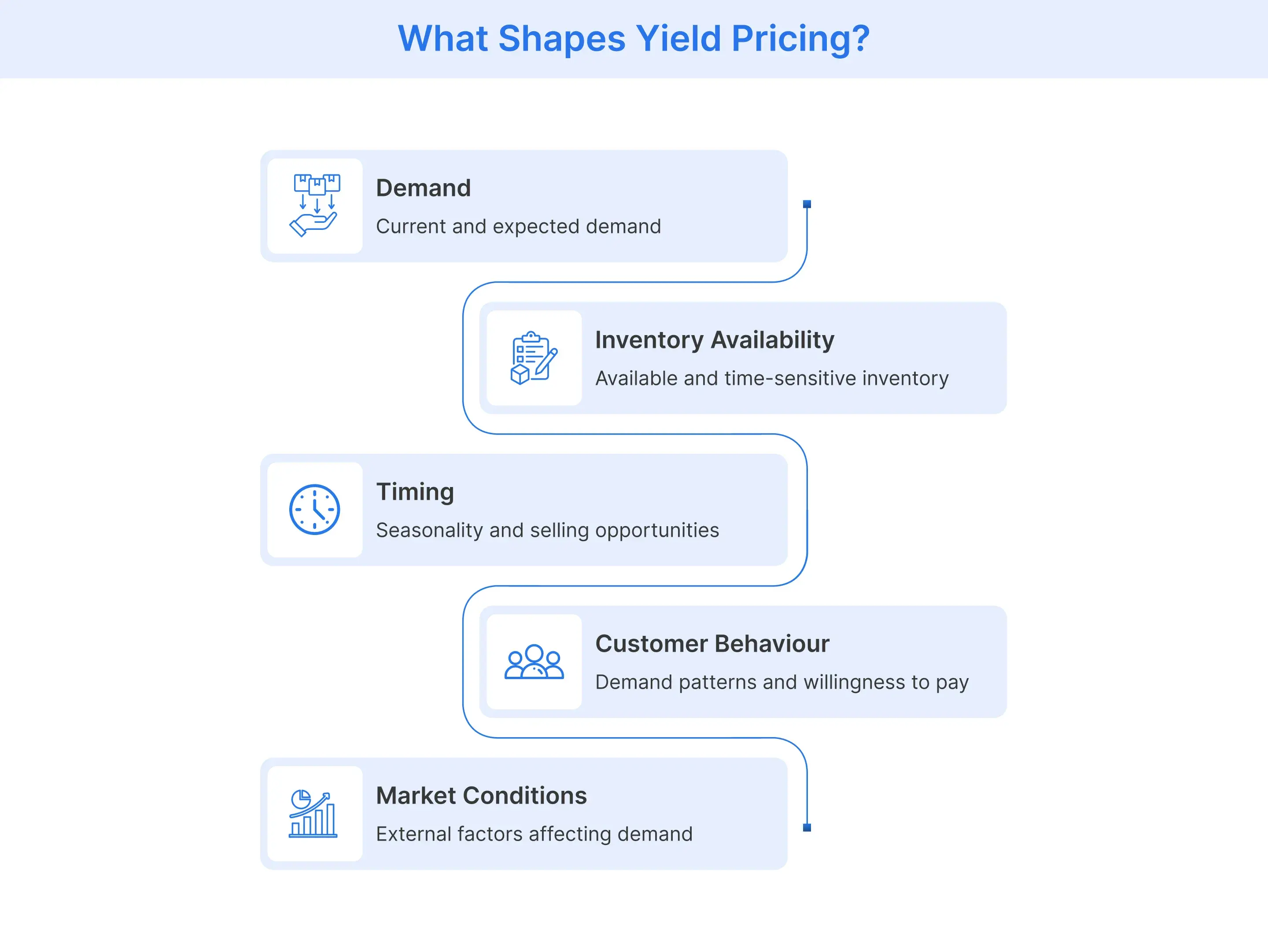
Yield pricing works by evaluating demand, inventory availability, timing, and market conditions, then adjusting prices to capture the best available revenue opportunity. Retailers can use this approach to respond to changes in customer behaviour and market demand rather than relying on fixed prices.
- Assess demand: Identify current and expected demand for the product. This helps retailers understand whether demand is rising, falling, or likely to change.
- Evaluate inventory and availability: Consider how much inventory is available and how quickly it needs to be sold. Products with limited selling windows may require different pricing decisions from products with longer availability.
- Consider timing and market conditions: Account for factors such as seasonality, events, peak periods, and changes in customer behaviour. These factors can influence how much customers are willing to pay.
- Adjust prices: Change prices according to demand and the available revenue opportunity. When demand is high, prices may increase, while weaker demand may create an opportunity for lower prices.
- Monitor and optimize: Continuously evaluate pricing performance and adjust the approach as demand, inventory, and market conditions change. This helps retailers refine their pricing decisions over time.
Why Is Yield Pricing Important for Retailers?
Yield pricing helps retailers make better pricing decisions as demand, inventory levels, and market conditions change. Instead of relying on fixed prices or unnecessary discounts, retailers can adjust pricing to capture revenue opportunities while managing inventory more effectively.
- Maximize revenue: Retailers can set prices that reflect market demand, including charging higher prices during periods of high demand.
- Improve inventory utilization: Yield pricing helps retailers manage available inventory more effectively, particularly for products with limited selling windows or changing availability.
- Reduce unnecessary discounting: When demand is strong, retailers can maintain the right price rather than using discounts that could reduce potential revenue.
- Respond to demand fluctuations: Retailers can adapt their pricing as shifting demand, seasonality, peak periods, and other market factors affect customer demand.
- Improve pricing decisions: Current demand, customer behaviour, inventory data, and other relevant signals can help retailers make more informed pricing decisions.
- Protect profitability: Aligning prices with demand and available revenue opportunities can help retailers improve their bottom line while making better use of their inventory.
When Should Retailers Use Yield Pricing?
Yield pricing is most useful when demand, inventory availability, or customers’ willingness to pay changes over time. Retailers can use it in situations where keeping the same price may mean missing opportunities to increase revenue or move inventory effectively.
- Products with fluctuating demand: When demand rises and falls frequently, retailers can adjust prices to reflect current demand and changing market conditions.
- Seasonal products: Products tied to specific seasons or shopping periods can benefit from price changes as demand increases, peaks, and eventually declines.
- Products with limited selling windows: Retailers can use yield pricing when inventory needs to sell within a particular timeframe, helping them make better pricing decisions as that window becomes shorter.
- Event-driven demand: Events, holidays, and other external factors can create sudden changes in demand, making it useful to adjust prices as market demand shifts.
- Inventory with changing availability: When stock levels change significantly, retailers can adjust prices based on the amount of inventory still available and expected demand.
- Peak and off-peak periods: During peak times, stronger demand may support higher prices, while periods of low demand may require a lower price to encourage purchases.
- Changing willingness to pay: When different customer segments show varying price sensitivity over time, retailers can adjust pricing to better reflect what customers are willing to pay.
What Are Examples of Yield Pricing?
Yield pricing can take different forms depending on how demand, timing, and inventory availability change. Here are some practical examples of how retailers can apply it:
- Seasonal demand: A fashion retailer may charge higher prices for popular winter jackets as demand increases during colder months. As the season ends and demand falls, the retailer may introduce a lower price to sell the remaining inventory.
- Event-driven demand: A sporting goods retailer may adjust the price of team merchandise when a major tournament or sporting event increases market demand. Prices can change again once the event ends and demand begins to decline.
- Falling demand: An electronics retailer with excess inventory of an older smartphone model may reduce its price as current demand shifts toward a newer model. This can help move remaining stock while there is still an opportunity to generate revenue from it.
- Changing inventory and selling time: A retailer selling limited edition products may make price changes based on how much inventory remains and how much time is left in the selling period. If demand is high and stock is running low, the retailer may increase the price. If inventory remains as the selling window closes, the price may be reduced to encourage purchases.
What Is the Difference Between Yield Pricing and Dynamic Pricing?
Yield pricing and dynamic pricing both involve changing prices in response to demand and other market factors, but they differ in their primary focus. Yield pricing is centered on maximizing revenue from available or time-sensitive inventory, while dynamic pricing is a broader pricing strategy that adjusts prices as market conditions change, sometimes in real time.
Yield Pricing vs. Dynamic Pricing |
||
|---|---|---|
|
Comparison |
Yield Pricing |
Dynamic Pricing |
|
Primary focus |
Maximizes revenue from available or time-sensitive inventory or capacity. |
Adjusts prices in response to changing market conditions. |
|
Key factors |
Focuses strongly on demand, timing, inventory availability, and capacity. |
Can use a wider range of pricing signals, including demand, competitor prices, customer behaviour, and other market factors. |
|
Typical application |
Often used when inventory is limited, perishable, or has a specific selling window. |
Can be used across a wide range of products, services, and industries. |
|
Main objective |
Supports revenue optimization by determining the right price for available inventory at a particular time. |
Enables businesses to make responsive price changes as market conditions and pricing signals change. |
How Can Retailers Implement Yield Pricing?
Implementing yield pricing requires reliable data, clear pricing objectives, and continuous monitoring. Rather than applying the strategy across every product at once, retailers can start with areas where changes in demand and inventory are likely to have the greatest impact.
- Collect reliable data: Gather accurate sales, inventory, and historical data to understand past performance and support better demand forecasting and pricing decisions.
- Identify suitable products and categories: Focus on products where demand fluctuates significantly or inventory has a limited selling window. This helps retailers prioritize areas where yield pricing can deliver the most value.
- Define pricing and revenue objectives: Establish what the pricing strategy should achieve, whether that means improving revenue, managing inventory more effectively, or protecting profitability.
- Monitor seasonality and customer behaviour: Track changes in demand, consumer behavior, seasonal patterns, and other market factors that could influence customers’ willingness to pay.
- Start small and test: Apply yield pricing to selected high-impact categories first. Retailers can evaluate the results, refine their approach, and gradually expand it to other suitable categories.
- Continuously evaluate and adjust: Monitor pricing performance alongside demand and inventory levels, then refine pricing decisions as conditions change. Continuous optimization can help retailers improve their yield management strategies and support long-term revenue growth.
Turn Yield Pricing Into Smarter Retail Decisions
Yield pricing gives retailers a more responsive way to make pricing decisions as demand, inventory availability, and market conditions change. By aligning prices with current revenue opportunities, retailers can manage inventory more effectively, improve overall revenue, and protect profitability.
With the right technology and data capabilities, retailers can turn these insights into faster, more informed commerce decisions. Flipkart Commerce Cloud (FCC) provides technology solutions that help retailers build more data-driven commerce capabilities and respond more effectively to changing customer and market needs.
Book a Demo to discover how FCC can help you build smarter, more responsive retail experiences.

FAQ
Yield management pricing, often referred to as yield management pricing, is a variable pricing strategy where businesses adjust rates in real time based on demand, timing, and consumer behavior. As a specific branch of revenue management, it helps merchants maximize profitability by offering different prices across fluctuating sales cycles.
The difference between yield management and revenue management comes down to operational focus and overall scope. While yield management acts as an inventory control mechanism to maximize immediate earnings from perishable stock, revenue management takes a broader strategic approach, analyzing overall distribution channels, customer segments, and long-term financial growth.
To calculate yield management, you divide the actual revenue achieved by the maximum potential revenue possible under ideal conditions. Multiplying this result by 100 yields a percentage that helps yield managers evaluate how effectively they are capturing market demand and generating additional revenue beyond baseline projections.
The key elements at the heart of yield management include accurate demand forecasting, real-time tracking, flexible pricing, and price elasticity analysis. Utilizing advanced platforms like Flipkart Commerce Cloud helps enterprise businesses implement a complete yield management system, enabling automated strategic decisions that adjust prices to optimize profitability.
The primary benefits of yield pricing for retailers include optimized inventory turnover, a sustainable competitive advantage, and the ability to boost revenue. Adjusting product prices dynamically across different segments of your customer base ensures merchants capture peak willingness to pay while clearing older stock effectively.
An example of yield pricing originated in the airline industry with pricing based on advance booking windows. Today, e-commerce retailers apply this model by offering discounts for an advanced purchase on seasonal items, systematically adjusting rates as inventory levels change to secure the best price for each transaction.