
July 27, 2026
What Is Uniform Delivered Pricing and How to Use It
Uniform delivered pricing is a geographic pricing strategy where a seller charges the exact same final price to all customers, regardless of their physical location.
Drishti, Manager - Digital Marketing

Table of Contents
- What Is Uniform Delivered Pricing (UDP)?
- What are Uniform Delivered Pricing Methods?
- Why Does Uniform Delivered Pricing Work for Sellers and Buyers?
- How Do You Calculate Uniform Delivered Pricing?
- What are Some Practical Examples That Show the Impact of Uniform Delivered Pricing?
- What are the Advantages of Uniform Delivered Pricing?
- What are the Challenges of Freight Cost Averaging in Uniform Delivered Pricing?
- What is the Difference Between Uniform Delivered Pricing vs FOB Origin vs. Zone Pricing?
- What are the Best Practices for Implementing a Uniform Delivery Strategy?
What Is Uniform Delivered Pricing and How to Use It?
Shipping cost is one of the biggest reasons online carts get abandoned, since the price a shopper expects rarely matches what they see at checkout. Uniform delivered pricing (UDP) solves the shipping cost problem by locking in one flat, all-inclusive price for every customer, no matter where they're ordering from.
In this article, you’ll get answers to what uniform delivered pricing is, and we’ll break down how the pricing model works, how to calculate it correctly, and where it holds up against alternatives like FOB origin and zone pricing.
- Uniform delivered pricing charges every customer the same final price, shipping included, regardless of location.
- It is calculated by blending an average freight cost into the base price, so nearby and distant buyers pay identically.
- Uniform delivered pricing works in two ways: The single-zone (one national price) and multi-zone (flat price within defined regions).
What is Uniform Delivered Pricing (UDP)?
Uniform delivered pricing is a geographical pricing method where a company charges every buyer the same final price for a product, including delivery, no matter the customer’s distance from the shipping warehouse. Whether the order is going three miles down the road or three states away, the price of the product stays the same.
This pricing approach is often nicknamed "postage stamp pricing” because a standard postage stamp costs the same whether you're mailing a letter across the street or across the country, and uniform delivery pricing works on that same logic.
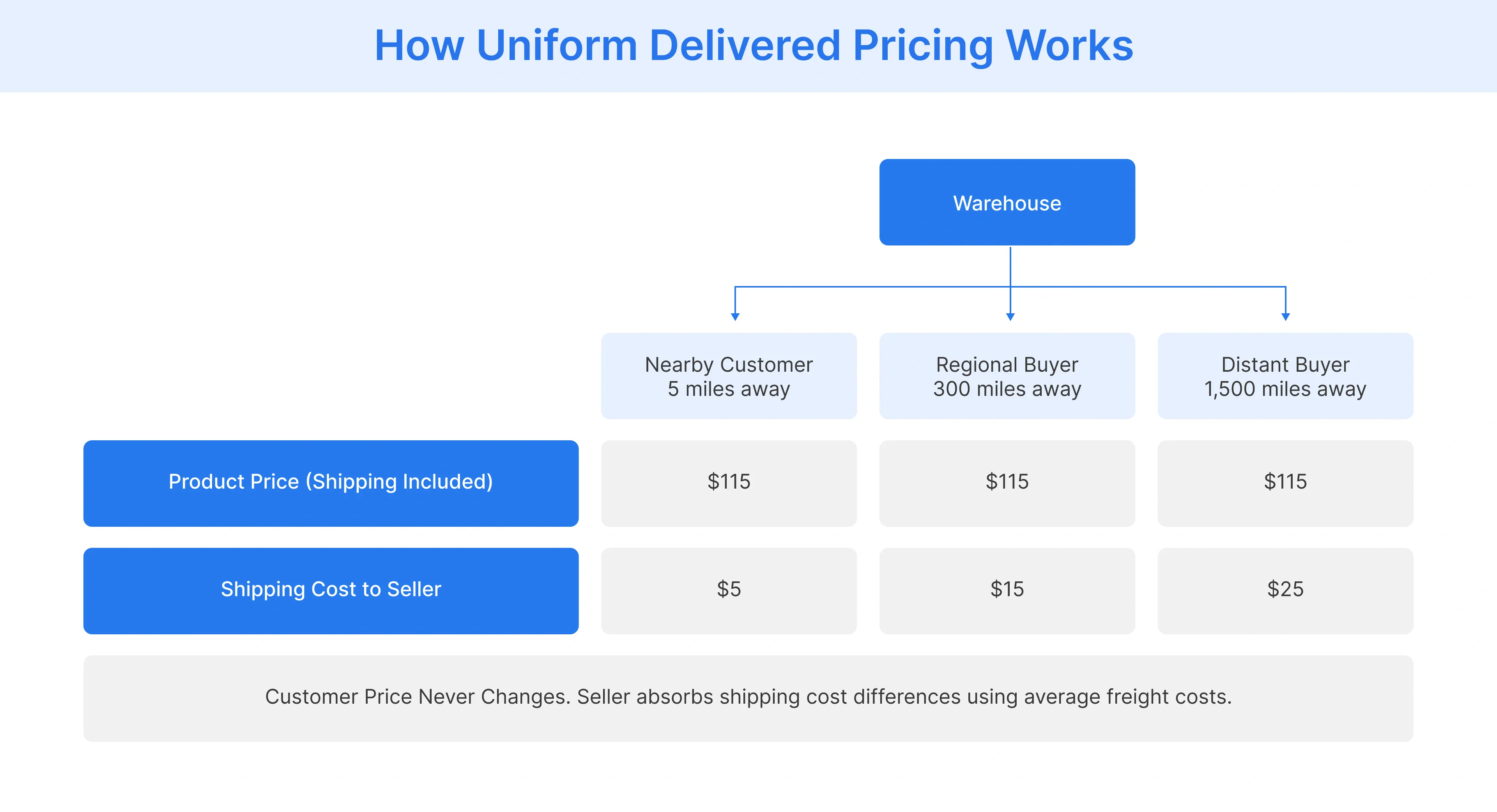
Under a uniform delivered pricing model, sellers skip calculating custom shipping fees for each purchase. Instead, the seller calculates their average freight cost across all regions, and blends the result of the average freight cost directly into the product’s base price, and absorbs any variance between expected and actual shipping costs on individual orders.
Also read: What is Order Fulfillment?
What are Uniform Delivered Pricing Methods?
Businesses that adopt a uniform delivered pricing strategy organize it around a single zonal pricing model or a multi-zone pricing model.
Single-Zone Pricing Model
Single-zone pricing is a uniform delivered pricing method where every customer across the entire country pays the same flat price. This means buyers who live close to the warehouse end up unknowingly paying the higher freight costs of buyers who live much farther away. It's simple to manage, but also has the most cross-subsidy effect.
Multi-Zone Pricing Model
In the multi-zone pricing method of uniform delivered pricing, a seller divides its shipping cost by territory or a few large geographic zones instead of one national price for delivery. E.g, East Coast versus West Coast. The delivery price stays uniform for every buyer within any single zone, but that flat rate shifts once a customer crosses into a different zone.
The Multi-zone uniform delivery pricing model gives businesses more control over shipping costs without losing the simplicity that makes uniform delivered pricing appealing in the first place.
Why Does Uniform Delivered Pricing Work for Sellers and Buyers?
Uniform delivered pricing strategy tends to succeed because it genuinely works in favor of both the sellers and buyers.
Appeal for Sellers
For sellers, uniform delivery pricing is a powerful marketing tool because it lets them advertise something like "free shipping countrywide" with total confidence.
It also makes revenue forecasting predictable over the long period a business operates, since freight costs are smoothed into the price rather than fluctuating order by order.
Uniform delivered pricing also appeals to sellers because it simplifies billing, as there's no need for real-time location calculation at cart checkout.
Appeal for Buyers
For buyers, uniform delivered pricing creates transparency; what shoppers see while browsing is the exact price they pay at store checkout, with no last-second surprises.
It removes the frustration of watching shipping costs spike right before payment, which is one of the most common reasons carts get abandoned in the first place.
Uniform delivered pricing lets customers shop with genuine confidence in what they're about to pay.
How Do You Calculate Uniform Delivered Pricing?
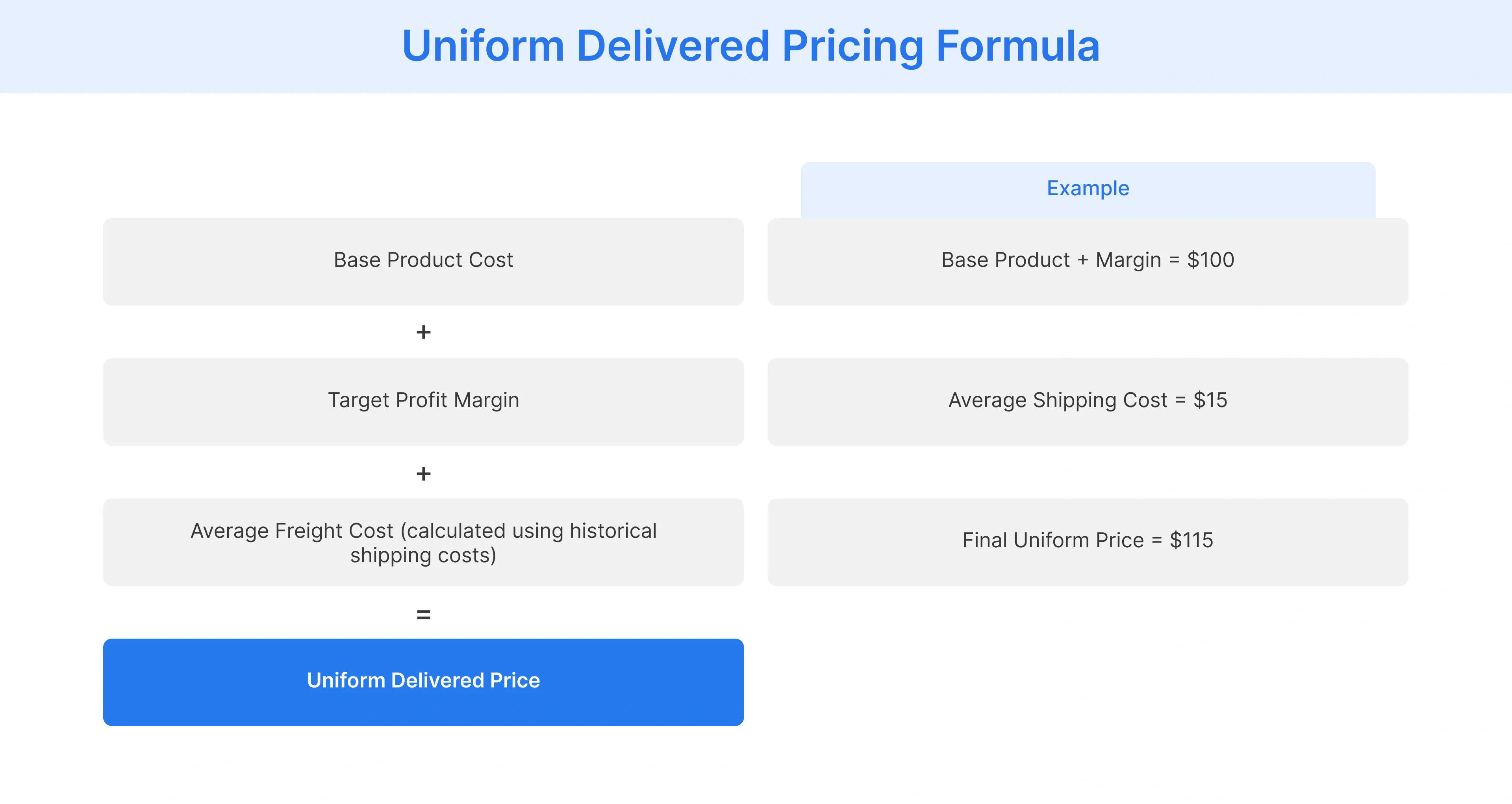
To calculate uniform delivered pricing, add the base product cost, target profit margin, and the average estimated freight cost.
The formula for uniform delivered pricing looks like this:
|
Uniform Delivered Price = Base Product Cost + Target Profit Margin + Average Estimated Freight Cost |
To find the average estimated freight cost, businesses add up total shipping expenses over a set period (usually a few months) and divide that total by the number of orders shipped in that same window. The single average is what gets baked into the final price of the product. This effectively smooths out the high cost of distant deliveries against the lower cost of nearby ones.
What are Some Practical Examples That Show the Impact of Uniform Delivered Pricing?
A quick real-world scenario makes this formula much easier to visualize.
The Setup
An online furniture brand selling an ergonomic chair with a base cost plus margin value of $100. Shipping to customer A, who lives nearby in the same city, costs the brand $5, while shipping to customer B, who lives a distance across the country costs $25. Both customers, though, will eventually pay the same price at checkout.
The Calculation
The brand looks at its full national shipping history and averages it out, landing on a blended freight cost of $15. Adding that to the $100 base cost plus margin brings the final uniform delivered pricing to $115, and that number applies to every customer, regardless of where the order is headed.
The Interpretation & Impact
The nearby customer A still pays $115, effectively covering about $10 in what's sometimes called "phantom freight," since their actual shipping cost was only $5.
The distant customer B also pays $115, but comes out $10 ahead, since their actual shipping cost was $25 and the brand absorbed the difference.
The financial impact balances out perfectly for the business, as long as order volumes remain steady across all regions and one area doesn't suddenly dominate order volume.
What Are the Advantages of Uniform Delivered Pricing?
- UDP Eliminates Checkout Friction: Shoppers consistently abandon carts when they're hit with a surprise shipping fee at checkout. Providing a single, predictable price up front reduces abandoned carts dramatically.
- UDP Simplifies Marketing and Advertising: Brands can run national ad campaigns featuring a single, clear price tag, something like "$99 shipped anywhere," without needing complex, location-based ad copy for every region.
- UDP Streamlines Accounting Operations: UDP eliminates the need to calculate real-time freight quotes for every unique zip code. This reduces administrative and invoicing complexity while supporting a frictionless unified commerce operational setup.
What Are the Challenges of Freight Cost Averaging in Uniform Delivered Pricing?
- The "Phantom Freight" Penalty: Nearby customers might eventually realize they are overpaying for shipping compared to local competitors. That awareness can push them to abandon your brand for one offering location-based pricing instead.
- Margin Erosion From Distant Buyers: If an unexpected wave of orders comes from your farthest, most expensive delivery regions, your average freight calculations fail to hold up, and shipping costs start eating directly into your profits.
- Inflexible Rigidity: Holding a single static price prevents you from adapting quickly to sudden, localized carrier surcharges or fuel price spikes. This is because any adjustment usually means recalculating and republishing the price everywhere at once.
What is the Difference Between Uniform Delivered Pricing vs. FOB Origin vs. Zone Pricing?
Uniform Delivered Pricing (UDP), Free On Board Origin, and Zone Pricing are geographic pricing strategies that determine who pays for shipping and whether the final price changes based on customer location.
Uniform Delivered Pricing charges every buyer the same flat price regardless of distance, Free On Board Origin makes the buyer pay the exact shipping cost for their specific location, and Zone Pricing falls in between, applying a flat rate within defined regional tiers that changes once a customer crosses into a new zone.
|
Pricing Framework |
Who Pays the Freight? |
Does the Price Change by Distance? |
Primary Business Advantage |
|
FOB Origin Pricing |
The buyer pays all actual shipping charges |
Yes, fluctuates completely based on exact zip code |
Maximum profit protection for the seller |
|
Zone Pricing |
The seller blends regional costs into specific area tiers |
Yes, changes when crossing wide regional boundaries |
Balances pricing fairness with freight cost recovery |
|
Uniform Delivered Pricing |
The seller includes an averaged freight cost in the price |
No, identical for all buyers in a territory |
Maximizes pricing simplicity and user trust |
What Are the Best Practices for Implementing Uniform Delivered Pricing Strategy?
The best practices for implementing a uniform delivered pricing strategy involves regularly auditing regional freight costs to adjust for rate changes, setting minimum order thresholds to protect profit margins, and strategically distributing inventory closer to high-demand buying zones.
- Audit regional shipping data: regularly update and recalculate your average freight costs every three to six months, so your blended pricing keeps pace with fluctuating carrier rates rather than lagging behind them.
- Set strategic minimum order thresholds: apply uniform delivered pricing only once an order hits a certain cart value to protect margins on smaller orders where the average freight cost eats into profit the hardest.
- Geographically distribute your inventory: use demand data and modern inventory management systems to place high-turnover items closer to your busiest buying zones to keep shipping costs running below the average you've calculated.
Optimizing Distributed Fulfillment With Flipkart Commerce Cloud
Running a uniform delivered pricing strategy successfully depends on keeping your price tags aligned with the reality of your warehouse network. If a brand lists a flat delivered price on paper but keeps fulfilling orders from disorganized, distant hubs, actual shipping costs will climb well past the budget, and profit margins quietly take the hit.
Flipkart Commerce Cloud, with real-time inventory visibility and an intelligent order management system, helps route orders to the fulfillment center that is closest to the customer and keeps actual freight costs as close as possible to your calculated average. Paired with accurate demand forecasting, FCC helps brands anticipate regional order spikes before they throw off the freight averages the entire pricing model depends on.
Book a demo with Flipkart Commerce Cloud and see how accurate fulfillment routing keeps your uniform delivered pricing profitable at scale.

FAQ
Uniform delivered pricing in marketing is a geographic pricing strategy where a brand charges every customer the same final price, including shipping, regardless of location. It's commonly used in national ad campaigns because it lets marketers advertise one flat price everywhere, without needing location-specific messaging or shipping disclaimers.
The uniform pricing method involves calculating an average shipping cost across all regions and folding that average directly into the base price of the product. Every customer then pays the same total price, whether they're located near the warehouse or far from it, simplifying both billing and customer expectations.
The uniform delivered price policy is a company's formal rule to charge one flat, all-inclusive price to every customer in a defined territory, regardless of shipping distance. It's often paired with a minimum order threshold, and businesses like Flipkart Commerce Cloud help keep such policies profitable through smarter fulfillment routing.
To calculate uniform pricing, add your base product cost, your target profit margin, and your average estimated freight cost. Find that freight average by dividing your total shipping expenses over a set period by the total number of orders shipped, then apply that same final number to every customer.
The 4 types of pricing are cost-plus pricing, competitive pricing, value-based pricing, and dynamic pricing. These foundational models allow businesses to set prices based on manufacturing costs, competitor benchmarks, perceived value, or shifting market demand. Flipkart Commerce Cloud helps retailers automate these strategies to maximize profit margins.
Industries that use uniform delivered pricing most commonly include e-commerce retail, consumer packaged goods, and subscription box services. This flat-rate geographic strategy works best for lightweight, standardized items where shipping costs remain low relative to product value, allowing brands to advertise predictable pricing nationwide.
Evaluating what is uniform delivered pricing effectively requires tracking metrics like shopping cart abandonment rates, gross profit margins per region, and average shipping cost variance. Monitoring these data points ensures your blended freight averages remain accurate over time, protecting your baseline profits from unexpected distant order spikes.