
May 24, 2026
What Is Basing Point Pricing?
Basing point pricing calculates shipping costs from a fixed location to standardize delivered prices across different regions.
Drishti, Manager - Digital Marketing

Table of Contents
- What Is Basing Point Pricing
- How Does Basing Point Pricing Work
- Types of Basing Point Pricing Systems
- Advantages and Disadvantages of Basing Point Pricing
- Industries That Use Basing Point Pricing
- Basing Point Pricing vs FOB Pricing
- Common Challenges of Basing Point Pricing
- Conclusion
What Is Basing Point Pricing?
Basing point pricing is a pricing system used in logistics and manufacturing where transportation costs are calculated from a designated geographic location called a basing point.
The final price of a product includes the base price plus freight charges from this designated location, even if the goods are shipped from a different origin.
This system is commonly used to standardize shipping costs across regions.
How Does Basing Point Pricing Work?
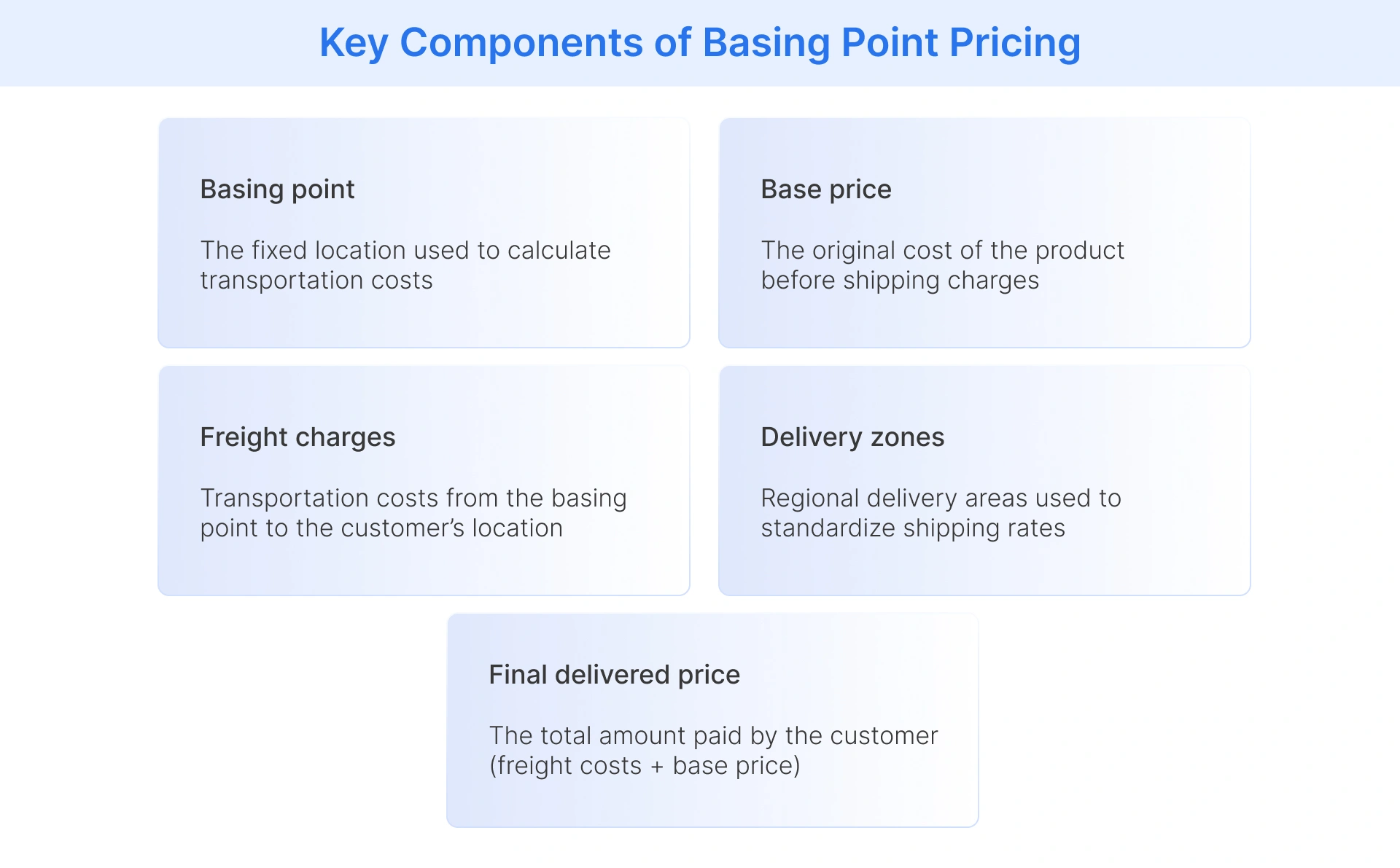
Basing point pricing works by combining three main elements. A base price is set for the product before transportation costs are added. A basing point is then selected as the fixed geographic reference used to calculate shipping costs. Finally, freight charges are added based on the distance from the basing point to the customer’s location.
|
Final Delivered Price = Base Price + Freight from Basing Point |
In some cases, this system creates phantom freight, where customers are charged shipping costs that do not reflect the actual shipping distance. In other cases, freight absorption occurs when the seller covers additional transportation costs if actual shipping distances exceed the basing point calculation.
Types of Basing Point Pricing Systems
- Single basing-point system: One fixed location is used as the universal reference point for pricing. All transportation costs are calculated from this single point, regardless of where the goods are actually produced or shipped from.
- Multiple basing-point system: Businesses can choose between several designated basing points. They usually select the one that results in the most favorable or competitive delivered price for the customer.
- Freight absorption pricing: The seller adjusts pricing by absorbing part of the shipping cost when actual transportation exceeds the basing point calculation, often to stay competitive in distant markets.
- Geographic zone pricing: Markets are divided into regions or zones, and each zone has a fixed delivery price regardless of the exact distance within that zone. This simplifies pricing for large distribution networks.
Advantages and Disadvantages of Basing Point Pricing
Advantages
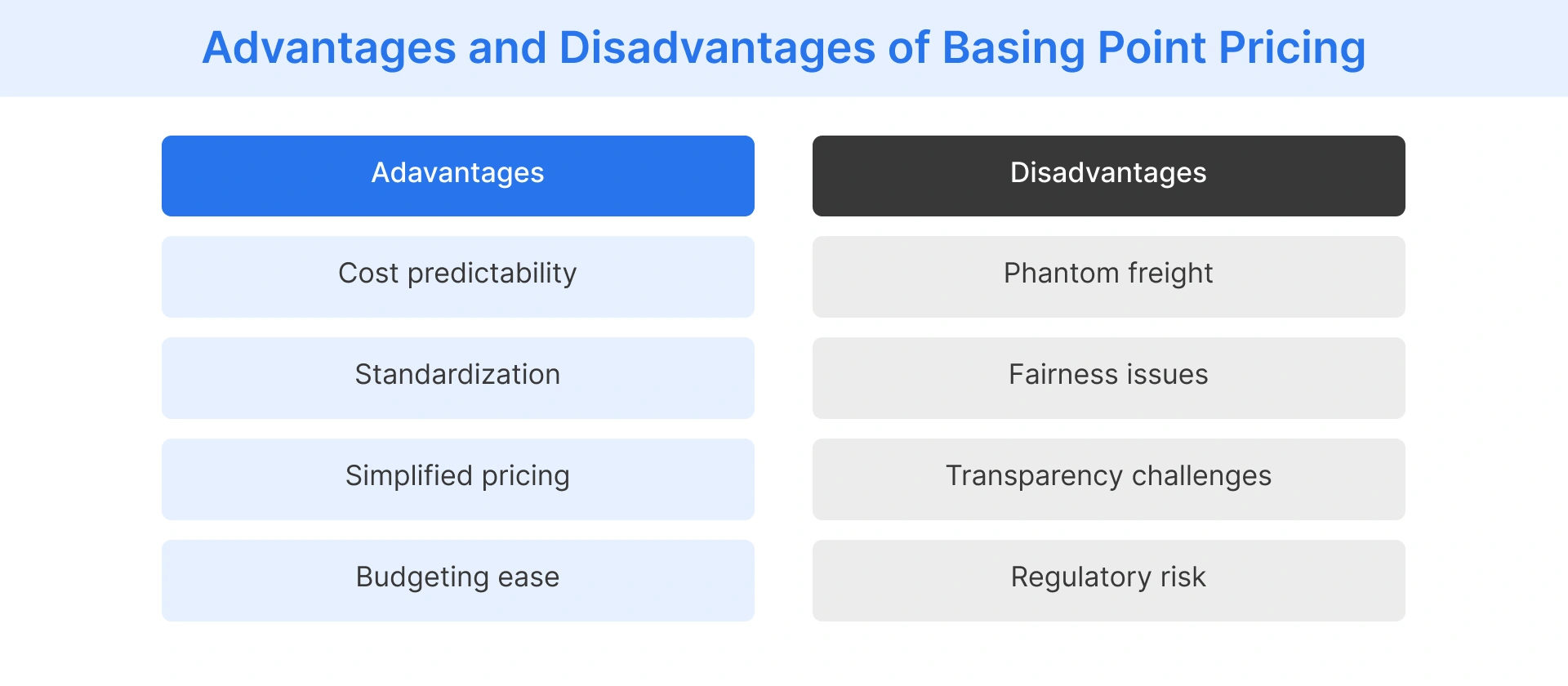
- Simplifies pricing structure: It standardizes how transportation costs are added to product prices, making calculations easier for businesses.
- Makes freight costs more predictable: Companies can estimate shipping expenses in advance, improving cost planning and forecasting.
- Easier budgeting for businesses: Fixed basing points help organizations plan overall logistics and pricing budgets more accurately.
- Standardized regional pricing: Ensures consistent pricing across different locations within the same market or zone.
Disadvantages
- Can create phantom freight charges: Customers may be charged for shipping distances that do not reflect actual transportation routes.
- May lead to unfair cost distribution: Buyers closer to production may pay the same as those farther away, creating pricing imbalance.
- Limited pricing transparency: The basing point system can make it harder for customers to understand the true shipping cost.
- Potential regulatory and antitrust concerns: The system has been criticized for reducing price competition in some industries.
Industries That Use Basing Point Pricing
- Steel industry: Used to standardize freight costs for heavy steel shipments across regions
- Cement industry: Helps set uniform delivery prices for bulk construction materials
- Automotive manufacturing: Applied to vehicle and parts distribution to balance regional shipping costs
- Heavy equipment production: Used because transport costs are high and vary significantly by distance
- Appliance retail: Standardizes delivery pricing for large household goods like refrigerators
- Logistics and warehousing: Used to standardize freight costs across distribution networks by using fixed basing points for pricing shipments.
These industries often deal with heavy or bulky goods where transportation costs significantly impact final pricing.
Basing Point Pricing vs FOB Pricing
Basing point pricing calculates freight from a fixed geographic location, regardless of where goods are actually shipped from.
FOB (Free on Board) pricing, on the other hand, charges shipping based on the actual origin point of the goods and shifts responsibility to the buyer once goods leave the seller’s location.
Basing point pricing is more standardized, while FOB pricing is more transparent and location-based.
Common Challenges of Basing Point Pricing
- Lack of pricing transparency: Basing point pricing can make it difficult for customers to see the true cost of transportation since prices are calculated from a fixed reference point rather than actual shipping origin.:
- Unequal freight cost distribution: Customers closer to production may end up paying the same freight charges as those farther away, leading to unfair cost allocation.
- Regulatory scrutiny in some industries: The system has faced criticism in certain sectors for reducing price competition and raising antitrust concerns.
- Complex freight calculation structures: Determining final prices can be complicated because it involves basing points, freight rates, and sometimes adjustments like absorption costs.
- Potential customer dissatisfaction due to indirect shipping costs: Customers may feel frustrated when shipping charges do not clearly reflect the actual distance or delivery effort.
Conclusion
Basing point pricing is a structured pricing system that uses a fixed geographic reference to calculate transportation costs. While it helps standardize pricing and simplify logistics, it can also introduce fairness and transparency challenges depending on its application.
Understanding pricing models, such as basing-point pricing, with a brand like Flipkart Commerce Cloud helps businesses make more informed decisions about logistics, freight management, and regional pricing strategies.

FAQ
Basing point pricing is generally legal, but it faces significant scrutiny from antitrust authorities like the FTC in 2026. While not inherently illegal, it becomes a violation if industry competitors collude to set a common base point to eliminate price competition. Legality often depends on whether the system fosters artificial price-fixing or discriminatory practices.
Phantom freight in logistics occurs when a buyer is charged for shipping costs from a designated basing point that is geographically further away than the actual production site. In this scenario, the seller profits from the "extra" freight charges. This artificial cost often arises in industries using standardized basing point pricing to maintain uniform regional quotes.
To avoid basing point pricing in purchasing, you should negotiate for Ex-Works (EXW) or Free on Board (FOB) terms instead of delivered pricing (DDP/DAP). By arranging your own transportation directly from the actual manufacturing origin, you eliminate artificial freight markups. This ensures you only pay for the real distance your goods travel to your facility.
The difference between single and multiple basing point systems lies in the number of geographic reference points used. A single system designates one universal location (often an industry hub) to calculate all freight, whereas a multiple system allows sellers to choose from several locations. Multiple points typically reduce phantom freight and offer more competitive delivered prices for buyers.
Companies still use basing point pricing today because it simplifies complex quoting for bulky commodities like steel or cement. By establishing a central reference, firms provide predictable, stable pricing across vast geographic regions. This method reduces chaotic regional price wars and allows producers to compete in distant markets through freight absorption without undercutting local competitors.