
November 26, 2026
Pricing Power in Retail: How to Assess and Strengthen It
Pricing power is a business’s ability to raise prices without causing a substantial decline in customer demand. In retail, it depends on factors such as product differentiation, brand loyalty, competition, and how sensitive shoppers are to price changes.
Drishti, Manager - Digital Marketing

Table of Contents
- What Is Pricing Power?
- What Factors Influence Pricing Power in Retail?
- How Does Price Elasticity Affect Pricing Power?
- What Are Some Examples of Pricing Power in Retail?
- Why Is Pricing Power Important for Retailers?
- How Can Retailers Measure Pricing Power?
- How Can Retailers Improve Their Pricing Power?
- Conclusion
Pricing Power in Retail: How to Assess and Strengthen It
When operating costs rise, retailers must decide whether to increase product prices or absorb the additional expenses through lower profit margins. However, customers do not respond equally to price changes. Some products can sustain higher prices with little impact on sales, while others may experience a noticeable decline in demand.
These differences make pricing power an important consideration in retail pricing decisions. This article examines the factors that influence pricing power, its relationship with price elasticity, and how retailers can assess and strengthen their position in competitive markets.
What Is Pricing Power?
Pricing power is a company’s ability to increase prices without experiencing a significant decline in customer demand. A business with strong pricing power can charge higher prices while retaining most of its customers. In contrast, weak pricing power means even a modest price increase may cause shoppers to reduce purchases or switch to competitors.
For example, a retailer selling an exclusive coffee blend may retain loyal customers after a price increase. However, a store charging more for a widely available bottled water brand may lose customers to competitors offering the same product at a lower price.
What Factors Influence Pricing Power in Retail?
Several factors determine how much flexibility retailers have to increase prices without losing customers. These factors influence how shoppers evaluate a product, compare alternatives, and respond to price changes.
The key factors include:
- Product differentiation: A unique product with distinctive design, features, or quality may be harder to replace with a comparable offering. This can give retailers greater pricing power than businesses selling largely interchangeable products.
- Brand reputation: A strong brand associated with consistent quality and reliability can increase customers' confidence in a product. This brand strength may make shoppers more willing to accept a premium price.
- Customer loyalty: Loyal customers may be less likely to switch retailers after a moderate price increase, particularly when they value an established relationship, consistent service, or loyalty benefits.
- Market competition: Retailers operating in highly competitive markets often have less flexibility to raise prices because shoppers can compare offers from competing sellers. Limited competition may provide greater pricing flexibility.
- Availability of substitutes: When customers can easily find comparable products at lower prices, a retailer’s pricing power is typically weaker. Products with few close substitutes face less direct pressure from alternative offerings.
- Perceived value: Customers weigh product quality, benefits, convenience, and the overall shopping experience against the price. When shoppers recognize greater customer value, they may accept higher prices even if cheaper alternatives exist.
These factors often interact. A retailer may benefit from strong customer loyalty but still face pricing pressure when competitors offer attractive alternatives.
How Does Price Elasticity Affect Pricing Power?
Price elasticity of demand measures how much the quantity demanded of a product changes in response to a price change. It helps retailers understand customer price sensitivity and assess their pricing power.
Products with inelastic demand are relatively less sensitive to price changes. Retailers may be able to increase their prices without experiencing a substantial reduction in sales volume. In contrast, products with elastic demand are more price-sensitive, making price increases more likely to cause a significant decline in demand.
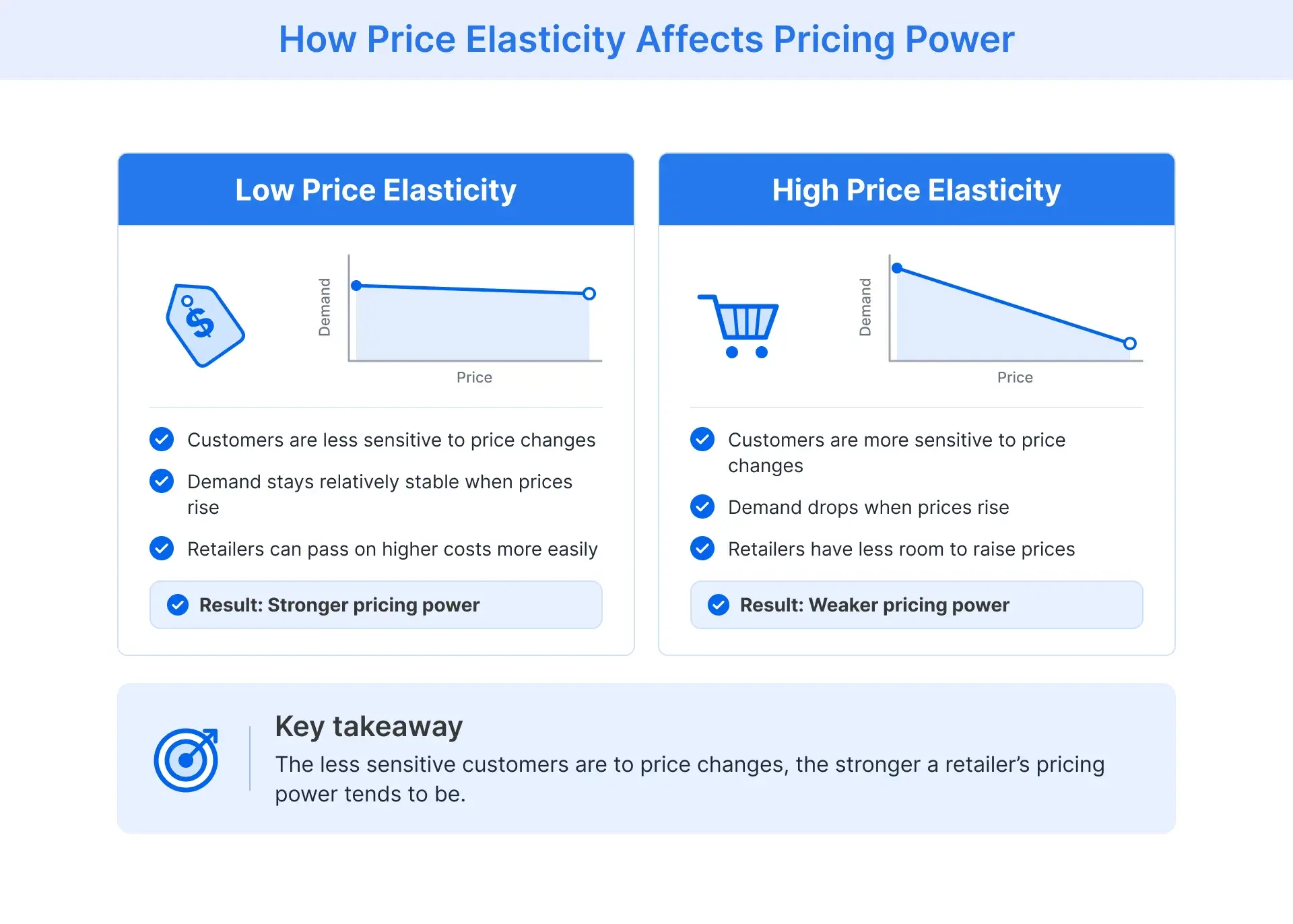
For example, if a retailer increases a product’s price by 10% and unit sales decline by 3%, its demand is relatively inelastic, with an approximate price elasticity of -0.3. If another product experiences a 15% decline in unit sales following the same price increase, its demand is relatively elastic, with an approximate elasticity of -1.5.
Although lower price elasticity can indicate stronger pricing power, it is not the only consideration. Retailers must also assess production or purchasing costs, competitive conditions, and profit margins to determine whether higher prices are commercially sustainable.
What Are Some Examples of Pricing Power in Retail?
Pricing power varies across retail products and markets. The following examples illustrate how product differentiation, customer loyalty, and the availability of alternatives can affect a retailer’s ability to maintain higher prices.
- Strong pricing power: An exclusive skincare range. A beauty retailer sells a proprietary skincare line known for its distinctive formulations and consistent product quality. Customers who trust the brand and value its unique features may continue purchasing after a moderate price increase. This gives the retailer greater pricing flexibility because shoppers perceive value beyond the product’s price.
- Weak pricing power: Widely available household products. A supermarket increases the price of a nationally distributed laundry detergent that competing stores sell at lower prices. Since customers can purchase the identical product elsewhere, the supermarket risks losing sales unless it offers another compelling reason to shop there, such as convenience or better service.
These examples show that pricing power depends not simply on the prices retailers charge, but on whether customers perceive sufficient value to accept those prices instead of choosing competing offers.
Why Is Pricing Power Important for Retailers?
Pricing power influences how effectively retailers can manage profitability, respond to cost pressures, and compete in changing market conditions. It gives businesses greater flexibility when making pricing decisions without relying solely on discounts to attract customers.
Its importance can be seen in several areas:
- Protecting profit margins: Retailers with strong pricing power may be better positioned to maintain margins when supplier prices, labor expenses, or distribution costs increase. They can pass some of these costs on to customers rather than absorbing them entirely.
- Maintaining pricing flexibility: Greater pricing power allows retailers to adjust prices according to business needs without automatically matching every competitor’s discount. This can reduce dependence on aggressive price competition.
- Strengthening competitive positioning: Retailers that can sustain their prices may protect their competitive position by emphasizing product quality, service, and the overall customer experience rather than price alone.
- Supporting business resilience: During periods of inflation or economic uncertainty, pricing power can provide greater room to respond to rising costs while maintaining operations and investing in long-term business priorities.
However, higher prices do not automatically translate into higher profits. If a price increase causes sales volume to fall significantly, total revenue and profitability may decline. Retailers must therefore consider customer demand, costs, and sales performance when evaluating pricing decisions.
How Can Retailers Measure Pricing Power?
Retailers can measure pricing power by analyzing how changes in product prices affect customer demand, sales performance, and profitability. Comparing results before and after price adjustments helps determine whether a business can sustain higher prices without losing substantial sales.
Key indicators include:
- Sales volume and demand changes: Track units sold before and after a price increase. A small decline in sales volume may indicate stronger pricing power, particularly when overall market demand remains stable. Changes in market share can provide additional context about sales performance relative to competitors.
- Price elasticity of demand: Calculate how responsive demand is to price changes. Retailers can use historical sales data or controlled pricing tests to estimate elasticity and identify products with greater pricing flexibility.
- Customer retention: Monitor repeat purchases, customer churn, and purchasing frequency following price adjustments. Stable retention may indicate that customers continue to value the retailer’s offerings despite higher prices.
- Profit margins: Examine gross margins and contribution margins to determine whether price increases improve profitability after accounting for product costs and changes in sales volume.
- Competitor pricing: Compare a retailer's current prices with those of competitors and assess customer responses at different price points. Retailers that consistently maintain a price premium without significant customer losses may have stronger pricing power.
These indicators should be evaluated together, accounting for seasonal demand, promotional activity, shifts in customer behavior, and changing economic conditions. No single metric can fully measure pricing power, and a temporary increase in margins does not necessarily indicate that higher prices are sustainable.
How Can Retailers Improve Their Pricing Power?
Retailers can strengthen their pricing power by giving customers compelling reasons to choose their products beyond price. This requires improvements in product value, customer relationships, and pricing practices that make competing offers less attractive.
Practical strategies include:
- Improve product quality and consistency. Maintain reliable product standards, address recurring quality issues, and ensure that merchandise meets customer expectations. Consistent quality can help justify premium prices and reinforce customer confidence.
- Differentiate product offerings. Introduce exclusive products, private-label ranges, or distinctive product features that are difficult for competitors to replicate. Differentiation reduces direct price comparisons and gives shoppers additional reasons to choose a retailer.
- Strengthen brand trust and customer experience. Provide accurate product information, dependable fulfillment, responsive customer support, and clear return policies. These practices can increase perceived value and reduce customers’ willingness to switch retailers solely because of price.
- Use customer and competitor insights. Analyze customer feedback, purchasing behavior, competitor pricing, and market trends to identify where shoppers recognize additional value. These insights can inform pricing decisions and reveal opportunities to maintain a price premium.
- Reduce unnecessary discounting. Evaluate whether frequent promotions are weakening price perception or encouraging customers to delay purchases. Use targeted discounts when they serve a clear commercial purpose rather than relying on price reductions to generate demand.
Retailers should assess whether these improvements allow them to maintain customer demand, sales volume, and healthy profit margins at higher prices. Sustainable pricing power depends on customers continuing to recognize the value behind those prices.
Conclusion
Pricing power plays an important role in how retailers manage profitability and respond to changing market conditions. Building sustainable pricing power requires understanding customer expectations, competitive pressures, and the value shoppers associate with a product.
Key takeaways include:
- Understand customer price sensitivity. Assess how demand responds to price changes before making significant pricing decisions.
- Build value beyond price. Product differentiation, consistent quality, and customer trust can help retailers maintain a competitive advantage.
- Monitor pricing performance. Evaluate sales volume, profit margins, and competitor activity to determine whether price adjustments remain commercially sustainable.
Managing prices across a large product catalog makes these decisions more complex. Flipkart Commerce Cloud offers a Pricing Solution that helps retailers assess demand elasticity and competitor prices before making adjustments.
Book a demo to see how these insights can inform your pricing strategy.

FAQ
Inflation increases input costs, including raw materials used by suppliers, transportation, and labor. Retailers with strong pricing power may pass some of these increases to customers without a proportionate decline in demand. Those with less pricing flexibility may absorb more costs, risking margin erosion.
There is no definitive ranking, but Hermès and Apple are often cited as examples of strong pricing power. Hermès benefits from brand equity, product exclusivity, and customers willing to pay premium prices. Apple’s product ecosystem and customer loyalty can create high switching costs. Both remain subject to changes in demand and competition.
Businesses with pricing power generally offer a distinctive value proposition or products with few close substitutes. Examples include luxury retailers, businesses selling exclusive products, and specialized software providers. Retailers selling similar products available from many competitors often have less flexibility to raise prices. Pricing power varies by product and market.